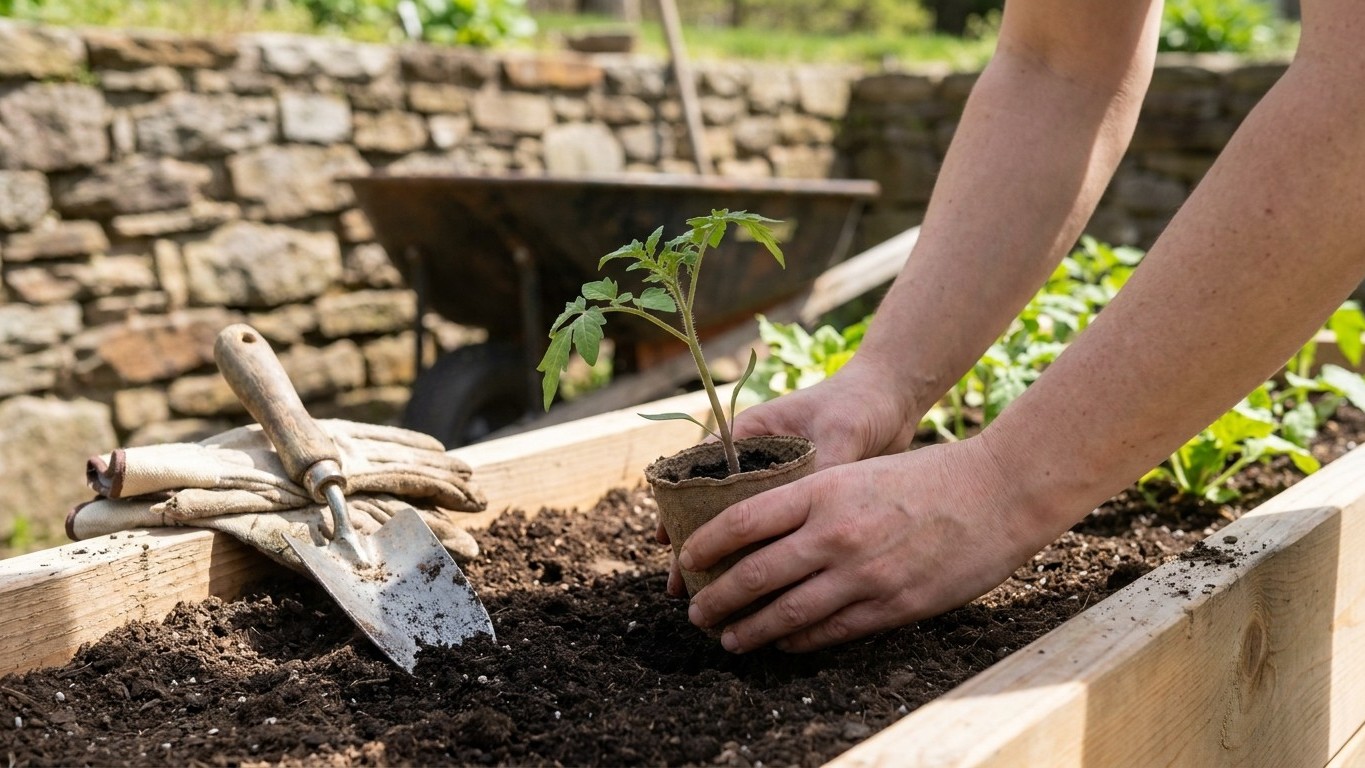

Near Philadelphia, NOAA’s 1991-2020 climate normals put the last spring freeze between March 29 and April 6, and that window is the anchor for setting out tomato transplants. First frost in fall arrives between November 5 and November 16 by the same normals, which marks the other end of the season. The action that follows: count backward six to eight weeks from your local frost window to find your seed-starting range, rather than trusting a fixed calendar date off a seed packet.
What this comes down to in Pennsylvania

Philadelphia’s last spring frost falls somewhere between April 6 and April 17, and that six-county southeast corner is about as forgiving as Pennsylvania gets. Push north into Erie or up into the Laurel Highlands and that window slides toward late May, sometimes further. Every tomato date you’ve seen floating around — Mother’s Day, mid-May, “after danger of frost” — only means something once you know which end of the state it was written for, and where your own dirt sits relative to it.
The frost window sets both ends of the season
First fall frost near Philadelphia lands between November 5 and November 16, per the same NOAA NCEI normals, and that closes the growing season from the other side. Everything a tomato plant needs to do between transplant and last harvest has to fit inside the space between those two windows. If you haven’t worked through site selection, soil prep and support systems yet, growing tomatoes in Pennsylvania covers that groundwork.
Where hardiness zones fit in
The USDA hardiness zone number describes average winter minimum temperatures, which matters for perennials that have to survive the cold, not for an annual like a tomato that dies at first frost either way. What the zone map is useful for here is a rough proxy for elevation and latitude: the state’s warmer 7b pocket sits around Philadelphia, and the coldest 5a pocket sits in the higher, more northern terrain, which is exactly where the frost window opens later and closes earlier. Treat the zone number as a clue about which direction to adjust, not as a source of a date by itself.
Working it out for your own garden
The method that survives a move to a different county, or just a cold spring, is counting backward and forward from your local frost window rather than memorizing a date. Start with the transplant date: tomatoes go outside only after the last spring frost window has passed, so near Philadelphia that means waiting until on or after the March 29 to April 6 range closes, with the safer bet being the later end of it in a cool year.
Counting back to a seed-starting date
Seed packets and catalogs typically call for starting tomato seed indoors six to eight weeks before transplanting outside. Applied to a range rather than a single day, that arithmetic gives another range, not a point: subtract six weeks from the start of the window (March 29) and you land in mid-February. Subtract eight weeks from the end of the window (April 6) and you land in early February. Put those together and the seed-starting range near Philadelphia runs roughly through the first half of February, sliding later for regions where the frost window itself runs later.
- Find your local last-spring-frost window from a source you trust for your specific area, not just the Philadelphia figure.
- Subtract six to eight weeks from that range to get your seed-starting window.
- Add a chosen cultivar’s days-to-maturity to your transplant range to see roughly when first ripe fruit should appear.
- Check that resulting date lands comfortably before your local first-fall-frost window, with a couple weeks of cushion.
Checking a cultivar against the window
Take a short-season cultivar like Early Girl, which catalogs list at around 50 days to maturity from transplant. Add that to the Philadelphia transplant range of March 29 to April 6, and the earliest ripe fruit should arrive somewhere in mid-to-late May, with roughly six months of slack before the November 5-16 fall frost window closes. Now take a long-season beefsteak type running closer to 90 days to maturity: added to the same transplant range, first ripe fruit lands closer to late June through early July, which still clears the fall frost easily near Philadelphia but eats deeply into the safety margin anywhere the season starts two to four weeks later. That’s the line worth watching, and a fuller rundown of which cultivars fit which part of the state’s season lives on Tomato Varieties That Ripen in Time in Pennsylvania.
What changes across the state
Pennsylvania is not one climate, and the Philadelphia-based frost window is a starting point, not a statewide instruction. Elevation is the biggest single factor inside the state: the ridges and valleys of the Allegheny Plateau and the Laurel Highlands sit hundreds to over a thousand feet higher than the Delaware Valley, and cold air pools in those higher valleys well after it has cleared the lowlands around Philadelphia.
North versus south, and the lake effect
The state’s northern tier, hugging the New York border, runs a noticeably later spring and an earlier fall than the southeast corner, simply from latitude and elevation stacking together. Erie County, along Lake Erie’s shoreline, is its own case: big open water moderates temperature swings, delaying both the first fall frost and, to a lesser extent, the last spring one, compared to inland spots at a similar latitude. None of this changes the fact that Philadelphia’s own window is the only precise figure available here; the honest way to use it is as one calibrated point, then adjust by direction and degree rather than by another borrowed number.
Treat every date as a range that shifts later the farther you are from the Delaware Valley, and confirm it against a source specific to your own county before you commit trays of seedlings to the ground.
The mistakes this state punishes

The most common error is transplanting into cold soil after a run of warm days fools a gardener into thinking spring has arrived early. Pennsylvania’s spring weather swings hard, and a week of 70-degree afternoons can be followed by a hard cold snap that sits right inside the March 29 to April 6 frost window near Philadelphia, or later almost anywhere else in the state. Soil temperature, not air temperature on a nice afternoon, is what a tomato root actually responds to, and cold, wet soil stunts a transplant even if it never actually frosts.
The second mistake is choosing a variety whose days-to-maturity number doesn’t leave enough room once you’ve done the arithmetic above, especially in the parts of the state where the season starts later and ends sooner than the Philadelphia figures suggest. A 90-day beefsteak that comfortably ripens by midsummer near Philadelphia can still be green on the vine when frost arrives in a colder county, if the transplant date itself was already pushed back by a late, cold spring.
The third is skipping the hardening-off period to make up for lost time after a delayed start. A transplant moved straight from a warm windowsill or greenhouse into open Pennsylvania wind and sun, right around a frost window that’s already running late, sets back growth for longer than the days saved by rushing it outside. It’s also worth building in slack for the pests that show up on a predictable schedule once the weather turns warm; Tomato Pests in Pennsylvania: Which Ones Actually Show Up Here walks through what to watch for once transplants are in the ground.
Checking this against your county
Every figure is measured at or near Philadelphia, and it is meant as a starting point, not a final instruction for a state that spans coastal plain, ridge-and-valley terrain, and a share of the Great Lakes shoreline. Before you commit a full flat of transplants to a date, run it past your own county’s Penn State Extension office and the university’s own tomato guidance at PSU Extension, which can speak to local frost records and soil conditions that a single statewide figure never will. A phone call to your county office is the fastest way to close the gap between a state-level normal and what’s actually happening in your own backyard this year.
Common questions
Is Mother’s Day still a safe bet for planting tomatoes in Pennsylvania?
It depends entirely on where in the state you garden. Near Philadelphia, mid-May falls comfortably after NOAA’s March 29 to April 6 last-frost window, but in the higher and more northern parts of the state where spring runs two to four weeks later, that same date can still carry real frost risk, so check your own area’s typical window rather than relying on a folk-calendar date.
What if the forecast calls for frost after I’ve already transplanted?
Cover the plants overnight with a sheet, frost cloth, or overturned buckets, and remove the covering as soon as temperatures rise the next morning. A brief dip right at freezing can still kill an uncovered tomato transplant outright, so it’s worth treating any forecast frost as real even after a warm stretch convinced you the window had closed.
Can I push my planting date earlier with row cover or a wall-o-water?
Season-extending gear can let you set transplants out a couple of weeks ahead of the open-ground date, since it buffers the plant from a light frost and traps some daytime heat in the soil. It doesn’t erase the risk from a hard freeze, though, and it works best paired with hardened-off plants rather than as a substitute for hardening off.
Do container-grown tomatoes follow the same schedule as ones in the ground?
Roughly, yes, since the plant itself still has no frost tolerance regardless of what it’s rooted in. The one real difference is that a pot’s soil warms and cools faster than garden soil, so containers can sometimes go out a little earlier on a mild day, but they also need to come back inside or under cover faster if a cold snap moves in.
Some gardeners also time this by the Moon: when to plant tomatoes by the moon, as almanac tradition rather than fact.