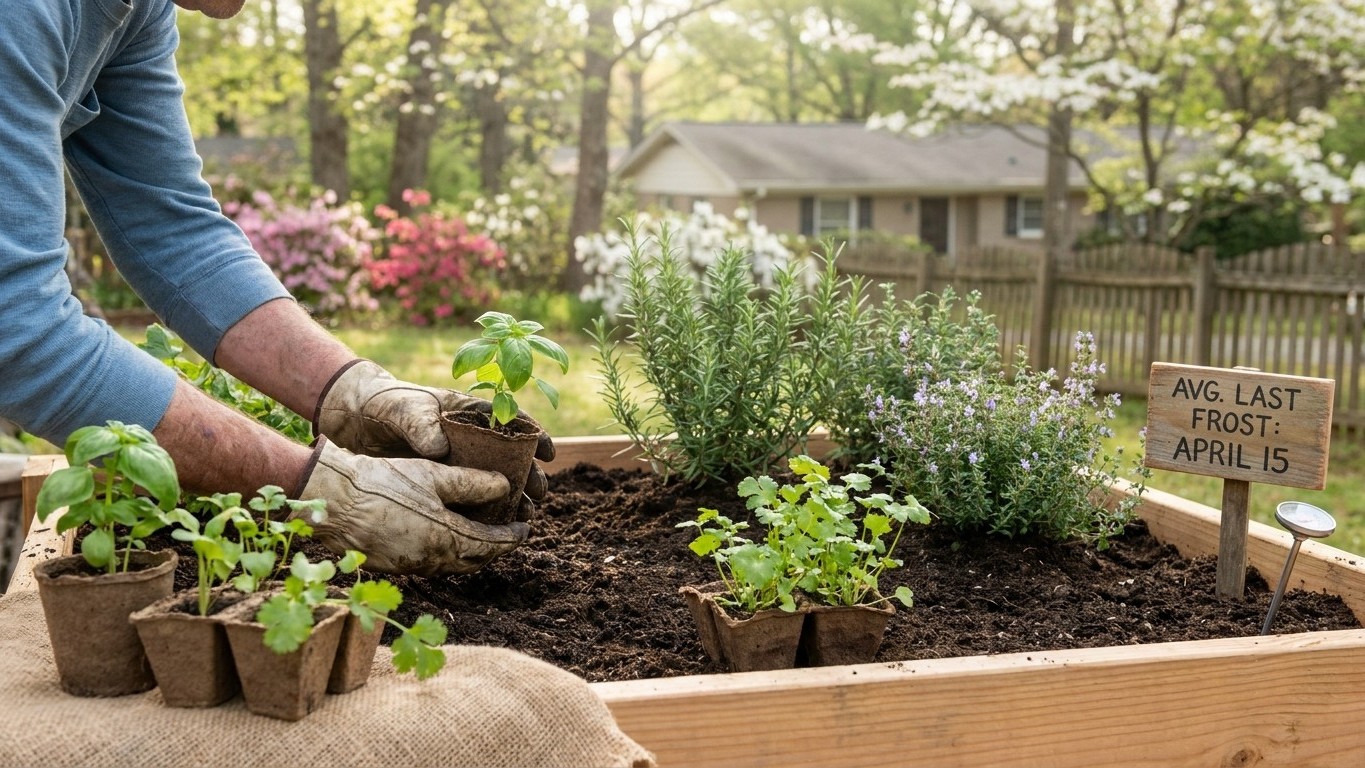

Hardy perennial herbs such as thyme, chives, and sage can go into Prince Edward Island soil as transplants in mid-to-late May, while tender herbs like basil should wait until early June. Both dates hang on the same number: the average last spring frost at Charlottetown falls on May 16, and that average hides more risk than most gardeners assume. Here’s how to read the local calendar correctly.
The short answer for Prince Edward Island
The frost-free window here runs, on average, from May 16 to October 17 at the Charlottetown A weather station, a span of roughly 154 days. But “average” is the operative word. Environment and Climate Change Canada’s 1981-2010 normals define May 16 as the mean last spring frost, which means that in one year out of every two, frost lands later than that date, sometimes by a week or more. The same applies in reverse to October 17: half the time, fall frost shows up earlier. Treat both dates as the midpoint of a moving window, not a green light or a hard deadline.
Inside that window, different herbs earn different start dates. Hardy perennials tolerate a light frost and can be set out as transplants a week or two before May 16, once the ground is workable and not saturated from spring melt. Tender herbs need the soil itself to warm, not just the air, so pushing them out before late May or early June usually means stalled growth rather than a head start.
Herb type, by planting window
| Herb type | Examples | When to plant | Why |
|---|---|---|---|
| Hardy perennial | Thyme, chives, sage, oregano | 1-2 weeks before May 16, as transplants | Tolerates light frost once established |
| Hardy annual/biennial | Parsley, cilantro | Direct-sow late April to early May | Seed germinates in cool soil, slowly |
| Tender annual | Basil, marjoram | Early June, after soil warms | Chills below roughly 40°F stall growth |
| Tender perennial | Rosemary, bay laurel | Bring indoors before first fall frost risk | Winters here are too cold for outdoor survival |
For fall, the same logic runs backward. Basil and other frost-sensitive herbs need to be harvested, dried, or frozen before the first real cold snap, which on average arrives October 17 but could just as easily land in the first week of that month. Hardy perennials, by contrast, can stay in the ground well past that date and simply go dormant.
What will not work here

The biggest mismatch on this island is climate optimism borrowed from warmer growing guides. Rosemary, bay laurel, and lemongrass are routinely sold as garden perennials in mail-order catalogs, and they are, in places where winter minimums stay above roughly 20°F. Prince Edward Island isn’t that place. The coldest month here averages a daily minimum of just 10.3°F. That’s not a record cold snap, it’s the typical low for the coldest month of a normal year. Left outside without protection, these herbs die, full stop. If you want rosemary or bay past October, plan to pot it and bring it indoors, not to mulch it and hope.
Direct-seeding heat-loving herbs straight into the garden is another common failure. Basil seed germinates poorly in soil that hasn’t warmed, and with a mean last frost of May 16 (and real risk running later), the soil often isn’t ready until close to June. Gardeners who direct-sow basil in mid-May frequently get spotty, weak germination, then blame the seed instead of the timing. Starting basil indoors four to six weeks ahead, or buying transplants, sidesteps the problem entirely.
The season is shorter than the calendar suggests
A 154-day mean frost-free window sounds generous until you subtract the buffer a cautious gardener should keep on both ends. Slow-maturing herbs that need a long, unbroken hot stretch, think of trying to bring rosemary to full size from seed in a single season, simply run out of days here even in an average year, let alone a year with an early fall frost. That’s a season-length problem, not a technique problem, and no amount of fertilizer fixes it.
Watering routines imported from drier regions also tend to misfire on the island. A once-a-week deep soak, standard advice in many gardening guides, can leave shallow-rooted herbs like basil and cilantro stressed during any stretch of dry, breezy coastal weather, while the island’s damp maritime air at other times keeps soil wetter than inland guides assume. Matching watering to what the soil actually feels like, rather than a fixed schedule, avoids both extremes.
What changes across Prince Edward Island
Prince Edward Island is small on a map, but it isn’t one uniform garden. The hardiness zone figure available for this region, 5b on the Canadian system, applies specifically to the reference city used by Natural Resources Canada, not to the whole province. That distinction matters more than it sounds. The Canadian zone system is built from seven climate variables, not the single winter-minimum figure the USDA system uses, so a Canadian 5b rating can’t be laid directly on top of a USDA zone map from a US-focused guide. The two scales measure different things and shouldn’t be cross-referenced as if they were interchangeable.
Within the province itself, coastal exposure does real work. Land close to the water, particularly along stretches facing the open Gulf of St. Lawrence or the Northumberland Strait, gets a moderating effect from the surrounding ocean that inland pockets don’t share. Inland and low-lying areas tend to collect cold air on clear, calm nights, which can push local frost dates earlier in fall and later in spring than the Charlottetown station reports. A garden twenty minutes from Charlottetown by car can run measurably behind or ahead of that station’s numbers.
None of this is a reason to guess. Natural Resources Canada’s Plant Hardiness Site maps zone data down to a fine grain, and it’s built for exactly this kind of question. Rather than assuming a home garden matches the reference city, the map is the tool that settles it.
Where to check this for your own county
Prince Edward Island’s provincial agriculture resource, at princeedwardisland.ca/en/topic/agriculture, is the place to check for anything more specific than the province-wide averages. State- and province-level pages like this one give a starting point built from a single reference station; they’re not built to know whether a particular county’s soil warms a week earlier or later than Charlottetown’s.
What’s worth looking for on that page is any local planting calendar tied to a specific county or growing region within the island, along with any list of herb or vegetable varieties that have actually been trialled in island conditions rather than just rated for a generic Canadian zone. Provincial agriculture offices often publish exactly this kind of trial data, sometimes buried under horticulture or home garden sections, and it tends to reflect real seasons rather than thirty-year averages.
A county-level or regional recommendation, when one exists, should be trusted over the province-wide averages every time. This article works from a single climate station and a set of provincial averages; a local extension resource works from repeated seasons of actual results in the ground closest to a reader’s own. When the two disagree, the local source wins.
Checking this against your own garden
No calendar date beats what the soil and the plants are actually doing in a given year, and that’s especially true on an island where the mean frost dates carry real, stated uncertainty. Three things are worth watching before trusting May 16 or October 17 as a hard line.
- Soil warmth by feel: push a bare finger a couple of inches into the bed in the morning. Cold, damp soil that feels uncomfortable to the touch isn’t ready for tender herb transplants, no matter what the calendar says.
- The first true leaves: seedlings that show only their initial rounded leaves are far more vulnerable to a cold snap than ones that have pushed out their first set of true, plant-shaped leaves. Waiting for that second stage before transplanting outdoors buys real insurance.
- How fast frost-sensitive volunteers reappear: if self-seeded dill or cilantro from a previous year is already up and thriving, that’s a decent sign the immediate microclimate is running warmer than the station average for that week.
These signs won’t override a hard frost warning, but they’re a better guide to a specific yard’s actual timing than any single date drawn from a thirty-year average taken miles away.
Some gardeners also time this by the Moon: when to plant herbs by the moon, as almanac tradition rather than fact.