
As of 2026, Prince Edward Island has not reported an established, spreading population of browntail moth the way Nova Scotia and coastal Maine have. But the insect has been creeping northeast for years, and PEI’s climate, mixed hardwood forests, and heavy apple and oak plantings make it a plausible next stop. The moth shows up in two windows each year, late June into July when adults fly, and late winter when their silk-wrapped nests are easiest to spot in bare trees. What stops it is mostly mechanical: clipping and destroying winter webs before April, combined with the biological fungus that already knocks back outbreaks in the U.S. Northeast.
What the Insect Actually Looks Like

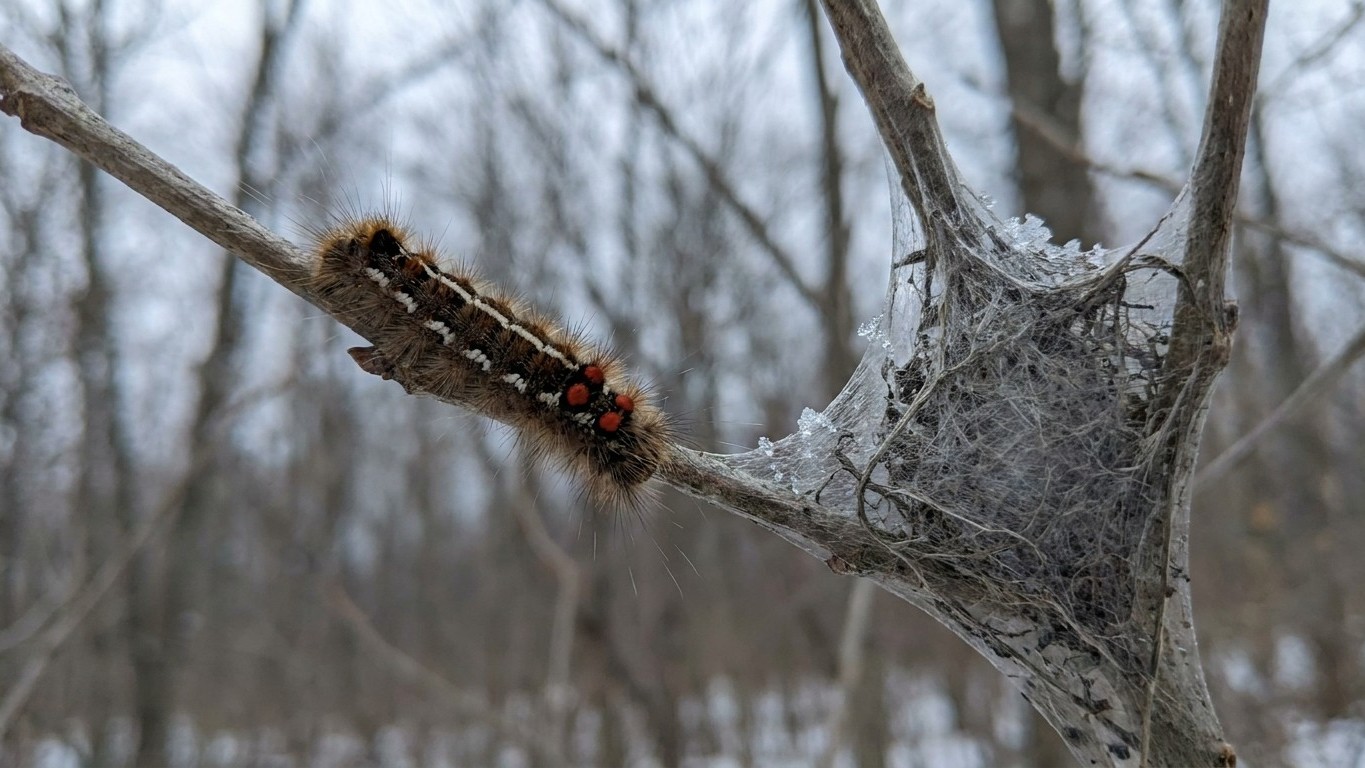
Browntail moth (Euproctis chrysorrhoea) is not native to North America. It arrived in Massachusetts around 1897, likely on imported nursery stock from Europe, and spent a century mostly confined to the Maine coast before starting to expand again in the 2010s. The caterpillar is dark brown with two distinctive orange-red spots near the tail end and rows of white broken stripes running down its sides, about 1.5 inches long at full growth.
The adult moth is smaller and easy to overlook: pure white wings with a tuft of brown hair at the tip of the abdomen, which is where the common name comes from. Adults only live a week or two, just long enough to mate and lay eggs, so most of what people actually notice is the caterpillar stage or the winter nests it builds.
Those nests are the real identifying clue for this region. Browntail caterpillars spin tight, silvery-white silk webs around the tips of branches, usually holding three to eight leaves folded together, and they overwinter inside as tiny larvae. A single mature tree can carry dozens of these nests, each one roughly the size of a golf ball to a fist, clinging to twig ends long after the leaves have dropped in autumn.
Why Prince Edward Island Is on the Watch List
The moth’s spread pattern explains the concern. It moved from a shrinking pocket on the Maine coast in the 1990s to reoccupy most of Maine and parts of New Hampshire and Massachusetts by the early 2020s. Nova Scotia confirmed its own population starting around 2021 in the Annapolis Valley, and New Brunswick has tracked isolated detections since. PEI sits directly between those two provinces, connected by the Confederation Bridge to New Brunswick and by ferry to Nova Scotia, both routes that move firewood, nursery plants, and outdoor equipment where egg masses or overwintering webs can hitch a ride.
Host preference is another reason the Island shows up on risk maps. Browntail moth caterpillars feed on more than 100 species of woody plants, but they show a strong preference for oak, apple, crabapple, cherry, birch, and beach roses, all of which are common in PEI’s coastal hedgerows, orchard operations, and residential landscaping. Wild rose in particular grows thick along dune systems and roadsides across the province, giving the caterpillar exactly the kind of low, sunny host it favors.
Coastal exposure matters too. Populations in Maine have historically clustered along the shoreline, where warmer microclimates and salt-tolerant shrubs like beach rose create ideal habitat. PEI is essentially all coastline by comparison, which is part of why provincial forestry and agriculture staff include it in regional monitoring even without a confirmed breeding population yet.
When It Shows Up: The Seasonal Timeline
Late Summer Through Fall
Adult moths fly for a short window in late June and July, and that’s when mating and egg-laying happen. Females deposit egg masses on the undersides of leaves, covered in a fuzzy brown coating made from their own body hairs. The eggs hatch in August, and the newly emerged caterpillars feed briefly before building small communal webs to spend the winter.
Winter: The Nest Stage
This is the stage most homeowners actually notice, because the caterpillars overwinter as partly grown larvae inside those silk-wrapped leaf nests, visible on bare branches from November through March. A single nest can hold 25 to 400 caterpillars packed together, waiting for spring warmth.
Spring: Active Feeding
Caterpillars break out of their winter webs in April as temperatures climb, and they feed aggressively on new leaf growth through May and June. This is when the toxic hairs become most airborne, since the caterpillars are moving, molting, and shedding hair fragments across a wide area. By late June they pupate, and the cycle restarts with a new flight of adult moths.
The Health Risk That Sets This Moth Apart
Unlike most caterpillars people encounter in a backyard, browntail moth larvae carry microscopic barbed hairs loaded with a toxin. Direct contact, or even just walking through an area where hairs have shed onto grass or laundry hanging outside, can trigger a burning, poison-ivy-like rash that lasts one to several weeks. Sensitive individuals report symptoms after indirect exposure too, from hairs stirred up by lawn mowing, leaf blowing, or simply wind carrying loose fragments off a nearby tree.
Respiratory irritation is the second concern. People with asthma or other breathing conditions can experience coughing and difficulty breathing after inhaling airborne hairs, particularly during peak caterpillar activity in late spring. The hairs themselves stay potent for up to three years even after they detach from a caterpillar, which means old shed skins, dead caterpillars, and even nest debris in gutters can still cause reactions long after the insect itself has moved on.
None of this makes browntail moth dangerous in the way a venomous spider bite would be, but it’s persistent and cumulative. Repeated exposure over a season tends to produce worse reactions, not milder ones, which is part of why regions dealing with active infestations advise against DIY removal without protective gear.
What Actually Stops It
Control for browntail moth works best when it targets the winter nest stage, before caterpillars disperse and before the toxic hairs become airborne in large volumes.
- Winter web clipping. Cutting out and destroying visible nests from November through early April, before caterpillars become active, removes the largest concentration of the population with the least hair exposure.
- Burning or soaking removed nests. Simply dropping clipped webs on the ground leaves the toxin-loaded hairs in the yard. Burning them or soaking them in soapy water neutralizes the risk.
- A naturally occurring fungus. Entomophaga aulicae, a fungal pathogen, has driven major population crashes in Maine during wet spring seasons, since damp weather favors fungal spread among caterpillars.
- Targeted insecticide treatment. Where infestations are already dense, licensed arborists sometimes apply treatments timed to early caterpillar feeding in spring, before the insects grow large and hairy.
- Protective clothing during removal. Long sleeves, gloves, and eye protection matter more with this insect than with almost any other defoliating caterpillar in the region, given how easily the hairs transfer to skin and clothing.
Natural predators offer limited help. A handful of parasitic wasps and generalist birds will eat browntail caterpillars, but the toxic hairs deter most predators enough that natural pressure alone hasn’t been reliable in Maine’s long-running outbreaks.
If You Spot a Suspected Nest on PEI
Because the province doesn’t yet have a confirmed established population, any suspected sighting is worth documenting rather than removing on your own. Photograph the nest or caterpillar from a safe distance, note the host tree species and location, and report it to provincial agriculture or forestry contacts rather than assuming it’s a look-alike species like eastern tent caterpillar or fall webworm, both of which build superficially similar structures but carry no toxic hairs.
Timing the report matters almost as much as making it. A winter nest reported in January gives forestry staff a full season to plan removal before the caterpillars disperse in spring, while a caterpillar spotted mid-summer, after the population has already scattered across a property, is far harder to contain.