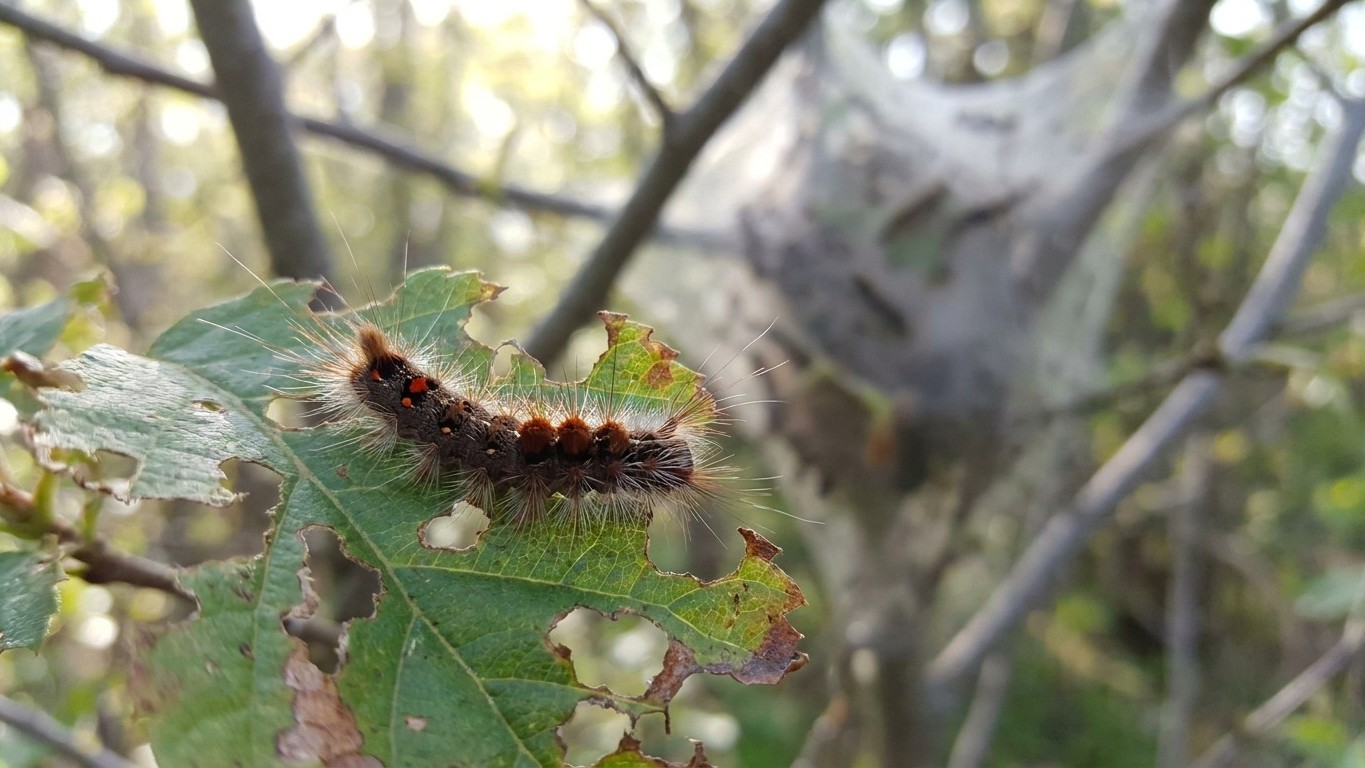

Browntail moth caterpillars show up in New Brunswick in two distinct waves each year: a brief, intense feeding period in April and May when overwintering caterpillars emerge from their silk webs, and a second, quieter hatch in August when newly laid eggs produce larvae that build the nests they’ll survive winter in. What actually stops the insect isn’t a single spray or trap. It’s removing those winter webs before April, catching young caterpillars with a bacterial insecticide in early spring, and keeping shed hairs out of your yard work for years afterward, since the toxic hairs stay active long after the caterpillars are gone.
Where Browntail Moth Has Established Itself in New Brunswick

Browntail moth (Euproctis chrysorrhoea) isn’t native to North America. It arrived from Europe in the late 1800s, took hold in Massachusetts, and stayed largely confined to coastal Maine and Cape Cod for over a century. That changed starting around 2015, when populations in Maine exploded and the moth’s range pushed steadily northeast, crossing the border into New Brunswick.
Southern New Brunswick, particularly Charlotte County and communities near St. Stephen and St. Andrews, sits directly across from Maine’s heavily infested coastal towns. That proximity matters. Adult moths fly, but caterpillars mostly spread through egg masses hitching rides on firewood, nursery stock, and vehicles, plus natural dispersal along the shared border. As Maine’s infestation grew from a few coastal pockets into a multi-county problem, New Brunswick started seeing the same webs turn up on oak, apple, and crabapple trees in yards close to the frontier.
The province hasn’t seen the kind of widespread, forest-wide defoliation reported in parts of Maine, where tens of thousands of acres have been affected in a single season. New Brunswick’s situation so far looks more localized, concentrated in specific neighborhoods and orchard areas rather than blanketing entire counties. That’s worth knowing if you live outside the immediate border zone: the risk right now is uneven, not uniform.
The Yearly Timeline: From Winter Webs to July Flights
Understanding when browntail moth is active tells you when to act. The insect runs on a predictable annual clock, and missing the right window means dealing with a bigger problem later.
Fall and Winter: The Webs You Can Actually See
By September, young caterpillars from that summer’s egg hatch have already spun small, tight silk nests wrapped around the tips of branches, usually anchored to a cluster of leaves. These webs, roughly the size of a golf ball to a fist, are what the caterpillars live inside all winter. Once deciduous trees drop their leaves in October and November, those webs become visible against bare branches, and they stay visible right through March. This is the single best window for control, because the caterpillars are dormant, concentrated in one spot, and easy to spot against gray winter branches.
April Through June: Feeding and the Skin-Rash Risk
As buds swell in spring, the caterpillars break dormancy and start feeding on the earliest new leaves. This is when populations do real damage to host trees and when the toxic hairs become airborne in the highest numbers, since actively feeding caterpillars shed hair constantly. By June, caterpillars have matured and start pupating, spinning cocoons in curled leaves, on tree bark, or on structures nearby.
Late June Into July: The Adult Moths Emerge
Adults are white moths with a distinctive tuft of brown hair at the tip of the abdomen, which gives the species its name. They emerge over a few weeks, mate, and females lay egg masses on the undersides of leaves, each covered in a layer of those same irritating hairs. Adults don’t feed and don’t live long, but the eggs they leave behind hatch in August, and the cycle starts over with a new generation of small caterpillars building winter webs before the leaves fall.
Why the Hairs Matter More Than the Bite
Browntail moth caterpillars don’t bite or sting the way people expect from a “dangerous” insect. The real hazard is microscopic. Each caterpillar carries thousands of barbed hairs, invisible to the naked eye individually, that break off easily and become airborne, especially when nests are disturbed, when caterpillars are actively feeding, or when yard equipment like mowers and leaf blowers stir up ground litter where hairs have settled.
Contact with these hairs triggers a skin reaction that looks and feels like a severe poison ivy rash: red welts, intense itching, and in some cases blistering that can last for days or weeks. Inhaling the hairs can cause respiratory irritation, and people with asthma or other lung conditions tend to react more severely. According to Maine’s state forestry health program, which has tracked the insect longer than any other jurisdiction in the region, the hairs can remain active in soil, on structures, and in leaf litter for up to three years after the caterpillars themselves are gone.
That persistence is the part most homeowners underestimate. A yard that had a bad browntail moth year two summers ago can still cause a rash today if someone rakes leaves, mows without a bag, or lets kids play in undisturbed litter near a former infestation site. The hairs don’t need a live caterpillar attached to cause a reaction.
What Actually Stops Browntail Moth
Control works best when it targets the insect’s weak points in its yearly cycle, rather than treating the whole yard reactively once a rash shows up.
Winter Web Removal (The Highest-Impact Step)
Clipping and destroying the silk winter webs between November and April removes a huge chunk of next year’s population before it ever gets a chance to feed or breed. The webs are easiest to find on bare branches, usually at the outer tips where thin twigs meet, wrapped tightly around a few dead leaves.
- Cut the branch several inches below the web, not just the web itself, since caterpillars can be tucked further down the twig.
- Drop clipped webs directly into a bucket of soapy water or burn them; don’t leave them on the ground or toss them in a compost pile, since caterpillars can survive and crawl back out.
- Wear gloves, long sleeves, and eye protection even in winter, since dried hairs on old webs are still capable of causing a reaction.
- For webs higher than a pole pruner can reach, this becomes a job for a licensed arborist or pest control company rather than a DIY ladder project.
Spring Treatment While Caterpillars Are Small
If winter removal wasn’t done or missed some webs, the next window is early spring, right as caterpillars start feeding on fresh buds. At this stage, a biological insecticide containing Bacillus thuringiensis kurstaki (commonly sold as Btk) applied to host tree foliage is effective and targets caterpillars specifically without the broader impact of conventional pesticides. Timing matters here more than almost anywhere else in pest control: Btk only works on actively feeding, young caterpillars, so spraying too early or too late wastes the application.
Larger or established trees, especially mature oaks with heavy infestations, often need a professional applicator with the right equipment to reach the canopy. Horticultural oil sprays directed at nests can also smother caterpillars before they disperse, but oil sprays need direct contact with the web to work, which limits their use to nests within reach.
Reducing Exposure Even After Caterpillars Are Gone
Because the hairs outlast the insect, yard habits matter for years after an infestation. Avoid dry-raking leaf litter under previously infested trees; wetting the area down first keeps hairs from becoming airborne. Skip the leaf blower in those zones entirely, since blowers are especially good at launching lightweight hairs into the air where they can drift onto skin or into lungs. If you’re mowing near former nest sites, a bagged mower beats an open-discharge one, and a dust mask isn’t overkill if you know the area had a heavy caterpillar year recently.
New Brunswick residents near the Maine border should also treat firewood and yard debris from affected properties with some caution before moving it, since egg masses and winter webs can hitch a ride on cut branches. It’s a small precaution, but it’s the same mechanism that helped the moth expand its range into the province in the first place.