
Sow Autumn Spinach in southern Quebec between mid-July and mid-August, counting backward from a harvest that lands before the season’s first hard frost. That window exists because two forces are pulling against each other: soil that’s often still too warm for good germination in mid-summer, and a frost that arrives, on average, in early October. Time it right and the crop skips the long, bolt-triggering days of a Quebec summer entirely.
The short answer
On the longest day of the year, the reference station near Montreal holds 15 hours and 29 minutes of daylight above the horizon. That number matters more than any thermometer reading for spinach, because flowering in this crop is triggered by long days as much as by warmth. A cool Quebec summer doesn’t cancel that signal. The plant reads the clock, not just the temperature, and once the days stretch out that far, spinach starts running to seed no matter how mild the air feels.
This is where a lot of gardeners get tripped up. Southern Quebec’s summers are genuinely gentle by continental standards. The reference station averages 0.0 days a year at or above 90 F, a heat load that’s about as low as it gets for a temperate garden zone. It would be reasonable to assume that mild heat buys spinach extra weeks of growth in June and July. It doesn’t. The 75 F growth ceiling for spinach is real, and staying under it helps, but the plant still bolts once day length alone crosses its threshold, regardless of how comfortable the air feels.
So is the limiting factor day length, heat, or both? Here it’s both, just at different times of year. Day length is the fixed, unavoidable constraint through the height of summer, when the calendar itself works against the crop no matter what you do with irrigation or shade cloth. Heat becomes the operative limit at the two edges of the season instead: a 75 F ceiling above which growth slows and leaves turn bitter, and an 80 F soil threshold above which germination drops off. Both numbers come from Utah State University Extension’s guidance on growing spinach, and both apply directly to how a Quebec garden should be scheduled.
Put plainly, the growing season here has two usable spinach windows, not one long one: a short spring push that ends when the days get long, and an autumn crop that has to wait for the soil to cool down before it can start. Nothing in between those two windows is worth sowing spinach into, no matter how good the weather looks in July.
How long the spring window really is
- Start date. Spinach is sown 2 to 3 weeks before the last spring frost. At the Montreal-area reference station, that frost falls on average around May 6, which puts a realistic sowing date somewhere in mid-to-late April. Treat May 6 as a midpoint, not a guarantee: in roughly half of all years, the last frost actually lands later than that date, so an early sowing still carries real frost risk for the seedlings.
- Growth phase. Once seedlings are up, the cool spring air works in the crop’s favor. With essentially no days above 90 F on average and air temperatures typically well under the 75 F growth ceiling through most of April and May, spinach can put on steady leaf growth without stress for several weeks.
- The closing trigger. The window doesn’t close because of heat. It closes because day length keeps climbing toward the June 21 solstice, when the reference station reaches its peak of 15 hours 29 minutes. As that threshold approaches, spinach shifts into flowering mode even on a cool day, and leaf quality drops fast once bolting starts.
- Net result. Counting from a mid-to-late April sowing to the point where rising day length forces the plant to bolt, southern Quebec gardeners get roughly six to eight usable weeks of spring spinach, a shorter run than the mild spring temperatures alone would suggest.
The autumn crop, and when the soil lets you sow
The fall crop runs on the opposite logic from spring. Instead of racing rising day length, it’s racing falling soil temperature on one end and an oncoming frost on the other. Utah State University Extension frames fall sowing as a simple count-back: plant 50 to 75 days before the date you actually want to harvest, not a fixed calendar date that applies everywhere.
Soil still too warm to germinate
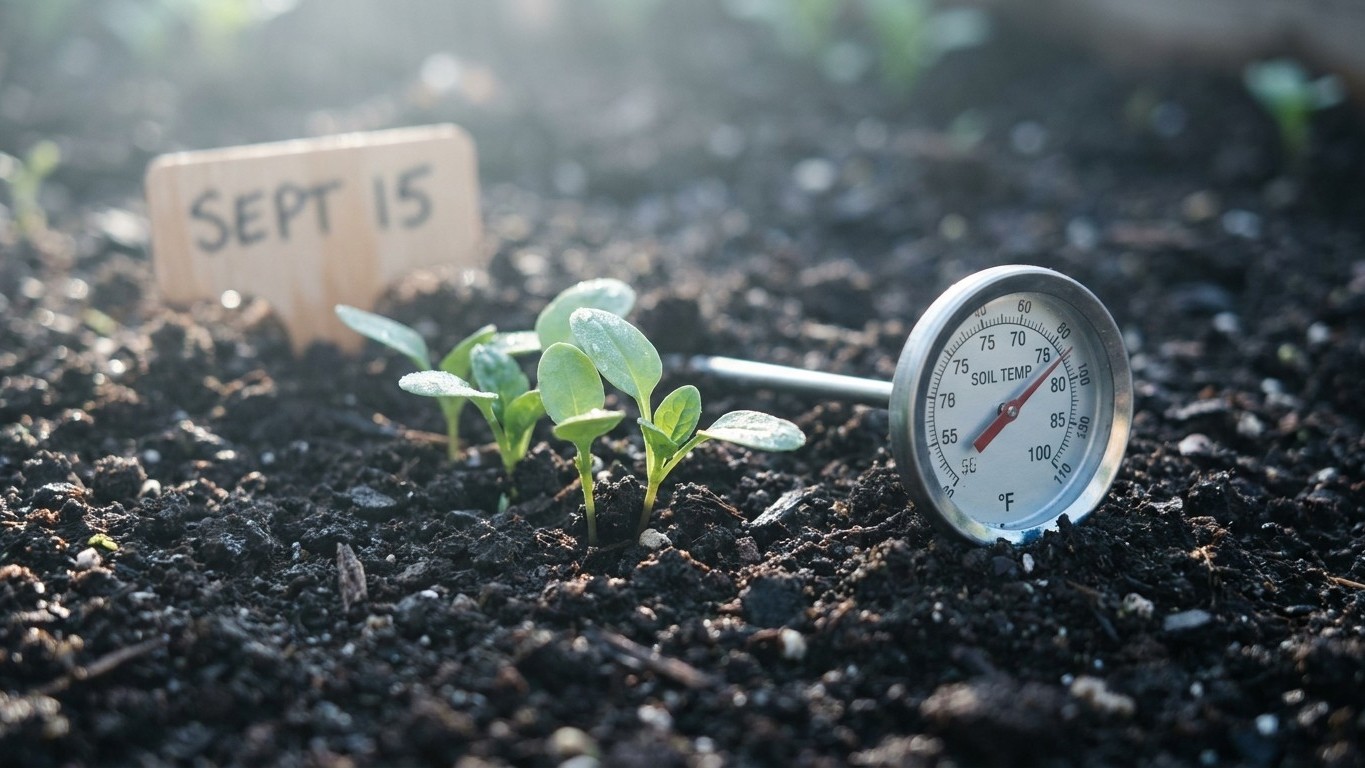
Spinach seed germinates poorly once soil temperatures climb above 80 F, and mid-summer soil in a sunny Quebec garden bed can sit above that line even when the air feels comfortable. The good news for this territory is that the heat load itself is modest. With an average of 0.0 days a year reaching 90 F, sustained stretches of soil holding above 80 F are less of an obstacle here than they would be farther south, which is one reason the fall sowing window can open by mid-summer rather than waiting until deep into August the way it might in a hotter garden. Shade cloth over the seedbed or sowing in the cooler part of the day still helps germination along.
The frost that ends the season
Working backward from a harvest target, the math is straightforward. The reference station’s average first fall frost lands around October 5. Counting back 75 days from that date lands on roughly July 22; counting back 50 days lands on roughly August 16. That gives a realistic autumn sowing window running from late July through mid-August, aimed at a harvest that finishes before frost shuts the garden down.
That October 5 date deserves the same caution as the spring frost figure: it’s a mean from Environment and Climate Change Canada’s climate normals, not a promise. In about half of all years the first fall frost arrives later than that, which gives a later-sown crop some extra cushion, but it’s not something to plan around deliberately. Gardens north of the Montreal area, or at higher elevation, should expect this whole calendar to shift earlier by however many days their local frost date runs ahead of the reference station’s.
On variety choice, four spinach cultivars come up repeatedly in extension guidance for fall crops: Bloomsdale, Melody, Teton, and Olympia. Utah State University Extension names these varieties but doesn’t publish maturity data, disease ratings, or performance comparisons for any of them, so no seed source or brand recommendation belongs here. The sowing math above applies regardless of which of the four a gardener chooses.
Common questions
Can spinach be sown in Quebec in June? Not with good results. June sits right at the point where day length approaches its 15-hour-29-minute peak, and that alone pushes spinach toward bolting even when the air stays under the 75 F growth ceiling.
My garden is north of Montreal. Do these dates still apply? The May 6 and October 5 frost averages come from a single reference station near Montreal. Gardens farther north or at higher elevation typically see a later last spring frost and an earlier first fall frost, which compresses both the spring and autumn windows described here.
How do I know when the soil has cooled enough for a fall sowing? The source behind these figures doesn’t publish a soil-temperature reading for this territory, only the 80 F germination threshold and the general fact that days above 90 F are essentially absent here in an average year, which limits how long the soil stays too warm.
Does spinach survive a light frost in Quebec? The guidance here only establishes an average first fall frost date to plan a harvest around, not a frost-tolerance rating for the crop.