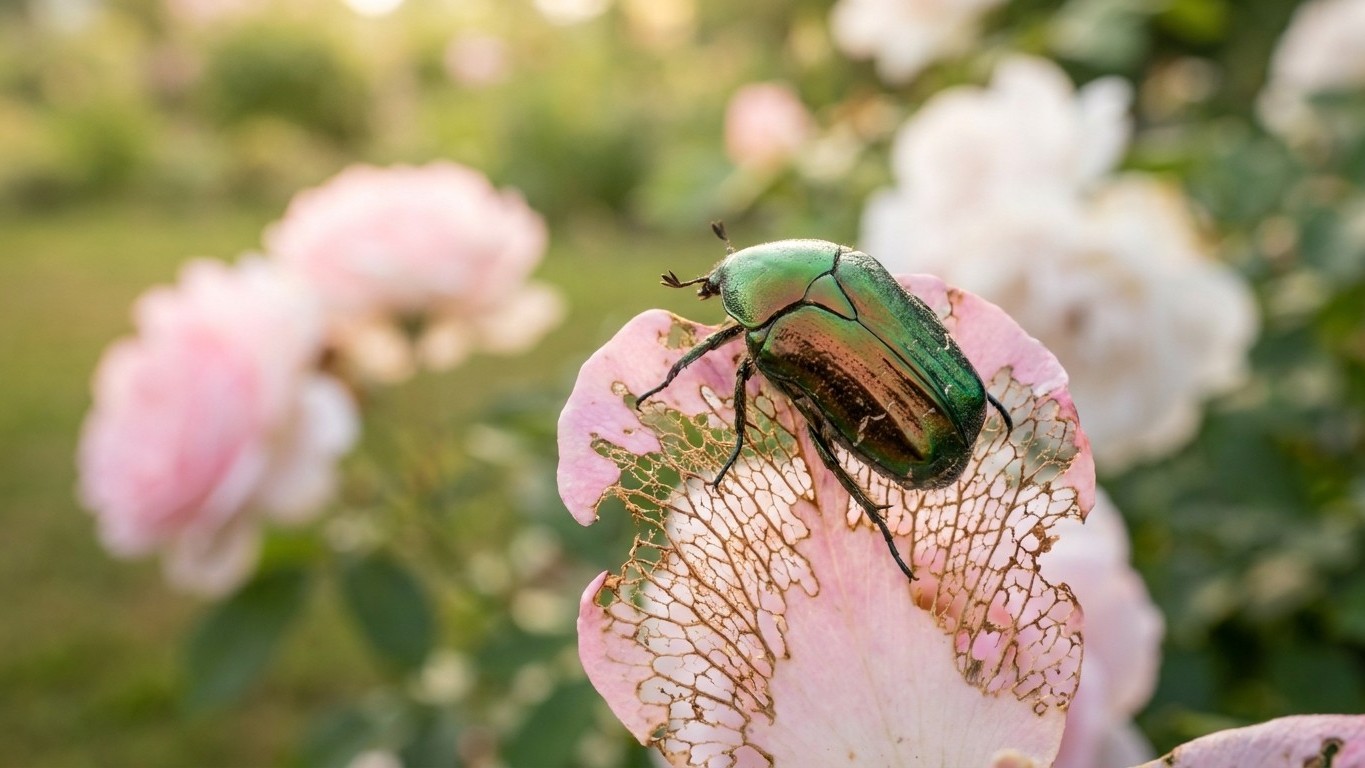

Rose chafers show up in Quebec gardens roughly two to four weeks after the last spring frost, once soil temperatures climb enough to trigger adult emergence from the turf. They target roses, grapevines, peonies, and raspberries, chewing leaves into lace and skeletonizing petals. Row covers timed to that emergence window are the cheapest real defense, and hand-picking works nearly as well once you know where to look.
Reading the calendar from your last frost

The last spring frost recorded at MONTREAL/ST-HUBERT A averages May 6, according to Environment and Climate Change Canada’s Canadian Climate Normals covering 1981-2010. That date matters less as a safety marker and more as a starting point for counting forward, because the rose chafer doesn’t consult a calendar. It waits for soil to warm past a certain threshold before the adult beetles dig out of the turf where they overwintered as larvae. A cold, wet May pushes emergence back. A warm one pulls it forward by a week or more.
Gardeners who transplant roses or young grapevines around that early-May mark typically see the first chewed leaves or skeletonized petals two to four weeks later, once beetles finish emerging and start feeding in earnest. That’s the practical window for getting row covers on before damage starts, and for planning when to take them off again if pollination needs access.
Here’s the catch worth repeating: May 6 is a mean, not a promise. In one year out of two, frost at that station falls later than the average, sometimes by days, sometimes by more. And a single station reading doesn’t speak for the whole province. Gardens in the Laurentides, Saguenay, or other northern and upland districts typically run weeks behind Montreal-area timing, which pushes both the frost date and the chafer’s emergence later on the calendar. Treat the date as a midpoint to plan around, never as a line you can count on with certainty.
What it attacks, and what the damage looks like
Most gardeners notice the damage before they ever spot the insect. Rose petals turn brown and ragged at the edges, sometimes reduced to a skeleton of veins with the soft tissue eaten away between them. Leaves on roses, grapevines, and raspberry canes develop a distinctive lace-like pattern, with the beetle chewing out the tissue between veins and leaving a see-through skeleton behind. Peonies show similar chewing on both foliage and flower petals, and the damage tends to cluster where sunlight hits the plant directly, since adult chafers favor light-colored and fragrant blooms.
Which life stage does the damage
This distinction decides what a gardener can still do about it. The adult beetle does virtually all the visible damage to foliage and flowers, feeding actively for several weeks after emergence before mating and laying eggs back in the soil. The larval stage lives entirely underground, feeding on the roots of turf grasses rather than on garden ornamentals, so a lawn with a heavy larval population won’t show chewed rose leaves directly, though it may show patchy, weak turf.
That split matters for treatment. Because larvae feed on grass roots and never touch the rose or grapevine itself, any control aimed at protecting flowers and foliage has to target the adult stage, during that narrow feeding window after emergence. Once the season moves past that window and beetles have already mated and died back, the visible damage is done for the year, and attention shifts to reducing next year’s larval population in turf instead.
How Quebec sits in this pest’s range

This pest is currently documented on this site in two territories, which puts Quebec near the edge of the range covered here rather than deep inside a widely tracked zone. That narrow footprint means less local research has been published specifically for Quebec conditions, so the nearest published guidance comes from the University of New Hampshire Cooperative Extension, across the border, rather than from a Quebec-based agricultural service.
That borrowing isn’t unusual for a pest whose biology depends more on regional soil warming patterns than on political lines. New Hampshire sits in a broadly similar northeastern climate band, which makes its extension guidance a reasonable proxy for timing and control approaches, but it’s still guidance drawn from a different jurisdiction with its own frost dates and turf conditions. A Quebec gardener using that guidance should adjust the timing forward or back based on local frost data rather than applying New Hampshire’s calendar directly.
None of this speaks to how common or severe rose chafer problems are in Quebec relative to other pests tracked on this site. The count of two territories reflects documentation, not an actual measure of how widespread or damaging the species is on the ground. Gardeners dealing with chewed roses or skeletonized grape leaves in the Montreal or Montérégie regions are working with a real, recognized pest, just one where local-specific research is still thin.
What actually works against it
Timing of planting comes first, because it costs nothing beyond planning.
- Delay planting of vulnerable transplants, like young roses or grapevines, until after the typical adult emergence window, since this reduces the plant’s exposure during the beetle’s short but intense feeding period. It doesn’t eliminate risk, since emergence timing shifts with the season, but it narrows the overlap.
- Use row covers during the two-to-four-week window after frost when adults are actively feeding, because they physically block adult beetles from reaching leaves and flowers through simple exclusion: a beetle that can’t land on the plant can’t chew it. Covers stop working the moment they come off, and they need to come off before flowering if the plant depends on pollinators, which creates a real trade-off for anyone growing roses or grapes for fruit rather than just foliage.
- Hand-pick adults by shaking affected branches over a container of soapy water during peak feeding weeks, exploiting the beetle’s habit of dropping rather than flying when disturbed, which makes this a genuinely effective, if repetitive, control method. This works only on adults above ground; it does nothing for larvae feeding on turf roots below the surface, since there’s no way to hand-pick something you can’t see or reach.
- Clear plant debris and maintain turf to reduce overwintering sites for larvae, which lowers the population available to emerge as adults the following spring. Crop rotation offers less benefit here than with soil-dwelling pests confined to a single bed, because adult chafers fly in from surrounding turf rather than emerging exclusively where last year’s plants grew.
Once larvae are established in turf roots, none of these above-ground measures reach them; control at that stage depends on turf management practices rather than anything applied to the ornamental plants themselves.
Common questions
Does covering roses in early May guarantee no damage?
No. Covers block adult beetles physically, but timing has to match actual emergence, which shifts with how warm the soil runs that particular spring. A cover applied too late, after beetles have already emerged and settled in, offers little protection.
Are rose chafer larvae the same insect causing lawn damage?
Yes, the larval stage lives in turf and feeds on grass roots, distinct from the adult stage that damages roses, grapevines, and peonies above ground. A weak, patchy lawn near affected ornamentals can indicate a larval population building toward next year’s adult emergence.
Why does Quebec-specific guidance rely on data from New Hampshire?
This pest is documented in only two territories on this site, meaning Quebec sits near the edge of tracked range rather than at its center. With less local extension research published, the nearest comparable guidance available comes from New Hampshire’s Cooperative Extension, a neighboring jurisdiction with broadly similar climate patterns.