
Rhode Island’s frost-free window runs roughly 190 to 209 days depending on where the season’s edges fall, which is plenty of time for nearly every standard winter squash type. The real filter here isn’t season length. It’s the state’s modest heat load and humid summer rainfall pattern, which push the smart choice toward disease-resistant, moderate-maturity varieties rather than the biggest or slowest ones on the seed rack.
The short answer for Rhode Island
Pick squash types that mature in 80 to 110 days and skip anything bred for long, scorching summers. That’s the entire calculation for this state, and it comes straight from two numbers: a frost-free stretch of 190 to 209 days (calculated from the last spring frost of April 7 to April 17, and the first fall frost of October 24 to November 3, both from NOAA’s 1991-2020 normals for the Providence-area reference station), and a summer heat load of just 9.4 days a year reaching 90°F or hotter.
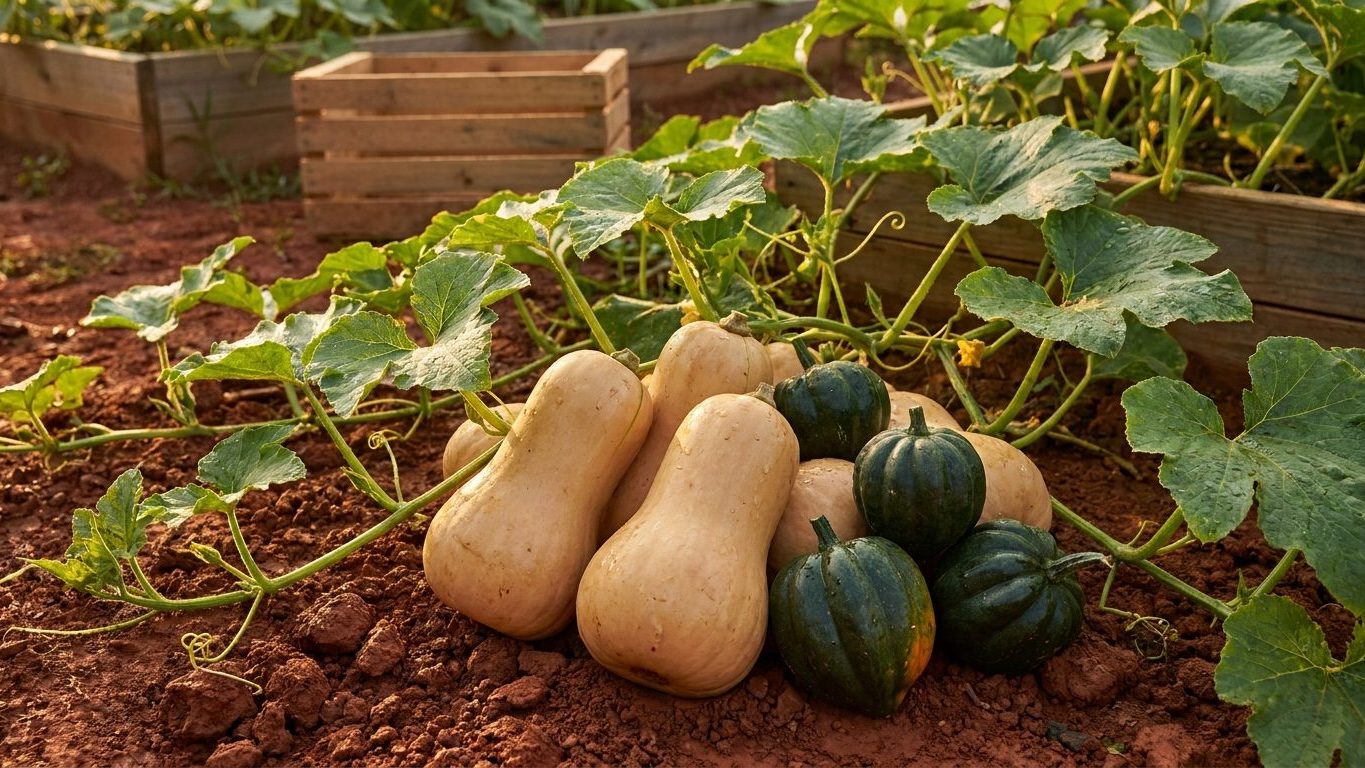
That combination means there’s enough calendar time for almost any squash, but not enough heat accumulation to push a slow, heat-hungry variety to full size and full cure. Acorn, delicata, and spaghetti squash, all typically in the 90 to 100 day range, fit comfortably even in a cautious planting year. Butternut, at 90 to 110 days, is the workhorse choice for most Rhode Island gardens because it tolerates the state’s cooler nights better than many other types while still curing a hard, storable rind. Buttercup and smaller kabocha varieties, generally 95 to 105 days, also perform well here and bring better resistance to the fungal pressure that comes with a humid coastal climate.
Where the longer-season types stand
Hubbard squash and other 100 to 120 day types are workable, but only if seed goes in the ground as soon as the last-frost risk clears rather than waiting into June out of caution. The margin shrinks fast once a variety pushes past 110 days, because the state’s low count of 90°F-plus days means fruit spends more of its maturing period in the 70s and low 80s rather than in the heat that speeds sugar development and rind hardening.
| Squash type | Typical days to maturity | Fit for Rhode Island |
|---|---|---|
| Acorn | 80-100 | Strong fit, reliable even in a cool year |
| Delicata | 90-100 | Strong fit, good disease tolerance |
| Spaghetti | 90-100 | Strong fit |
| Butternut | 90-110 | Best all-around choice for most gardens |
| Buttercup / small kabocha | 95-105 | Good fit, better mildew resistance |
| Hubbard | 100-120 | Workable only with an early planting |
What will not work here
Giant, competition-style pumpkins and other Cucurbita maxima types bred for very hot, long southern summers are the clearest mismatch for this state. They’re built to convert heat units into size, and Rhode Island simply doesn’t generate them, averaging fewer than ten days a year above 90°F. Fruit on these varieties often stalls short of its advertised size and can struggle to cure a hard enough rind before the first fall frost arrives, which at the early end of the range hits October 24.
The second failure point is spacing borrowed from drier-climate growing guides. Rhode Island’s summer isn’t sparse on rain, it averages about 10.3 inches across June, July, and August, but that rain arrives as a humid backdrop with June bringing 3.81 inches and August 3.59 inches. Combine that moisture with mild temperatures and you get ideal conditions for powdery mildew on vine crops. Planting winter squash at the tighter end of a spacing recommendation, the kind meant for climates where the air dries out fast, invites mildew to move through a patch within weeks. Wider spacing than the package suggests, with real airflow between hills, matters more here than it does in a drier state.
The third trap is assuming that decent summer rainfall means no watering can. July is the driest month of the growing season at just 2.91 inches, and that dip lands right during fruit set for most varieties planted on a normal schedule. A sandy garden bed sheds that rain within a day, so a gardener who skips watering because “it rains enough here” can watch fruit set falter in exactly the month it matters most. The fix isn’t complicated, it’s just supplemental watering during that July stretch rather than trusting the seasonal average to smooth itself out.
What changes across Rhode Island
Rhode Island’s hardiness zone range, 6a to 7b under the USDA’s 2023 map, tells you this is not one climate. That’s a wide spread for a state this size, and it comes almost entirely from the ocean’s moderating effect on the coast and islands compared with the inland uplands.
Coastal and island areas, the stretch that includes Newport County and Block Island, sit at the warmer end near 7a to 7b. Ocean-moderated air keeps extreme winter minimums milder and tends to push the first fall frost later than the state’s inland average, which gives longer-season squash types like Hubbard a better shot at finishing without a rush. Inland and northern sections, roughly the higher ground in Providence County and the state’s northwestern corner, run cooler at 6a to 6b, with colder extreme minimums and typically an earlier first frost than the coast.
A gardener working land in that cooler, inland zone should lean toward the 80 to 95 day varieties, acorn and delicata over Hubbard, and should treat the early end of the frost-free window as the one to plan around rather than the late end. A gardener on the coast or an island has more room to try a 100 to 120 day type, since the ocean buffer tends to buy extra weeks at both ends of the season. Neither of these is a guess you should make from a state map alone, since a 6a-to-7b range covers real, on-the-ground differences in how late fall frost actually holds off.
Where to check this for your own county
This page gives a state-level answer built from a single reference weather station near Providence. Your county is not that station, and the gap between them can run one to two weeks on both frost dates, more if you’re at elevation or in a low-lying frost pocket. The University of Rhode Island Cooperative Extension is the source built to close that gap.
Two things are worth pulling from that resource before you finalize a planting plan. First, look for their local planting calendar, which will reflect frost timing closer to your actual county rather than the airport-station average used throughout this page. Second, look for any list of squash varieties they’ve trialled specifically in Rhode Island conditions, since a variety that performs well in a university trial plot in this state carries more weight than a general seed-catalog description written for a national audience.
A county-level recommendation from Extension will beat this page every time it’s available, because it accounts for local soil, local frost pockets, and local disease pressure in a way a state-wide summary can’t. Treat this article as the starting framework, the reasoning behind why butternut and acorn are safer bets than Hubbard in most of the state, and let your county’s Extension office fill in the specific dates and cultivar names that apply to your actual garden.
Checking this against your own garden
Frost dates and hardiness zones describe an average year at a fixed weather station. Your own garden will tell you something more useful, and it does it for free. Three signals matter most for winter squash, and none require a tool beyond your own hands and eyes.
Soil warmth by feel is the first check. Squash seed sulks in cold soil and can rot before it germinates, so press a bare hand a few inches into the planting bed in mid-spring. Soil that still feels cool and damp, closer to what you’d feel from a refrigerator shelf than from bathwater, means the ground hasn’t caught up to the calendar yet regardless of what the frost-date range suggests.
The first flush of male flowers is the second signal. Squash plants typically produce male blooms before female ones, and their appearance tells you the plant has moved from vegetative growth into reproductive mode. A garden that’s consistently slower to show male flowers than a neighbor’s plot a mile away is quietly telling you it sits in a cooler microclimate, the kind that favors the shorter-maturity end of your variety list.
The first true leaves, the ones that emerge after the initial rounded seed leaves, mark the point where the plant is actually functioning on its own. How quickly they appear and how vigorous they look gives you a read on both soil temperature and fertility that no regional average can match. Watch these three things over a couple of seasons and you’ll have a better planting calendar than any zone map, built entirely from your own patch of ground.