
Direct-sow winter squash outdoors in Rhode Island from roughly May 1 through May 20, once soil has warmed past the reference station’s April frost window. That timing gives most varieties, planted by seed rather than transplant, enough runway to mature before the first fall frost arrives between October 24 and November 3.
The short answer for Rhode Island
The reference figures for this state come from the NOAA climate station near Providence: a last spring frost window of April 7 to April 17, and a first fall frost window of October 24 to November 3. Those are 30-70% probability bands, not fixed dates. Read April 17 as the point where the odds of frost drop to roughly 30%, and October 24 as where they climb back to 30%. A gardener planting right at either edge is still accepting real risk.
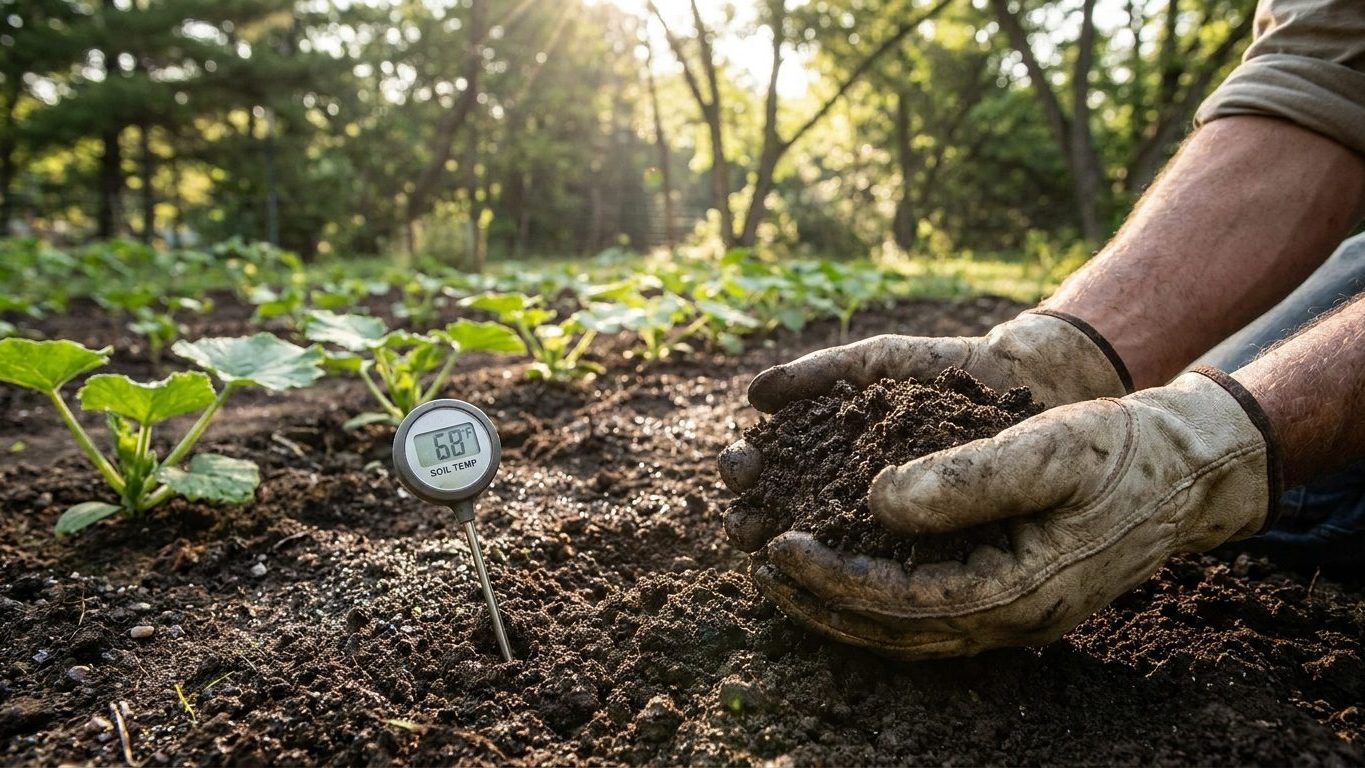
Winter squash seed does not want to go into cold soil. Even after the last frost date passes, soil temperature usually needs another one to two weeks to climb past 60F, which is the threshold squash seed needs to germinate reliably rather than rot. That pushes the practical direct-sow window to early May through the third week of May for most of the state, using the Providence-area normals as the starting reference.
Counting forward from a May 1 sowing to the earliest fall frost date of October 24 gives about 176 days. Counting from a May 20 sowing to the latest fall frost date of November 3 gives roughly 167 days. Either way, that’s comfortably more than the 65 to 100 days most winter squash varieties need to reach maturity, including butternut, acorn, and delicata at the faster end. Slower Hubbard and some large kabocha types, which can run 100 to 110 days, still fit if seeded by mid-May rather than pushed toward June.
This page gives a state-level answer built on one reference station. It is not a substitute for what your own county extension office publishes, and the section further down explains exactly where to find that.
What will not work here
Two things sink Winter Squash in Rhode Island most often, and neither is frost timing.
The first is planting a slow, 100-plus-day Hubbard or large kabocha variety after the calendar has already slipped into June. Even with a fall frost window stretching to November 3 in a good year, a June 10 sowing of a 110-day variety is asking for maturity right around, or after, the earliest edge of that frost window. Add the caution built into these frost normals, that suburban and rural gardens away from the coastal reference station often see frost arrive a week or two earlier, and a late-planted slow variety can be caught with unripe fruit on the vine.
The second is watering on a weekly schedule through a Rhode Island summer and assuming that’s enough. The reference station averages about 10.3 inches of rain across June, July, and August, but July, the hottest stretch of the growing season, is also the driest month at 2.91 inches. Layer on an average of 9.4 days a year that hit 90F or higher, mostly clustered in July and August, and evaporation demand spikes exactly when rainfall dips. A single weekly soak on sandy, fast-draining soil common along much of the Rhode Island coastal plain will not hold moisture through a stretch of 90-degree days between rains. Squash roots sitting in dry topsoil during flowering and fruit-set is a common reason for blossom drop and stunted fruit here, and it has nothing to do with planting date.
There’s a third, quieter failure mode worth naming: cramming vines into tight spacing because the garden bed is small. Rhode Island summers carry enough humidity that powdery mildew and squash vine borer pressure both build faster in crowded plantings with poor airflow, and a wet early-summer stretch (June averages 3.81 inches, the wettest of the three summer months) can prime foliage for fungal problems before the dry mid-summer stretch even arrives. Wide spacing and morning watering that lets leaves dry by afternoon matter as much here as the sowing date does.
What changes across Rhode Island
Rhode Island’s USDA Plant Hardiness Zone spread runs from 6a to 7b, according to the 2023 USDA map. That’s a meaningful gap for a state this size, and it comes down almost entirely to distance from the moderating effect of Narragansett Bay and the Atlantic coastline. Coastal and island locations, the kind of areas that sit toward the milder 7b end, tend to warm up sooner in spring and hold heat later into fall. Inland and higher-elevation spots, more likely to fall in the cooler 6a-6b range, see both a later spring warm-up and an earlier autumn chill.
Practically, that means a gardener on the milder end of the zone spread can often push sowing a few days earlier in May and stretch harvest slightly later into October than the state-level window suggests. A gardener on the cooler end should treat the later side of the sowing window, and the earlier side of the fall frost window, as the more realistic planning targets, and lean toward faster-maturing varieties rather than the slowest Hubbard types.
This page can’t tell an individual reader which of those zones applies to their own yard, since a zone boundary can run through a single town, or shift with a hill or a valley. The USDA Plant Hardiness Zone Map lets you check by ZIP code, and that’s the right next step before locking in a planting date based on the state-wide range alone.
Where to check this for your own county
Every figure on this page, the frost windows, the rainfall normals, the heat-day count, comes from one reference weather station near Providence. That’s useful for a state-wide picture, but it is not a county forecast, and it’s not a substitute for what the University of Rhode Island Cooperative Extension publishes for local growers.
URI Cooperative Extension is the state’s land-grant extension service. Two things are worth looking for once there. First, any county- or region-specific planting calendar that adjusts the frost-date assumptions used on this page for your part of the state, whether that’s Washington County’s milder coastal strip or the cooler inland stretches of Providence and Kent counties. Second, any list of winter squash varieties the extension service has trialled locally, since a variety that performs well in a university trial plot in Kingston has already been tested against Rhode Island’s actual disease pressure and season length, not a generic seed-catalog description.
A county-level recommendation from your extension office will always beat a state-level page like this one, because it’s built on local trial data and local growers’ reported results, not a single weather station’s 30-year averages. Treat this page as the starting frame, and the extension office as the fine-tuning.
The Moon calendar is a separate, older custom: see when to plant winter squash by the moon, written as tradition rather than fact.
Checking this against your own garden
Dates on a page are averages. Your own garden is the actual measurement, and it will tell you more than any calendar once you know what to watch.
Start with soil warmth, checked by hand rather than a thermometer: press your fingers a couple inches into the bed in the morning. If the soil still feels cold and damp rather than merely cool, it hasn’t caught up to air temperature yet, and squash seed sitting in it will stall or rot rather than germinate, regardless of what the calendar says.
Watch for the first flush of male flowers once vines are running, the smaller blossoms that appear before the female flowers with the tiny swollen fruit behind them. Male flowers showing up early and heavy is a sign the plant is settled in and growing vigorously in your specific spot; a long delay, especially compared to a neighbor’s garden a few blocks over, often points to a cooler or shadier microclimate than the state average assumes.
And note how fast true leaves follow the seed leaves after germination. Quick, sturdy true-leaf growth within a week or so signals warm soil and good light. Slow, pale growth suggests your bed runs cooler or wetter than the reference-station numbers on this page, which is exactly the kind of local variation that no state-wide planting calendar can fully capture.