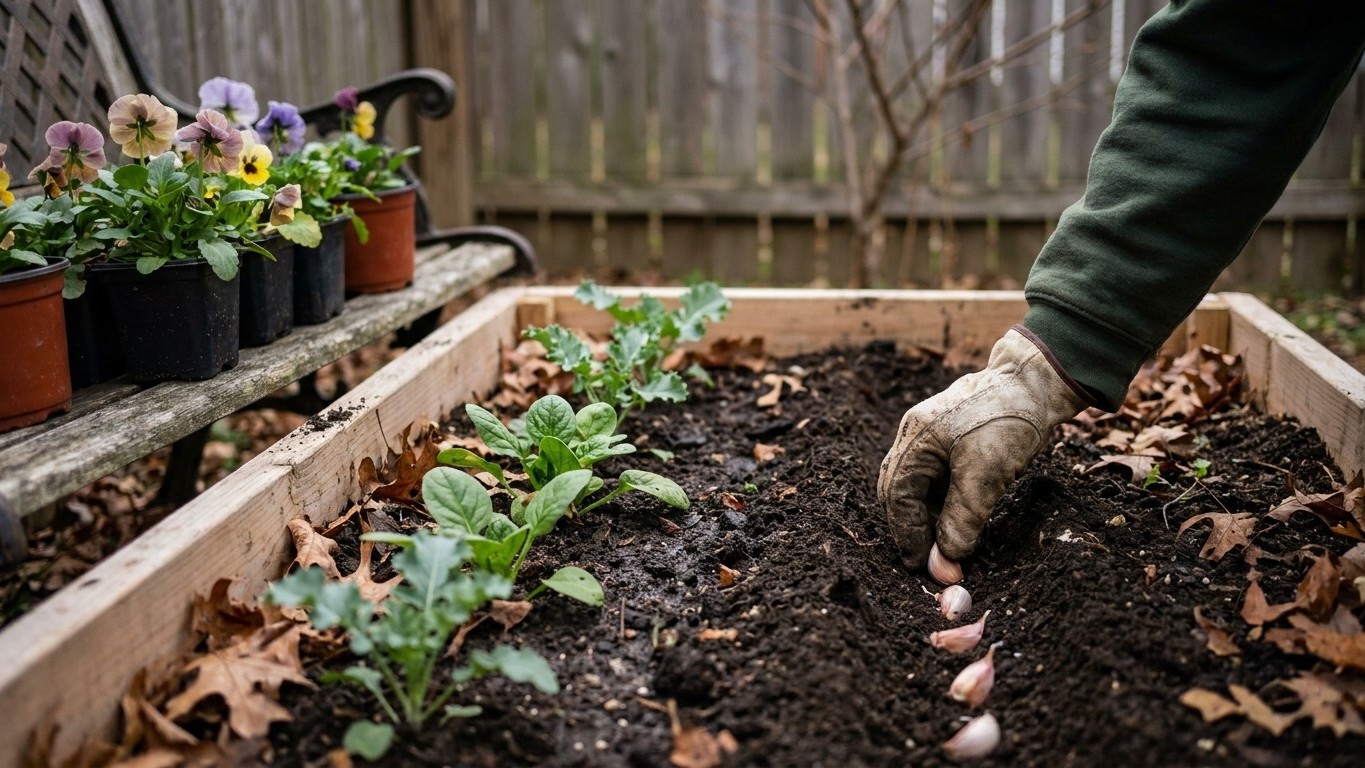

By October, the frost has typically already arrived in Saskatchewan, so the ground work now is about what survives dormancy, not what grows fast. Garlic and shallots still go in while soil is workable, cold frames stretch a few hardy greens, and bare-root stock and dormant divisions can be tucked in before the ground locks up. Everything else waits for spring.
What goes in the ground in October

The Saskatoon SRC station’s climate normals put the average first fall frost at September 18. That means most of October opens after the season’s tender-crop window has already closed on the calendar’s own terms, not because of a hard rule but because soil temperatures have usually dropped past the point where seeds germinate reliably outdoors. Air can still feel mild on a sunny afternoon, but the ground underneath tells a different story, and it’s the ground that decides.
So the honest answer for direct-sown or transplanted crops in open beds is short: almost nothing goes in fresh this month with any real chance of establishing before freeze-up. What does work is planting for dormancy rather than growth. Garlic cloves and shallot sets go into loosened, well-drained soil now, timed so they root before the ground freezes solid but don’t push green top growth that would only get burned back. Push them 2 to 3 inches deep, mulch heavily with straw once the surface has cooled, and let them sit through winter to sprout on their own schedule next spring.
Cold frames and low tunnels are the other real option. Under that cover, a narrow list of cold-hardy greens (spinach, mâche, arugula) can still be sown for a spring harvest, since the cover buffers soil temperature enough to let roots establish before true dormancy sets in. Bare-root fruit trees, canes, and perennial divisions can also go in if the supplier ships this time of year and the site drains well; they’ll sit dormant and start growing when the soil warms. Forcing rhubarb or chicory indoors, in a dark box with soil and warmth, is a reliable way to pull fresh stalks or chicons out of storage roots while the outdoor garden sleeps.
What to start under cover
Counting backward matters more than counting forward this time of year. Instead of working from the last spring frost (mean date May 18, still more than half a year off), work from how many weeks of open soil are left before the ground freezes hard under snow cover. In most seasons that’s a narrow window, often just a few weeks past the mean first frost date of September 18, before daytime soil temperatures drop below what fast-germinating cool-season seeds need.
That arithmetic favors quick, cold-tolerant crops sown directly into a cold frame or under a low tunnel right away rather than started separately indoors first. Spinach and mâche are the classic choices: both germinate in cool soil, put down roots fast, and then simply pause when daylight and temperature drop, resuming growth as soon as the cover lets in enough spring light. The goal isn’t a harvest before winter. It’s a head start that turns into the earliest possible spring picking.
The two failure modes are worth naming plainly. Sow too early relative to that shrinking window (which in practice means treating a mild early-October stretch as if it were still late summer) and the seedlings push soft, leafy growth that a hard freeze then kills outright, wasting both the seed and the effort. Sow too late, waiting past the point where soil still has workable warmth, and the seeds either fail to germinate at all or sprout without enough root mass to survive dormancy. There’s rarely a second chance once the ground stiffens, so this is not a job to leave for a warmer weekend that may not come.
What is ready to pick
Outdoors, the honest picture in October is thin. Most annual vegetable harvests are finished or close to it, and anything still standing in the open garden has likely already taken a frost hit. But the kitchen doesn’t have to go empty. Kale and leeks left in the ground actually improve after frost, since cold triggers the plant to convert starches to sugars, and both can often be pulled or cut well into the season as long as the ground isn’t frozen solid around the roots. Leeks in particular hold in place under a heavy mulch layer far longer than most gardeners expect.
Cold frames planted earlier in the fall, or ones still holding late-summer sowings, keep producing small cuts of spinach, lettuce, or mâche as long as the cover keeps ambient temperature above what the plants can tolerate. Indoors, sprouts and microgreens fill the gap with almost no equipment, just a tray, some seed, and a windowsill, and they’re ready to cut within a week or two of sowing regardless of what’s happening outside.
This is also the month to walk the root cellar or storage shelf with a critical eye. Squash should be firm with no soft spots or sunken patches, potatoes should feel solid and show no green tinge or sprouting, and onions should be dry-necked with no give when squeezed. Anything showing early rot needs to be pulled and used immediately rather than left to spread spoilage to the rest of the batch. A single soft squash in a bin can take out its neighbors within a couple of weeks if it’s not caught.
The jobs that matter this month

Dormant pruning is one of the highest-value jobs on the list, and October is close to the right window for it in many years, once leaves have dropped from fruit trees and cane berries but before the deepest cold sets in. Pruning now removes damaged or crossing wood while the plant’s energy is stored safely in the roots, and it’s far easier to see branch structure without foliage in the way. Cutting too early, while sap is still moving, invites dieback at the wound; that’s why this job trails leaf drop rather than a fixed date.
Seed ordering belongs on this month’s list too, even though it feels early. Popular varieties, especially open-pollinated and heirloom types from smaller seed houses, sell out well before spring planting season, and ordering now means the seed is in hand and ready rather than back-ordered when soil finally warms.
The rest of the list is unglamorous but pays off directly:
- Testing and amending soil while beds are empty, so amendments have all winter to integrate
- Turning finished compost into beds and starting a fresh pile with fall garden waste
- Cleaning and sharpening tools before they sit unused, and oiling metal parts against rust
- Repairing raised bed frames, trellises, and fencing while there’s no crop in the way
- Sketching next season’s crop rotation while this year’s layout is still fresh in memory
None of these are filler tasks. A pile of compost started now is ready by spring; one started in April is not.
What not to do in October
The most common mistake this month is trusting a warm afternoon over the calendar. A mild stretch can make garlic planting or mulching feel unnecessary, but soil temperature underground lags well behind air temperature, and waiting for it to “feel right” often means missing the workable window entirely before the ground locks up for winter.
A close second is pulling mulch or row cover off too soon after a stretch of unusually warm days. It happens most often with newly planted garlic beds or cold-frame greens: a week of sun convinces a gardener that winter protection isn’t needed yet, the cover comes off, and the next cold snap hits exposed crowns and seedlings hard. Cover goes on once soil has cooled and stays on; a few warm days in between don’t change that.
Feeding nitrogen at the wrong point causes its own damage. Any fertilizer heavy in nitrogen pushes soft, leafy growth, and that new growth has no time to harden off before a freeze arrives. Established perennials, fruit trees, and canes should be moving toward dormancy this month, not being encouraged to grow. If soil needs amending, do it with compost or a balanced, lower-nitrogen product, and save any nitrogen-heavy feeding for spring when growth is actually wanted.
Finally, don’t let stored crops sit unchecked because the harvest itself felt like the finish line. A squash or potato that starts to soften in storage keeps deteriorating whether or not anyone looks at it, and a monthly check takes minutes compared to the loss of a whole bin.
Checking this against your own county
A province-wide picture is a starting point, not an instruction. Saskatchewan’s hardiness zone sits at 3a on the Canadian system near Saskatoon, but elevation, proximity to lakes, and simple north-south distance shift frost windows by weeks across the province. A garden near the Alberta border or in the north can lag well behind the Saskatoon-area normals used here, while sheltered spots in the south may run ahead of them.
Before committing to any of the timing above, check it against the Saskatchewan Ministry of Agriculture’s own resources for regional guidance, since local advisors track conditions county by county in a way a province-wide average never can.
Saskatchewan Ministry of Agriculture
Common questions
Is it too late to plant garlic in October in Saskatchewan?
Not usually, as long as the soil is still workable. Garlic is planted specifically for dormancy over winter, so the goal is root establishment before hard freeze, not top growth. Once the ground stiffens enough that a shovel won’t go in, the window has closed for the season.
Can vegetables started under cover in October actually survive winter?
Cold-hardy greens like spinach and mâche can pause growth under a cold frame or low tunnel and resume in spring, provided they got enough root development before the coldest weeks hit. They aren’t growing through winter so much as waiting it out under protection.
Why did my leeks or kale taste better after frost?
Cold triggers these plants to convert stored starches into sugars, which softens their flavor. It’s a normal response, not a sign of damage, and it’s part of why gardeners deliberately leave both crops in the ground past the first frost.
What’s the single most important job to not skip this month?
Checking stored produce for early rot. A single soft squash or sprouting potato left in a bin can spread spoilage to everything around it within a couple of weeks, undoing an entire season’s storage effort in a way that’s easy to prevent with a quick monthly check.
Gardeners who plant by the Moon can check the October 2026 moon planting calendar, a tradition rather than a proven method.
Related guides
- the Saskatchewan planting calendar
- What to Plant in Saskatchewan in September
- What to Plant in Saskatchewan in November
Elsewhere? See what to plant in October in every state and province.