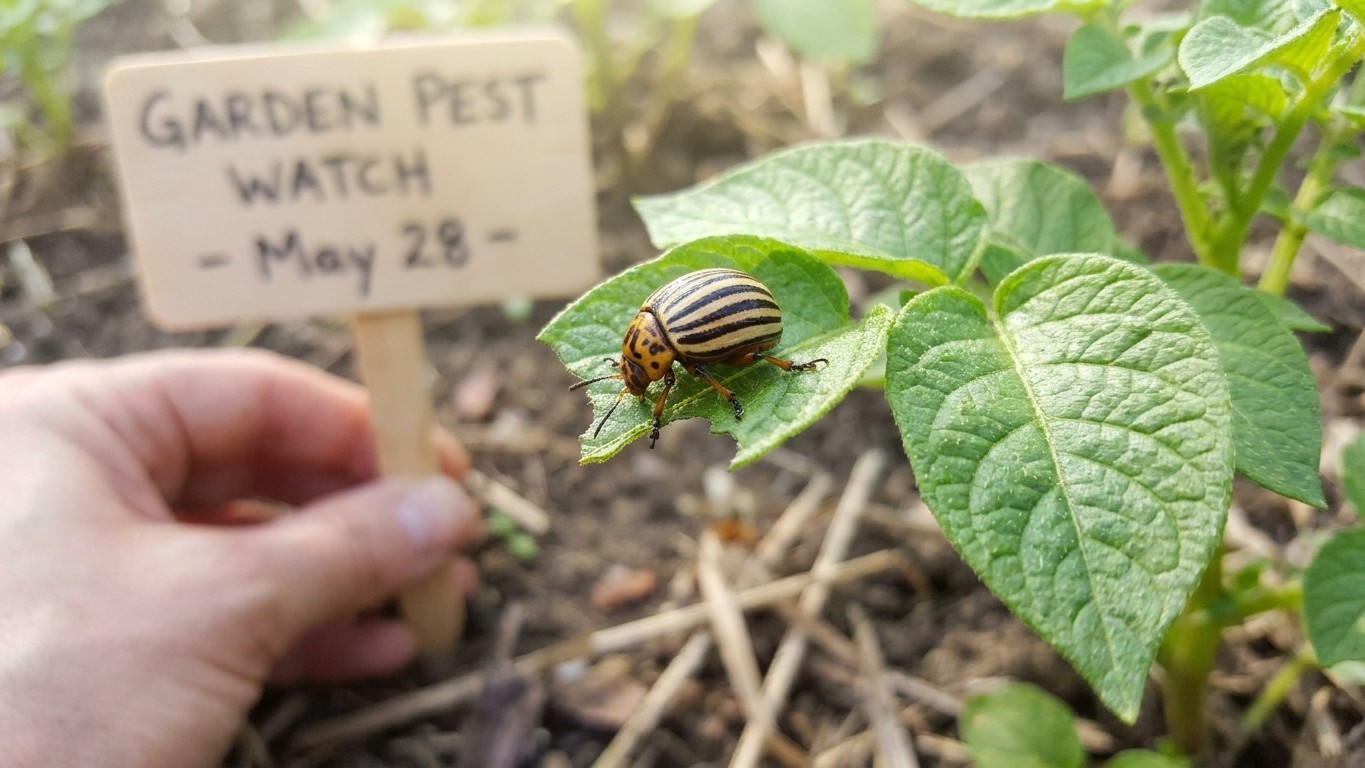

Colorado potato beetles typically emerge in Saskatchewan fields and gardens between mid-May and early June, once soil temperatures climb past 50°F. By the time potato plants push through the ground, the overwintered adults are already crawling out of the soil, hunting for the first tender leaves. Stopping them comes down to three things done in sequence: rotating where you plant, physically blocking the beetles from walking into new beds, and catching the first generation before it lays eggs.
That sounds simple. It rarely plays out that way in a province where potato acreage is concentrated in a handful of irrigated pockets, and where a warm July can squeeze in a partial second generation that catches growers off guard.
When Colorado Potato Beetles Show Up in Saskatchewan

The beetle overwinters as an adult, buried six to eight inches down in the soil of last year’s potato field or along field margins. It doesn’t fly much in spring. Instead, it walks. That single fact shapes almost every control strategy used on the Prairies.
Emergence timing tracks soil warmth more than the calendar. In a mild spring, beetles can be out and feeding by the third week of May around Saskatchewan’s main potato-growing zone near Outlook and the Lake Diefenbaker irrigation district. In a cold, wet spring, that first appearance slides into mid-June. Once out, adults feed for one to two weeks before mating and laying eggs, which arrive in tight clusters of 20 to 40 on the underside of leaves, bright orange-yellow and hard to miss if you’re checking plants closely.
Eggs hatch in four to nine days depending on temperature. The larvae then go through four growth stages over roughly two to three weeks, and this is the window that does the real damage. A single larva can strip a leaf clean in days, and a heavy infestation defoliates a potato row fast enough to cut yield noticeably if it hits during tuber bulking.
One Generation, Sometimes Closer to Two
Saskatchewan’s shorter, cooler growing season usually limits the beetle to one full generation per year, unlike warmer regions in the eastern Prairies or the northern US where two generations are routine. But in a hot, dry summer, enough of the first generation’s offspring reach adulthood early enough to start a partial second wave in August. Growers who assume the season is over after the July larvae disappear sometimes get caught by this second flush right before harvest, when new adults are simply feeding to build fat reserves for winter rather than reproducing.
Where the Pressure Is Worst in the Province
Colorado potato beetle pressure in Saskatchewan isn’t spread evenly. Commercial potato production concentrates around the irrigated land near Outlook, Lucky Lake, and Elrose, where reliable water from Lake Diefenbaker supports the intensive rotations potatoes need. That concentration of host plants, year after year, in a relatively compact area, gives the beetle a stable population base to work from.
Home gardens scattered across Saskatoon, Regina, Prince Albert, and smaller towns face a different dynamic. Isolated plots see lighter, more sporadic pressure because there’s less continuous host material for the beetle to build up on. But an individual garden with no rotation and a potato patch in the same spot for five straight years can end up with a beetle population just as stubborn as anything in a commercial field, just on a smaller scale.
Compared to Manitoba, where potato acreage is roughly triple Saskatchewan’s and the climate runs slightly warmer and wetter, Saskatchewan growers generally deal with lower overall beetle pressure. That’s a modest advantage, not immunity. The insect has been established in the province for decades and shows no sign of losing ground.
Identifying the Beetle at Each Stage
Adults are hard to confuse with much else in a potato patch. They run about three-eighths of an inch long, rounded, with a yellow-orange body and ten black stripes running lengthwise down the wing covers, five per side. The head carries irregular black spots.
Larvae look nothing like the adults. Young ones are dark red with black heads; as they grow through their four stages they turn orangish-pink, plump, and soft-bodied, with two rows of black spots along each side. They’re the stage that does the most chewing, and they’re the stage most gardeners notice first, usually because half a plant’s foliage is suddenly gone.
Eggs cluster in tidy groups on leaf undersides, bright yellow-orange, oval, and standing on end. Checking the undersides of leaves once a week starting in late May catches these clusters before they hatch, which is the single most effective scouting habit a home grower can build.
What Actually Stops the Colorado Potato Beetle
No single tactic handles this insect on its own. It has beaten nearly every insecticide class thrown at it somewhere in North America over the past seventy years, including organophosphates, carbamates, pyrethroids, and in some populations, neonicotinoids. Resistance builds fast because the beetle produces several generations across its range and because it’s been under chemical pressure since DDT was still in use. Saskatchewan populations haven’t shown the extreme resistance documented in parts of the northeastern US, but relying on one product year after year is a documented path toward exactly that outcome.
Crop Rotation Does the Heavy Lifting
Because overwintered adults walk rather than fly to find food, moving the potato planting even a quarter mile from the previous year’s site forces beetles to cross open ground to reach it. Many don’t make it, or arrive late enough that early scouting and spot treatment can catch the rest. A rotation of at least 200 yards away from the prior potato field, ideally paired with a two- or three-year gap before potatoes return to that soil, is the baseline recommendation from provincial agriculture extension programs across the Prairies.
Physical Barriers and Trap Strategies
Some commercial operations dig plastic-lined trenches around field perimeters, since walking beetles fall in and can’t climb the smooth sides back out. On a garden scale, straw mulch spread thickly around potato plants makes it harder for beetles to locate host plants by sight and scent, and floating row covers installed right after planting keep the first wave of walking adults out entirely, provided the edges are sealed into the soil.
Trap cropping, planting a small early block of potatoes a few weeks ahead of the main crop, draws emerging adults to a concentrated area where they can be handpicked or treated, leaving the main planting largely untouched.
Biological and Manual Control
Ladybird beetles and predatory ground beetles feed on Colorado potato beetle eggs and young larvae, and encouraging these predators by avoiding broad-spectrum insecticide sprays helps keep populations in check naturally. Bacillus thuringiensis var. tenebrionis, a bacterial insecticide specific to leaf beetles, kills young larvae without harming most beneficial insects, and it’s widely available for home garden use.
Handpicking remains genuinely effective for gardens under an acre. Adults and larvae dropped into soapy water don’t come back, and a weekly check through June catches the population before egg-laying gets ahead of you. It’s tedious. It also works, which is more than can be said for some of the chemical options after decades of resistance development.
Timing Your Intervention
The narrow window that matters most runs from first adult emergence through early larval stages, roughly mid-May through mid-June in most of Saskatchewan. Acting during this stretch, whether that means installing row covers before beetles arrive, scouting for and crushing egg clusters, or applying Bt to newly hatched larvae, prevents the population from building toward the damaging third and fourth larval stages that strip plants fastest.
Waiting until visible defoliation shows up means dealing with larger, tougher larvae that are harder to control with biological products and closer to pupating, which restarts the cycle. Fall tillage that disturbs the top several inches of soil in and around former potato beds can also expose overwintering adults to freezing temperatures and predators, trimming next spring’s starting population before it ever gets moving.
Related guides
- Colorado potato beetle in Manitoba: When It Shows Up and What Stops It
- Colorado potato beetle in South Dakota: When It Shows Up and What Stops It
- Colorado potato beetle in Tennessee: When It Shows Up and What Stops It