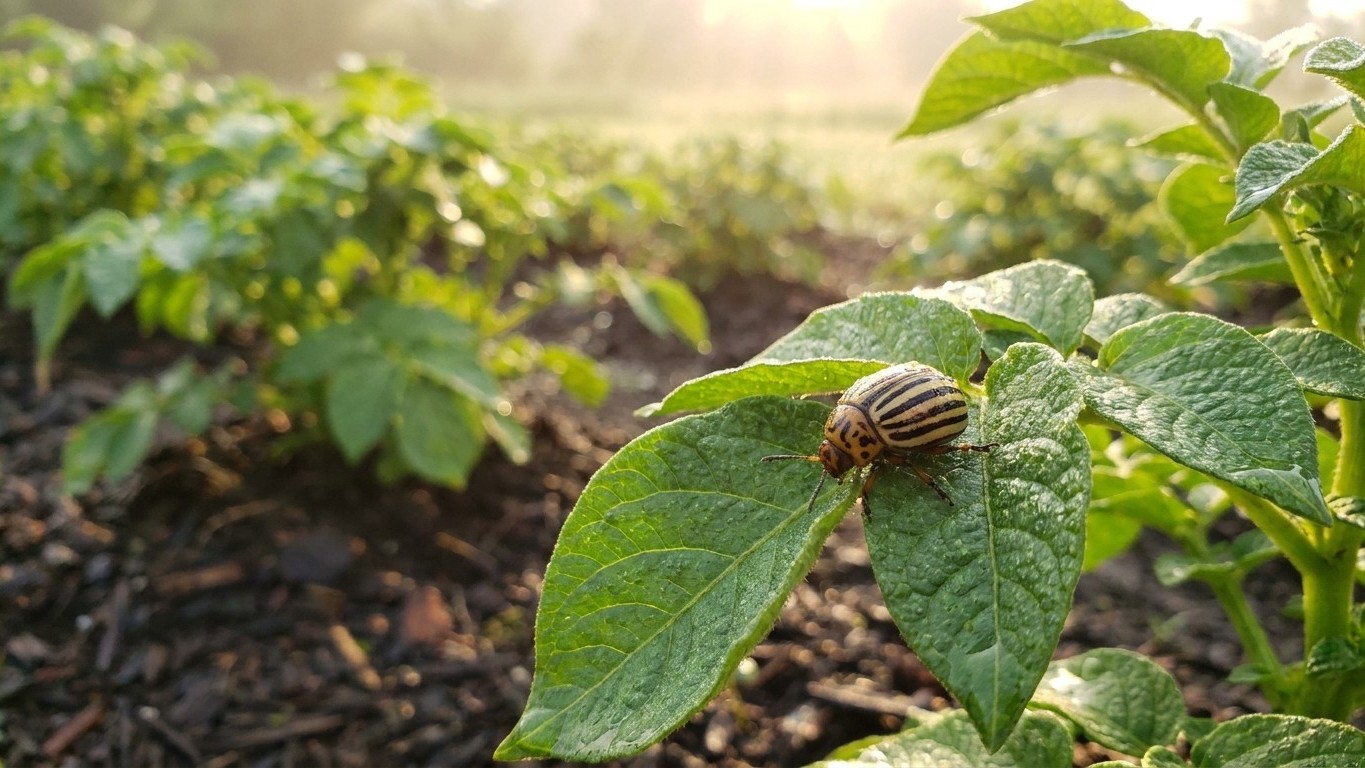

Colorado potato beetles typically emerge in South Dakota between mid-May and early June, once soil temperatures climb past 50°F and volunteer potato plants or early transplants break ground. The state’s shorter growing season usually limits the pest to one full generation with a partial second wave by late July, giving growers a narrower but still critical window to catch them before they strip a potato patch bare.
When Colorado Potato Beetles Actually Arrive in South Dakota

These beetles don’t fly in from somewhere else each spring. They overwinter right in your soil, burrowed six to eight inches down as adults, waiting out the Dakota winter in a state of near-dormancy. Once the ground thaws and daytime temperatures hold steady in the 50s, they dig out and start walking. Some populations also take short flights on warm, still afternoons to find fresh host plants, which is why beetles can show up in a garden that had none the year before.
In eastern South Dakota counties like Minnehaha, Brookings, and Lincoln, emergence tends to run slightly earlier than in the western part of the state, tracking with soil warm-up patterns. Growers around Rapid City and the Black Hills foothills often see beetles a week or two later, sometimes not until the first week of June, because cooler nighttime temperatures slow that soil warming process.
Once the overwintering adults find host plants, mostly potatoes but also tomatoes, eggplant, and even some nightshade weeds, they mate and the females start laying. A single female can lay 300 to 500 eggs over her lifetime, dropped in tidy orange-yellow clusters on the undersides of leaves. Those eggs hatch in four to nine days depending on temperature, and the resulting larvae are the real damage engine. A short, hot stretch in June can compress this whole cycle, so scouting weekly rather than monthly makes a real difference in South Dakota’s variable spring weather.
One Generation or Two?
South Dakota’s growing season, generally frost-free from mid-May to late September in the southeast and shorter in the northwest, usually supports one complete generation of Colorado potato beetle plus a partial second generation. Compare that to states like Iowa or Nebraska, where two full generations are common. This matters for timing: the first generation of new adults typically emerges from the soil in mid-to-late July, and whether a second wave of egg-laying happens depends heavily on how warm August runs. In a hot, dry year, expect that second push. In a cooler, wetter year, the first generation may be the only one that matters.
Identifying the Beetle and Its Damage Stages
Adult beetles are hard to mistake once you know what to look for: about 3/8 inch long, with a rounded, oval body striped in black and cream-yellow down the wing covers. Ten black stripes total, five per wing cover, is the classic count. The larvae look completely different: humpbacked, brick-red to orange grubs with two rows of black spots along each side, growing from pinhead size to nearly half an inch over about three weeks.
Damage shows up fast once larvae hatch. A potato plant that looked fine on Monday can be reduced to bare stems by the following weekend during a heavy infestation, because larvae feed almost continuously through their four growth stages before dropping to the soil to pupate. Research from land-grant universities in the Northern Plains has shown that potato plants can tolerate some defoliation early in the season without major yield loss, but losing more than 20 percent of leaf area during tuber bulking (typically July in South Dakota) cuts yields noticeably.
Here’s what to check for during a five-minute walk through the patch:
- Orange-yellow egg clusters (usually 20-30 eggs) on leaf undersides
- Humpbacked red-orange larvae with black spots, clustered near feeding damage
- Adult beetles mating or feeding on upper leaves, often in pairs
- Skeletonized leaves with only the veins remaining
- Overwintered adults near the soil line at the base of plants in early spring
What Actually Stops Colorado Potato Beetle in South Dakota Gardens
Crop rotation is the single most effective non-chemical tool, and it works because of how these beetles overwinter. Since adults burrow into soil near where they fed the previous season, moving your potato bed even 30 feed away, ideally further, forces newly emerged beetles to walk to find host plants. A lot of them don’t make it, or they arrive late enough that early hand-picking has a real shot at controlling the population before eggs hatch.
Hand-picking still works surprisingly well for home gardeners and small market growers, particularly for knocking down that first wave of overwintered adults before they lay eggs. Dropping beetles into a bucket of soapy water each morning for the first two or three weeks after emergence can prevent the bulk of the season’s egg-laying. It’s tedious. It’s also free, and it doesn’t build resistance the way repeated insecticide applications do.
Straw mulch has shown a measurable effect in field trials, reducing beetle colonization by disrupting the beetles’ ability to locate host plants visually and by creating habitat for predatory insects like ground beetles and spiders. A three- to four-inch layer applied after plants are established gives a modest but real reduction in beetle pressure.
Biological and Chemical Options
Bacillus thuringiensis subspecies tenebrionis (sometimes labeled Bt-t or Btsandiego) targets young larvae specifically and has minimal impact on beneficial insects, making it a solid choice for gardeners trying to protect pollinators and natural predators. It works best applied when larvae are small, in the first two growth stages, since older larvae are less susceptible.
Neem-based products and spinosad are other options with lower toxicity profiles, though spinosad can affect bees if applied while plants are flowering, so evening application after bees have left the field reduces that risk.
Synthetic insecticides remain widely used on commercial potato acreage, but resistance is a documented, serious problem with this particular pest. The Colorado potato beetle has developed resistance to more insecticide classes than almost any other agricultural pest in North America, according to entomology research tracked through university extension programs. Rotating chemical classes between generations, rather than using the same product repeatedly, is standard guidance from extension entomologists to slow further resistance development. The EPA’s pesticide safety guidance is worth reviewing before applying any product, particularly around application timing near harvest.
Row covers offer strong protection for smaller plantings, physically excluding both overwintered adults and later flying beetles. The catch: covers need to come off during flowering if the potato variety benefits from pollinator visits, and they need to be sealed tightly at the edges, since beetles that find a gap will exploit it fast.
Regional Notes for South Dakota Growers
Soil type plays a bigger role in overwintering survival than most gardeners expect. Sandy, well-drained soils, common in parts of central South Dakota, allow beetles to burrow deeper and survive harsh winters more reliably than the heavier clay soils found in parts of the southeast. Growers on sandy ground may see more consistent beetle pressure year over year for that reason.
Late blight and other potato diseases sometimes get confused with beetle damage in early diagnosis, but the two are easy to tell apart once you know the difference. Blight damage shows dark, water-soaked lesions and fuzzy white growth in humid conditions, while beetle damage is purely mechanical, chewed leaf tissue with no discoloration beyond the feeding site itself. South Dakota State University Extension offers regional pest monitoring resources that track both issues across the growing season, which can help growers distinguish between the two when damage first appears.
Timing insecticide or Bt applications around rainfall matters more in South Dakota than in drier Western states, since summer thunderstorms can wash off contact products within hours of application. Checking a forecast before spraying, and reapplying after a heavy rain event, prevents wasted product and wasted time.
Volunteer potatoes left in the ground from a previous season’s harvest are a commonly overlooked beetle magnet. Tubers missed during digging can sprout the following spring and give overwintered beetles an early, unmonitored food source well before the main crop goes in. Walking harvested beds in early spring and removing any volunteer sprouts closes that gap.