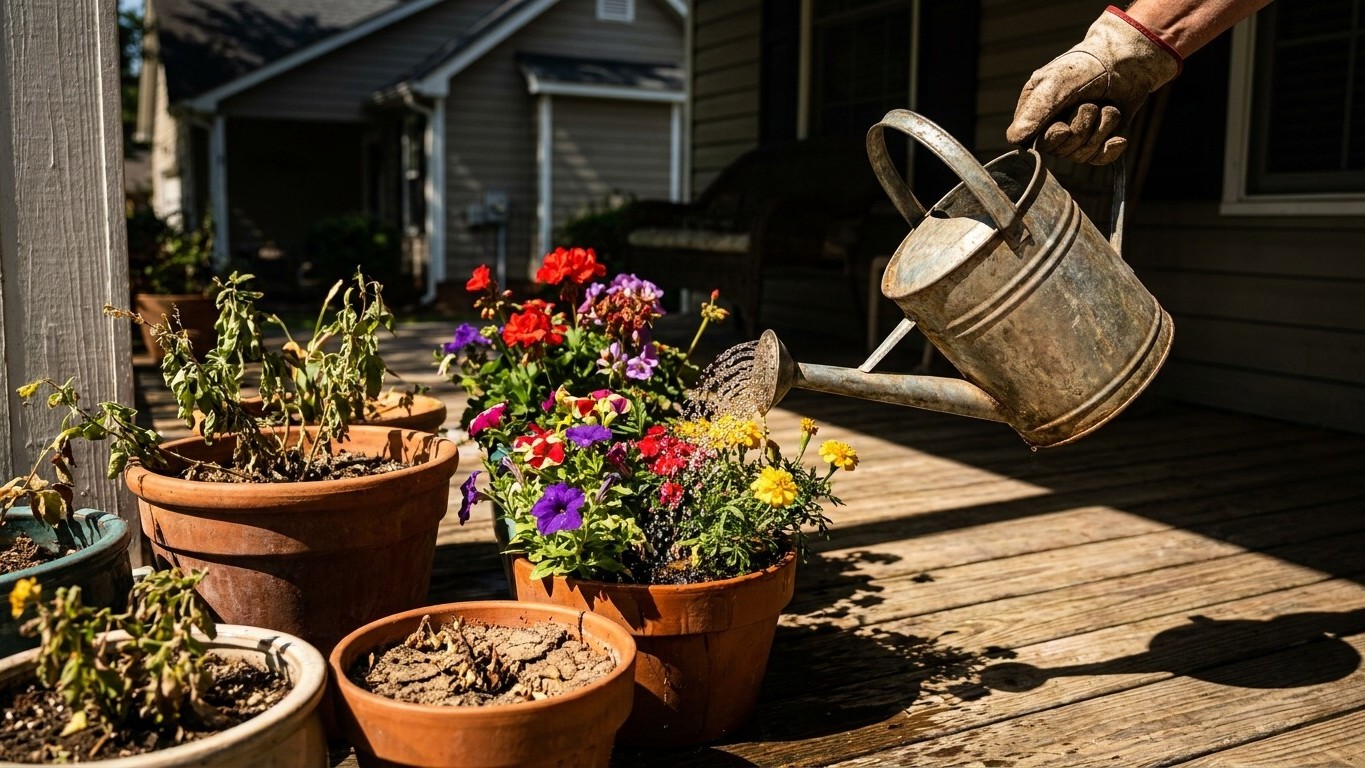

South Carolina’s summers push soil moisture in two directions at once: real rainfall on paper, but heat and small root zones that burn through it fast. Pots and containers feel this more than garden beds because their soil volume is tiny and their sides sit exposed to full sun. Watering here means checking the pot, not the sky.
What changes here

Two numbers set the stage. The driest summer month at the reference station is June, with 6.21 inches of rain. And the state averages 55.1 days a year at or above 90F. Put together, that’s a month with real rainfall on the calendar but enough heat load to pull moisture out of a container faster than any rain gauge suggests.
Do the arithmetic on that June figure. Spread across a 30-day month, 6.21 inches works out to roughly 1.45 inches for an average seven-day week, which on paper clears the rule of thumb that a bed wants about an inch of water a week. A garden bed with deep soil can bank some of that. A pot cannot. Container watering doesn’t average out over a month; it resets every time the mix dries, and on a 90-degree afternoon that can happen in a single day for a small pot.
That June rain also tends to arrive as a thunderstorm rather than a steady soak, and a downpour that dumps half an inch in twenty minutes mostly runs off the surface of a potting mix and out the drainage holes before it has time to wet the root ball. Add an overhang, a porch roof, or a fence line, and a container can miss a storm entirely while the ground six feet away gets soaked. The lesson from these two figures together: rainfall totals for South Carolina describe the region, not the pot sitting on a deck under an eave.
One more distinction matters for containers specifically. Native South Carolina soil, whether sandy along the coast or heavier clay farther inland, only affects plants growing directly in the ground. A container plant lives in bagged potting mix, which drains and dries at roughly the same rate whether the pot sits in Charleston or Greenville. The state’s heat and rainfall numbers still apply to the pot; the state’s soil type mostly doesn’t.
How to water when it matters
Deep, infrequent watering at the base, done in the morning, works for one reason: it pushes moisture through the entire root ball instead of just wetting the top inch, so roots grow down into the pot rather than clustering at the surface where heat and sun reach them first. Morning watering also gives foliage time to dry before evening, when cooler air and still conditions let dampness sit on leaves overnight and invite fungal disease.
Checking the surface of the mix tells a gardener almost nothing in a South Carolina summer. The top half-inch can look bone dry within hours of watering while the root zone two inches down is still damp, or the reverse can happen after a light shower. A finger pushed two inches into the mix, or a trowel tip pulled up from the same depth, is the only reliable test. If it comes up dry, water. If it’s still cool and moist, wait.
The rhythm depends on the pot and the potting mix, but the pattern is consistent: small containers with little soil volume dry fastest and need shorter, more frequent watering, sometimes daily once the state’s 55.1 days above 90F start stacking up in July and August. Larger containers and anything with a moisture-retentive mix can go longer between waterings, but they also punish overwatering more, since a pot with poor drainage holds water at the bottom and drowns roots exactly the way waterlogged clay does in a garden bed.
- Push a finger or trowel tip two inches into the mix before watering; water only if that depth is dry.
- Water slowly at the base until it runs from the drainage holes, not just until the surface looks wet.
- Water in the early morning, before the day’s heat starts pulling moisture back out.
- Start with daily checks on small containers and every-second-day checks on larger ones once temperatures push past 90F, then adjust based on what the finger test actually shows.
- After a summer storm, still check with a finger before assuming the pot got enough; a downpour that ran off the surface can leave the root ball dry.
That daily-check starting point is exactly that, a starting point. Pot material, mix type, and how much sun a spot gets all shift the real number, and only the finger test settles it for a specific container.
What goes wrong
Watering a little every day
A quick daily splash wets the top inch of mix and stops there, training roots to stay shallow near the surface instead of growing down where moisture and cooler temperatures last longer. Those shallow roots are the first to scorch on a 90-plus-degree afternoon, which given the state’s 55.1 such days a year is a mistake that costs more here than almost anywhere else.
Wetting the leaves in the evening
Overhead watering after work feels convenient, but wet foliage sitting through a warm, still South Carolina night is an open invitation to fungal disease. Water at the base, not the leaves, and do it early enough in the day that anything splashed upward has hours to dry.
Trusting a summer thunderstorm
A hard rain that looks soaking from a window often wets only the top half-inch of a container’s mix before running off the sides or out the drainage holes. Overhangs and roof lines make it worse by blocking pots from rain that reaches the rest of the yard. The finger test, not the sound of rain on the roof, is what confirms a pot actually got watered.
Letting a waterlogged pot sit
With close to 20 inches of rain across a South Carolina summer, the opposite failure shows up too: a container without good drainage, or one left sitting in a full saucer after a storm, keeps roots wet for days. Roots that never dry out suffocate and rot just as surely as dry ones scorch, so a pot that stays soaked after rain needs its saucer emptied, not another round of sun.
Local help
Clemson University’s Cooperative Extension Service is South Carolina’s land-grant resource for home gardening and container-plant questions, with county offices and published guides at clemson.edu/extension. Watering restrictions tied to drought or municipal supply vary by district and change through the season, so check current rules with the local water provider rather than assuming a statewide standard applies.
Common questions
How often should I water container plants in South Carolina summer heat?
Check the mix two inches down daily on small pots and every second day on larger ones once temperatures push past 90F, then water only when that depth is dry rather than on a fixed schedule.
Does South Carolina’s summer rainfall mean I can skip watering pots?
Not reliably. Even June’s 6.21 inches often arrives as thunderstorms that run off a container’s mix rather than soaking the root ball, and overhangs can block pots from rain entirely.
Does South Carolina’s clay or sandy soil matter for container gardening?
Only for plants growing directly in the ground. Container plants live in potting mix, which drains and dries at a similar rate regardless of the native soil underneath the pot.
What’s the biggest watering mistake for pots in South Carolina?
Light daily sprinkles that wet only the surface, training roots to stay shallow where the state’s 55.1 days a year above 90F can scorch them fastest.