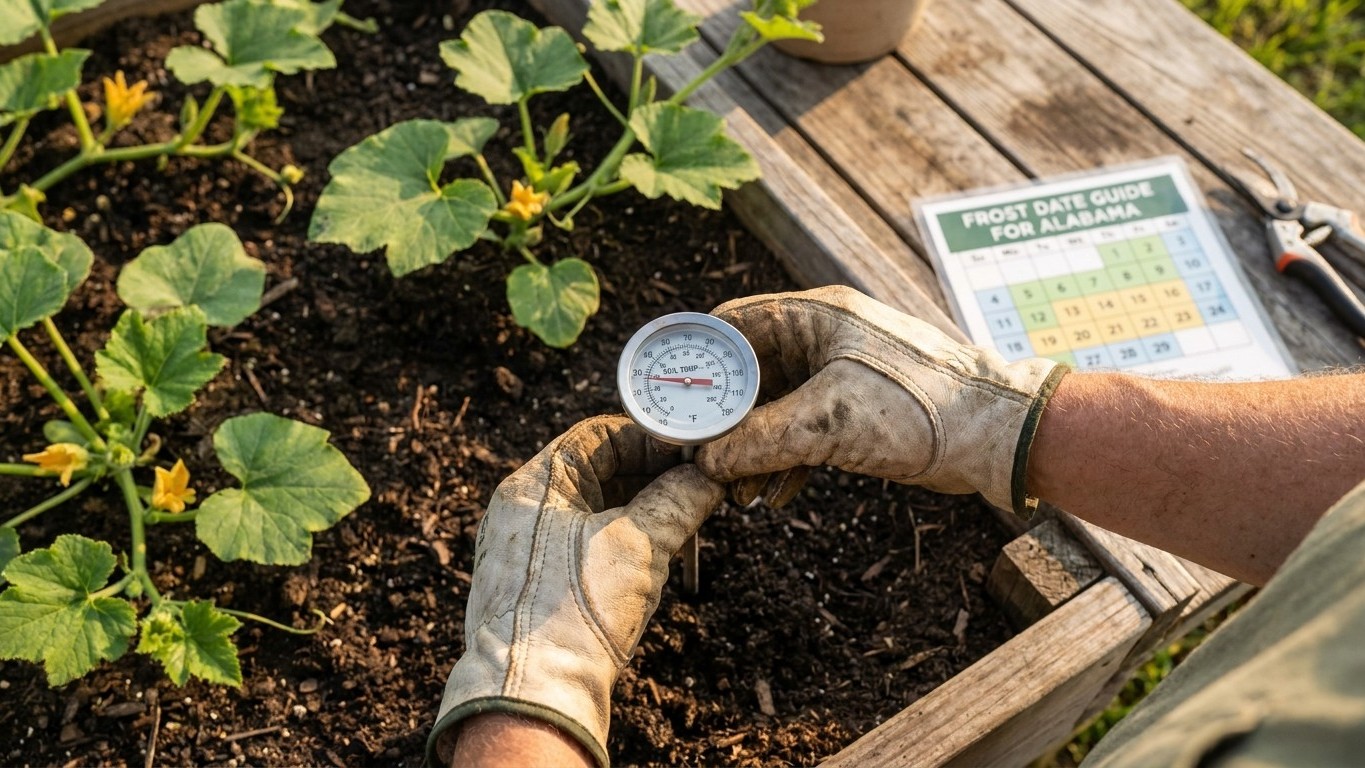

South Carolina gardeners sow pumpkin seed outdoors once soil holds at 65°F, which lands somewhere in mid-spring depending on where the garden sits. That date isn’t picked at random. It’s built backward from the state’s first fall frost, which arrives anywhere from November 20 to December 5 depending on location. Since a pumpkin flower needs 45 to 55 days to become a ripe fruit, the sowing window has to leave enough room for the vine to grow, bloom, and finish coloring before that frost line closes the season.
The short answer
South Carolina’s first fall frost lands somewhere between November 20 and December 5, based on 1991-2020 climate normals recorded at station USW00013880. That six-week spread matters more than it looks. It’s the line every pumpkin vine in the state is racing against, and it shifts depending on geography. Peninsular Charleston, buffered by the harbor, tends to see frost arrive on the later end of that window or later still. The Upstate, farther from the coast and higher in elevation, typically freezes weeks earlier in fall and thaws weeks later in spring, squeezing the growing season from both ends.
What the frost date actually controls isn’t sowing. It’s flowering. Once a pumpkin flower opens and gets pollinated, the fruit behind it needs 45 to 55 days to mature and harden its skin, according to Utah State University Extension. That window runs from bloom, not from the day the seed went into the ground. So the math that decides the season isn’t a fixed count of days from planting. It’s counting backward 45 to 55 days from frost to find the last date a flower can safely open.
Run the numbers against South Carolina’s frost window and the picture sharpens. Counting 55 days back from November 20 lands in late September. Counting 45 days back from December 5 lands in late October. That gives a working range: somewhere between late September and late October, the state’s pumpkin flowers need to stop opening for the first time and start finishing instead. Gardeners closer to the coast, where frost holds off longest, can lean toward the back end of that range. Gardeners in the Upstate, where frost lands earlier and harder, should treat the front end as the real deadline, not the average.
None of this sets a specific sowing day, that’s a separate calculation built on soil temperature, not frost date. But it explains why a patch that still looks green and busy in October can quietly fail. If the vine keeps throwing new flowers past that cutoff, those late blooms are decorative. They won’t have time to become anything but green fruit killed by frost.
When to sow here
Sowing date in South Carolina isn’t set by the calendar square marking the last frost. It’s set by the soil itself, and soil warms on its own timeline, well behind the air above it.
- Let the last frost window close first. South Carolina’s last spring frost falls between February 28 and March 17, per the same NOAA NCEI normals used for the fall date. That’s the earliest boundary, not the sowing date itself.
- Wait for soil, not air, to reach 65°F. Air temperature can clear the frost mark weeks before the ground underneath actually warms enough for pumpkin seed to germinate reliably. Soil holds cold longer than air does, so sowing the week after the last frost often means sowing into ground still too cool to work.
- Expect the real sowing window to land well after frost clears, not on it. In practice that pushes direct sowing into mid-spring across most of the state, closer to the earlier side of that stretch in the Lowcountry, where soil warms fastest, and later across the Upstate and Midlands, where cooler nights hold soil temperature down longer.
- Use row covers to move the date earlier, by about two weeks. Clear or lightweight row cover traps solar heat against the soil surface during the day, which speeds warming underneath. That doesn’t change when the last frost happened. It changes how fast the soil under the cover catches up to 65°F, buying roughly two weeks against the uncovered timeline.
- Check with a soil thermometer instead of a date on a calendar. The lag between frost and 65°F soil shifts every season with weather, so the only reliable way to know the ground is ready is to measure it directly at planting depth, over several consecutive days rather than a single warm morning.
What goes wrong here
South Carolina’s season length causes a specific set of failures, and each one traces back to the same 45-to-55-day clock running out of room.
- A late flower that never colors. When vines keep blooming into October, some of those flowers open past the point where 45 to 55 days remain before frost. The fruit behind them stays green and hard, because it never gets enough warm days to finish. The remedy is to count backward from the local frost window at planting time and treat any bloom opening after that deadline as decorative: pinch it off so the plant’s energy goes into fruit already set, rather than fruit that will never ripen.
- A fruit caught by frost. Even a well-timed fruit can still be on the vine when the first hard frost arrives, since South Carolina’s window runs from November 20 to December 5 and vines don’t always finish exactly on schedule. Utah State University Extension recommends harvesting with the stem attached before frost hits, then storing the fruit somewhere it will not freeze. That guidance carries no specific storage temperature or humidity figure, only that instruction, so the safest reading is to check fruit regularly as frost approaches rather than rely on a fixed number that isn’t published here.
- A vine that dies back before the skin hardens. Pumpkin skin needs a living, functioning vine to finish curing. When the vine collapses early, whether from disease pressure, pest damage, or simple exhaustion late in the season, the fruit is left exposed with a soft, unfinished rind. Squash bugs and cucumber beetles are common causes of that early collapse in South Carolina gardens, and both pests already have dedicated pages on this site covering identification and control. The remedy here is prevention earlier in the season rather than a late-season rescue, since a vine already dying back has little time left before frost closes the window anyway.
Common questions
Can pumpkins still be sown in South Carolina in early summer?
The math gets tight fast. Working backward 45 to 55 days from a fall frost that arrives between November 20 and December 5 means flowers need to open by late September at the latest in most parts of the state, earlier still in the Upstate. Sowing much past early summer leaves little cushion for the vine to grow before it needs to start blooming for the last time.
Which pumpkin varieties show up in South Carolina gardens?
Home gardeners across the state commonly grow varieties such as Connecticut Field, Jack Be Little, Howden, Big Max, Cinderella, Baby Pam, Small Sugar, Autumn Gold, and Jarrahdale. These are names growers will recognize on seed packets, but no maturity length, size, or color data is attached here for any of them. Whatever variety gets chosen, the same 45-to-55-day post-flowering clock and the same statewide frost window still apply.
Is starting pumpkin seed indoors worth it in this state?
Starting seed indoors moves the sowing decision earlier on the calendar, but the seedling still has to go into ground that has already reached 65°F. Since soil in South Carolina lags well behind the last frost date rather than following it directly, an indoor start doesn’t shortcut that soil-temperature requirement. It only changes where the seed spends its earliest days.
What happens if frost arrives before the fruit is fully colored?
Utah State University Extension’s guidance is to harvest with the stem attached before frost hits, then keep the fruit somewhere it will not freeze. That source doesn’t publish a storage temperature, humidity level, or keeping time, only that single condition. Given South Carolina’s frost window runs from November 20 to December 5, checking vines closely as that stretch approaches matters more than waiting for a perfect finish.