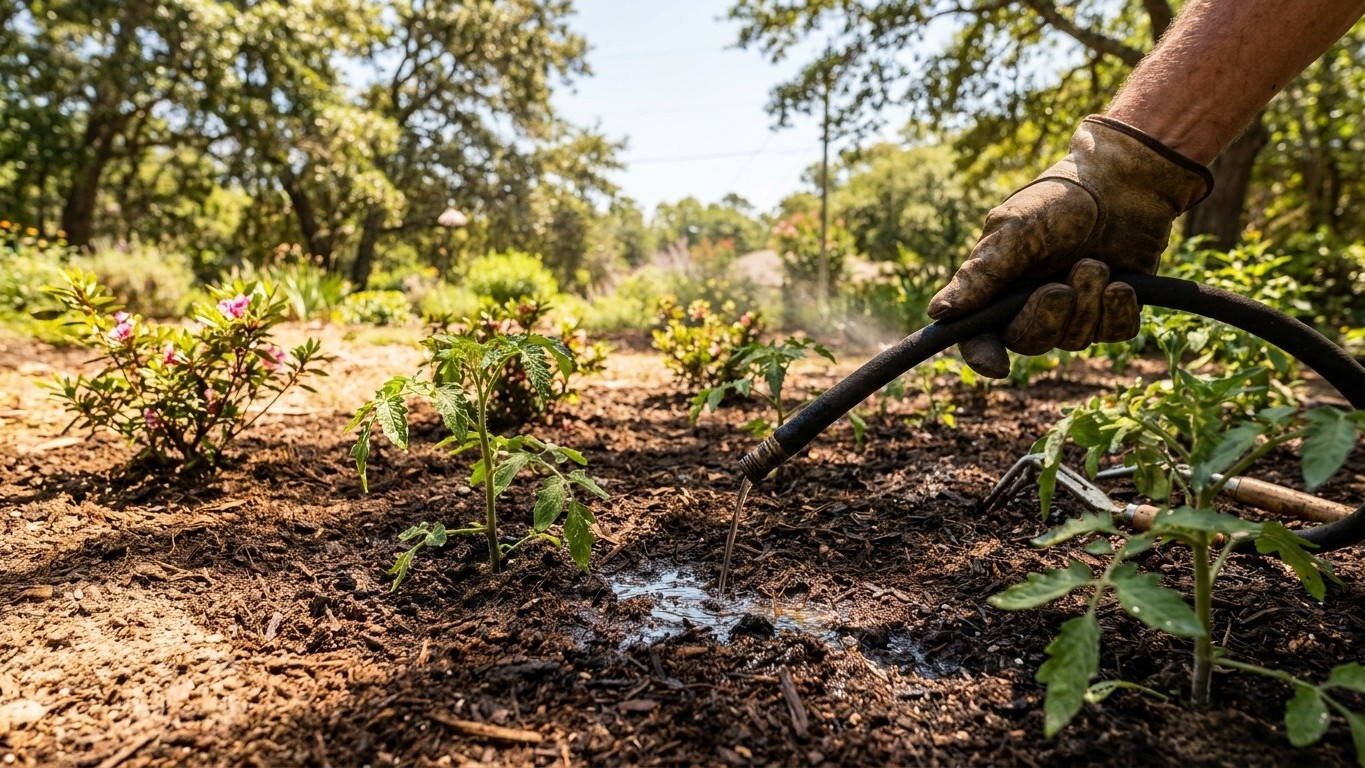

South Carolina gardens don’t fail from lack of effort. They fail from watering on a schedule instead of watering by what the soil and the sky are actually doing. The short answer: most beds want about an inch of water a week, delivered deeply and infrequently, with the exact frequency set by your soil texture, the season, and whichever water restrictions your local utility has posted.
What the climate asks of you

Two numbers do most of the deciding in a South Carolina garden, and they don’t point the same direction. The first is heat: at the Charleston reference station, an average of 55.1 days a year reach 90F or higher, per NOAA’s 1991-2020 Climate Normals. That’s not a handful of scorchers in August. It’s nearly two months of the year when a plant is losing water faster than its roots can pull it back in, which is the whole reason “water when it looks wilted” fails here.
The second number isn’t really a number at all, it’s geography, and it matters just as much. South Carolina runs from ocean sand along the coast to red Piedmont clay in the Upstate, with a sandy-loam Midlands belt in between. Rainfall totals and timing shift along that same line, so a single statewide rain figure doesn’t behave the way the heat figure does. What holds true everywhere is the arithmetic gardeners have used for decades: a vegetable bed or a young shrub wants roughly an inch of water a week during the growing season, whether that inch falls from the sky, comes out of a hose, or some mix of both. In a summer with heavy, well-spaced rain, the sky might cover most of that. In a dry stretch, or on a week when a cold front slides through without dropping much, the gardener carries all of it, which is exactly the situation covered in Watering Through a Dry Spell in South Carolina.
Soil changes the math
An inch of water behaves completely differently depending on what it lands on. On the sandy soils common along the coast and in parts of the Sandhills, that inch drains through in a day or two, leaving the root zone dry again fast. On Piedmont clay, the same inch can sit near the surface for a week, which sounds convenient until you remember that clay also drowns roots if it’s watered again before it’s had a chance to dry. Two gardens fifty miles apart, same rainfall, completely different watering calendars. That’s why “once a week” is a starting guess here, not a rule, and why the next section is about reading the ground instead of the calendar.
How much, how often
Deep and infrequent beats shallow and daily, and the reason comes down to where roots decide to grow. A sprinkler that runs for ten minutes every evening wets the top inch of soil and nothing below it, which trains roots to stay shallow, right where the 90F days hit them hardest. A soaking that reaches six to eight inches down pushes roots deeper, into soil that stays cooler and holds moisture longer between waterings. This same logic applies to Watering Pots and Containers in South Carolina, where limited soil volume makes the depth and frequency of watering even more critical. Given how many days a South Carolina summer spends above 90F, shallow-rooted plants are the ones that struggle first.
The test for whether it’s time to water isn’t the color of the leaves, it’s what’s happening two inches down. Push a finger or a trowel into the soil near the base of the plant. Dry and crumbly at that depth means water now. Cool and slightly moist means wait another day or two, even if the surface looks dusty. This single habit prevents most of the overwatering that rots roots in clay soil and most of the underwatering that stunts plants in sand.
A watering routine that fits South Carolina soil
- Check soil at root depth before turning on any hose or timer, using a finger or trowel two inches down at the plant’s base.
- Water early morning, ideally before 10 a.m., so moisture soaks in before the day’s heat and evaporation peak.
- Aim at the soil, not the leaves, since wet foliage in humid South Carolina air invites fungal disease faster than dry heat does.
- On sandy coastal or Sandhills soil, water in shorter, more frequent sessions, since the ground holds little moisture between waterings.
- On Piedmont clay, water less often but more thoroughly, and never work or soak the soil again while it’s still visibly wet from the last round, since compacted, waterlogged clay suffocates roots.
- Increase frequency during the driest stretch of summer, when high heat and low rainfall combine, and taper off as fall approaches and frost dates near, using the November 20 to December 5 average first-frost window as your cue to slow down.
Restrictions and rules
Watering restrictions in South Carolina aren’t set at the state level in any uniform way. They’re issued by individual water utilities and municipalities, and they change based on drought conditions, reservoir levels, and the season, sometimes with little notice. A rule in effect this July may be lifted by September, or tightened further if a dry spell drags on.
Because the rules shift by provider and by year, there’s no single schedule worth printing here that would still be accurate by the time you read it. What’s worth doing instead is checking with your local water utility or municipal water department before setting an automatic timer, since running afoul of an odd-even watering day rule or a time-of-day restriction can mean a fine, not just a warning.
Given how much of South Carolina spends nearly two months a year above 90F, and how unevenly rainfall lands across the coastal, Midlands, and Upstate regions, drought-driven restrictions are a real possibility in most summers somewhere in the state, even if your particular county isn’t under one right now. Clemson Cooperative Extension tracks regional conditions and can point you toward your local utility’s current rules; find your county office through the Clemson Extension directory rather than guessing based on what a neighboring county requires.
Using less
Cutting water use in a South Carolina garden isn’t about watering less carefully, it’s about losing less of what you already put down. A few changes do most of the work, and they’re worth stacking together rather than picking just one.
- Mulch, two to three inches deep: a layer of pine straw, shredded bark, or leaf mulch slows evaporation from the soil surface, which matters most during the stretch of the year with 55.1 average days above 90F pulling moisture out of exposed dirt.
- Drip irrigation or soaker hoses: water goes straight to the root zone instead of misting into the air or running off compacted clay, cutting losses that a sprinkler simply hands over to evaporation and wind.
- Group plants by water need: putting drought-tolerant natives next to thirsty vegetables means one or the other is always getting the wrong amount; separating them lets you water each zone on its own real schedule.
- Work organic matter into the soil: compost improves both extremes, it helps sandy coastal soil hold water longer between rounds and helps heavy clay drain enough to avoid waterlogging.
- Rain barrels, where local code allows them: an inch of rain falling on a 1,000-square-foot roof yields roughly 600 gallons of runoff, which is real capacity if a storm passes through. The catch in South Carolina is timing, since rainfall here doesn’t arrive evenly through the summer, and a barrel that fills fast during a wet stretch can sit empty for weeks once a dry pattern sets in, which means it supplements a watering routine rather than replacing one.
Common questions
What USDA hardiness zone is South Carolina in?
South Carolina spans USDA Plant Hardiness Zones 7a through 9a, according to the 2023 USDA map based on 1991-2020 normals. That’s a wide range for a single state, running from the cooler Upstate to the milder coastal areas, so a planting or watering recommendation dated to one part of the state may not apply to another. Charleston, used as the reference point for the heat and frost data here, sits toward the milder end of that range.
When should I stop watering as heavily in the fall?
Use the average first-frost window as your guide, which runs from November 20 to December 5 at the Charleston-area reference station. As that window approaches, most plants need less frequent watering since cooler temperatures and shorter days slow water loss, though the Upstate reaches frost several weeks earlier than the coast.
Can I water on any schedule I want if I have my own well?
Well water isn’t automatically exempt from local watering restrictions in every jurisdiction, and rules vary by utility and municipality. Check directly with your county or municipal water authority, since some restrictions apply based on drought stage regardless of water source.
Does clay soil in the Upstate need less frequent watering than sandy coastal soil?
Generally yes, since clay retains moisture far longer than sand once it’s saturated. But that same retention means clay soil punishes overwatering fast, causing root rot if it’s soaked again before drying, so “less frequent” doesn’t mean “less careful,” it means watching the two-inch soil test even more closely.