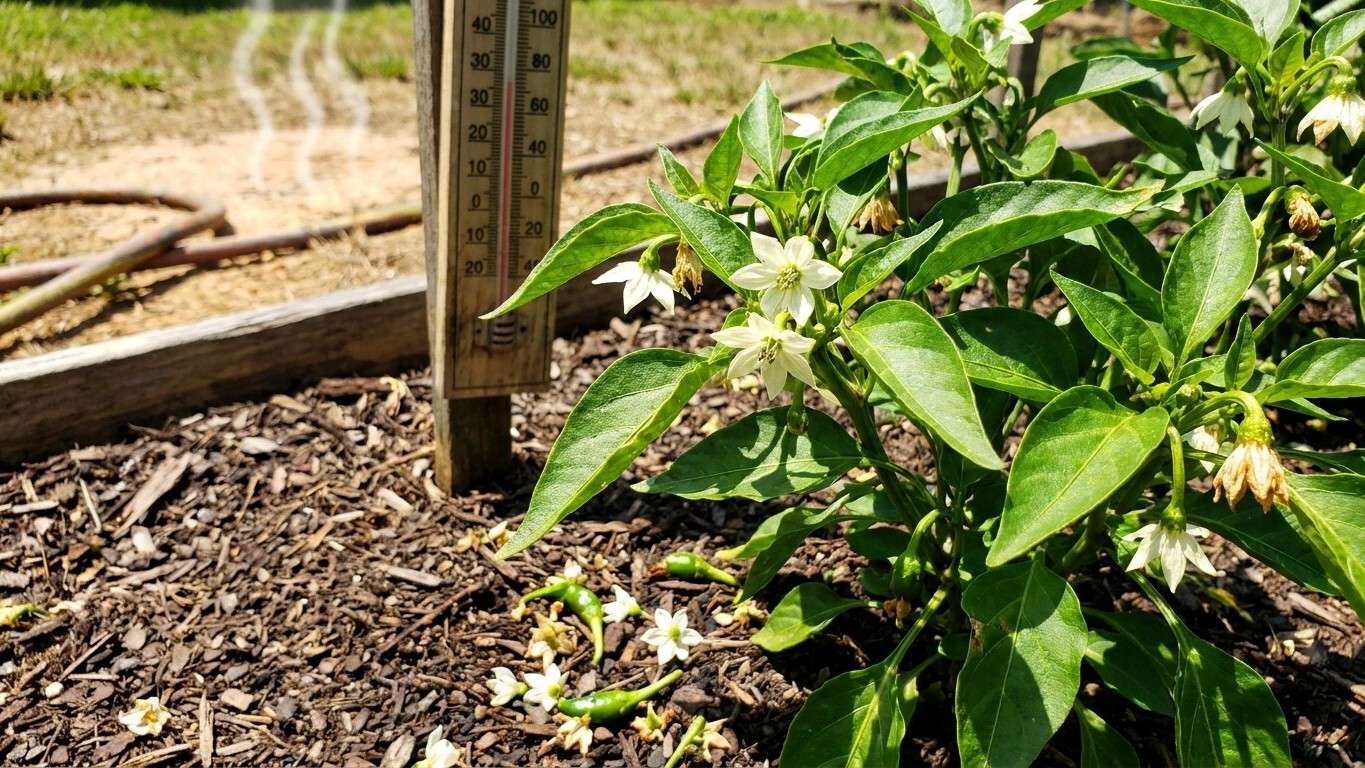

South Dakota gardeners lose pepper fruit for two opposite reasons: heat that shuts down pollen during a stretch of 90-degree afternoons, and cold nights that stall flowering before a single bloom opens. Sioux Falls averages 13.8 days a year at or above 90 F, enough to matter during bloom season, but this site does not track summer night minima, so watching your own thermometer after dusk is the only way to catch the cool-end failure before it costs you a crop.
The short answer
Start with the heat side, because it’s the one number on record here. The Sioux Falls reference station logs an average of 13.8 days a year at 90 F or hotter. That’s not a wall of triple-digit weeks, it’s more like scattered spikes across July and August, but pepper flowers don’t need a heat wave to fail. A single afternoon above roughly 90 F during bloom can be enough to make the pollen sterile or too dry to fertilize the flower, and the plant responds by dropping that blossom rather than wasting energy on a fruit that was never going to form. If your garden sits on blacktop-adjacent soil, near a south-facing wall, or in a spot with poor air movement, you can hit that failure threshold on days the weather service never even flags as unusually hot, because local heat load runs higher than the official reading.
Now the other end, and this is the one growers underestimate. Pepper fruit set fails just as reliably when nights drop below 55 F, according to Utah State University Extension. A cool snap in late spring, or an early cold front sliding through before the first fall frost, can knock blossoms off a plant that looks perfectly healthy otherwise. The flower simply doesn’t develop viable pollen at that temperature, and the plant drops it days later, often confusing gardeners who assume something is wrong with soil or feeding.
Here’s the catch specific to this page: this site carries days-above-90 data for South Dakota, but it does not carry summer night-minimum data. There’s no reliable way to state, from a state-level climate normal, how many nights in a given South Dakota county actually dip under 55 F during pepper bloom season. That figure depends on elevation, valley position, proximity to water, and local microclimate in ways a single station reading can’t capture. The only honest guidance is to track your own overnight lows with a min-max thermometer near the pepper bed once flowering starts, rather than assume the answer from where you live on the map. Latitude alone tells you nothing reliable about a specific night’s low, and neither does the coldest month of the year, since a June or July cold snap behaves differently than a January freeze.
Put together, that means South Dakota pepper growers are working with a bloom window bounded on both sides, hot afternoons on one edge, cool nights on the other, and the plant needs steady conditions in between to actually hang onto its flowers long enough to set fruit.
When to start seed here
Work backward from the transplant date rather than forward from a seed packet, since the packet doesn’t know your soil or your last frost. Utah State University Extension recommends starting pepper seed 8 to 10 weeks before transplanting outdoors, and transplanting only after frost danger has passed and soil has warmed to 60 F. Here’s how that math plays out using the Sioux Falls reference station’s frost window.
- Find your last spring frost window. The Sioux Falls airport station (USW00014944) shows a 30-70% probability band for the last 32 F freeze running from April 29 to May 9, based on NOAA NCEI’s 1991-2020 Climate Normals. That’s an airport reading, and airports tend to run warmer than the surrounding countryside, so a rural or low-lying garden a county over often sees its last frost one to two weeks later than this window suggests.
- Add the soil-warming step. Frost clearing doesn’t mean the soil is ready. Pepper transplants need soil at 60 F, and cold South Dakota clay or heavy loam can lag well behind air temperature after a cool spring. Check soil temperature directly with a probe thermometer at planting depth rather than guessing from the calendar.
- Set your realistic transplant date. If your county’s last frost typically lands in mid-May once you account for the rural lag, and soil takes another week or two to reach 60 F, your practical transplant date may sit anywhere from mid-to-late May, not the airport’s early-May window.
- Count back 8 to 10 weeks for seed-starting. If you land on a mid-May transplant date, seed indoors runs from roughly early-to-mid March. If your county pushes transplanting into late May, move the seed-starting date back to match, staying inside that 8-to-10-week span so plants aren’t leggy or root-bound before they go outside.
- Recheck before you plant. Because the reference station’s frost dates are a probability band, not a guarantee, hold your transplants a few extra days if a late cold snap is forecast, even if the calendar says you’re past the average date.
This arithmetic works the same way for any South Dakota county: pull the local frost data, add the rural buffer, confirm soil temperature, then subtract 8 to 10 weeks. Skipping the soil-check step is the most common reason transplants stall right after they go in the ground, since air temperature and soil temperature don’t warm at the same rate.
What goes wrong here
- Blossom drop from a hot spell. A run of days near or above 90 F during flowering, the kind Sioux Falls sees on close to 14 days most years, can sterilize pollen and cause flowers to fall without setting fruit. Provide afternoon shade with cloth during the hottest stretches and keep soil moisture even, since drought stress on top of heat makes the drop worse.
- Blossom drop from a cool night. Nights under 55 F during bloom can cause the same dropped-flower symptom as heat, just from the opposite direction. Since this site doesn’t track night minima, run a min-max thermometer in the pepper bed through bloom season, and be ready to cover plants with row cover on nights that turn unexpectedly cool, especially right after a late frost-free start or ahead of an early fall front.
- Sunscald on exposed fruit. Strong sun on fruit that isn’t shielded by foliage can cause soft, sunken, whitish patches on the fruit’s shoulder, especially on plants pruned too aggressively or thinned of leaves. Avoid removing healthy foliage during peak summer sun, and use light shade cloth over exposed rows during the hottest weeks.
- Blossom-end rot. Fruit develops a dark, leathery patch at the blossom end, usually from uneven watering that disrupts calcium uptake rather than a calcium shortage in the soil itself. Keep watering consistent, mulch to hold soil moisture steady, and avoid letting the bed swing between bone-dry and soaked, particularly during the heat spikes that also drive blossom drop.
Common questions
Can I fix blossom drop once it starts?
You can’t save flowers that have already dropped, but you can protect the next flush. Shade cloth during heat spikes, row cover during a cool snap, and steady watering give the plant a better shot at holding its next round of blossoms through pollination.
Does variety choice help with heat or cold tolerance?
Utah State University Extension names several pepper varieties suited to home gardens but does not publish heat ratings, days-to-maturity, or fruit-size figures for them. Choosing by those unpublished traits isn’t possible from that source, so focus instead on timing and site conditions, which you can control directly.
How long after a flower survives does the fruit actually appear?
Once a flower successfully sets, expect the fruit itself to develop over the following weeks of the growing season rather than overnight. The critical window is the flowering stage itself, since that’s when both heat above roughly 90 F and cold nights under 55 F do their damage, well before any fruit is visible.
Should I plant earlier to dodge the summer heat spikes?
Not without checking soil temperature first. Transplanting before the soil reaches 60 F, even to beat the heat, tends to stall growth and delay flowering into the same heat window you were trying to avoid. It’s better to hit the 60 F soil mark on schedule and manage heat spikes with shade cloth once bloom arrives.