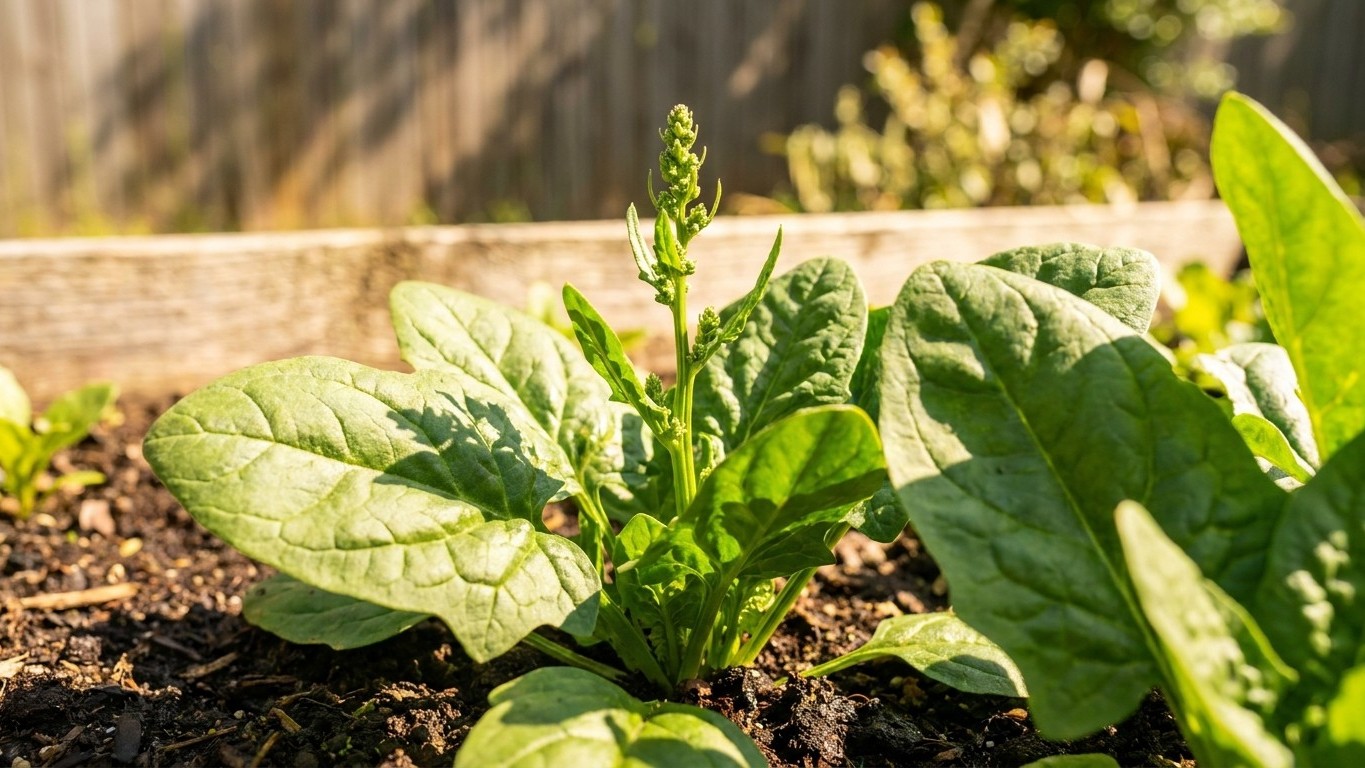

Yes. Spinach bolts early almost everywhere in South Dakota, and it has less to do with a hot afternoon than with the calendar itself. At the reference station, summer days stretch to 15 hours and 15 minutes at the solstice, and that alone flips the switch on spinach’s flowering trigger. Add in 13.8 days a year hitting 90 F or hotter, and the plant gets pushed from two directions at once. The workaround isn’t fighting the season. It’s timing two short crops around it.
The short answer
Start with the daylight number, because it explains more than any thermometer reading. On the longest day of the year, the reference city sees 15 hours and 15 minutes of daylight. Spinach flowers in response to long days combined with warmth, and 15 hours and 15 minutes sits well past the point where that flowering response kicks in. This is the opposite of what long days do to onions on this site, where extra daylight builds the bulb. For spinach, long days do the reverse: they push the plant to bolt, to send up a seed stalk, and to turn bitter, no matter how mild the temperature happens to be that week.
That’s the part gardeners underestimate. A cool June in South Dakota doesn’t rescue a spinach crop. It might slow the process by a few days, but the daylight clock keeps running regardless of what the mercury is doing. So the limit here isn’t purely heat. It isn’t purely day length either. It’s both, stacked on top of each other in a way that narrows the growing window from two ends at once.
Here’s how the stacking works in practice. Day length starts climbing toward that 15-hour-15-minute peak well before the hottest part of summer arrives. That means spinach can start feeling the bolting pressure in late spring, even while daytime highs are still comfortable. Then, as the calendar moves into the parts of summer when the reference station logs its 13.8 average days above 90 F, the heat piles onto a crop that’s already leaning toward flowering. Spinach grows best under 75 F, and that number is doing double duty. It’s the ceiling for good growth, and it’s also roughly where the leaves start turning bitter. Once the plant crosses into daytime highs well above that mark, on top of long daylight hours, both quality and flavor decline together.
None of this means spinach can’t be grown well in South Dakota. It means the crop has to be treated as two short, deliberate plantings, timed tightly around the two named frost windows, rather than one long summer-season vegetable the way tomatoes or peppers work. The rest of this piece walks through exactly how tight those windows are.
How long the spring window really is
- Sowing date. Spinach seed goes in the ground about 2 to 3 weeks before the last spring frost. At the reference station, that frost falls between April 29 and May 9, which puts a realistic sowing date somewhere in the second half of April for most gardens tied to that station.
- Early growth, low risk. Through late April and most of May, day length is still well short of the solstice peak, and daytime highs are typically nowhere near the 75 F ceiling. This stretch is where spinach does its best, cleanest growing, with little pressure toward bolting.
- The daylight climb. Moving into late May and June, day length keeps rising toward that 15 hour, 15 minute peak. Spinach starts feeling the bolting trigger from daylight alone during this stretch, independent of temperature.
- Heat arrives on schedule. The reference station logs 13.8 days a year at 90 F or above, and most of those days land in June, July, and August. Once those hot days start showing up, they combine with the long daylight hours to finish the job the daylight already started.
- Net usable window. Counting from a mid-to-late April sowing date to the point where day length and heat together push the crop past good quality, spring spinach in South Dakota realistically gets somewhere around five to seven weeks of good growing before bolting and bitterness set in.
That’s a tight window, but it’s a workable one if the seed goes in as early as the soil allows rather than waiting for settled warm weather the way a gardener might for beans or squash. Every week gained at the front end is a week of usable leaf at the back end.
The autumn crop, and when the soil lets you sow
Fall spinach solves the daylight problem automatically, since day length is falling instead of climbing as autumn approaches. The obstacle in South Dakota isn’t the sun. It’s the ground.
Soil that’s still too warm to germinate
Spinach seed germinates poorly once soil temperature climbs above 80 F, according to Utah State University Extension. In a region logging 13.8 days a year at 90 F air temperature, soil at seeding depth often sits above that 80 F mark well into late summer, especially in exposed or sandy garden beds that heat up faster than the surrounding air suggests. That rules out an early-August sowing in most years and pushes the realistic sowing date later, once overnight temperatures start pulling soil back down under that threshold.
The frost that ends the season
The other boundary is the first fall frost, which the reference station places between September 24 and October 4. Utah State University Extension’s guidance for a fall crop is to sow 50 to 75 days before the target harvest date, with no specific days-to-maturity figure published for spinach beyond that range. Counting backward from the fall frost window gives a sowing target: 75 days before September 24 lands around July 11, while 50 days before October 4 lands around August 15. That’s the working range for South Dakota gardens, but it overlaps directly with the stretch when soil is still too warm to germinate well.
The practical answer is to sow toward the later end of that range, once soil has started cooling from its midsummer peak, even if it means the harvest lands closer to the 50-day mark than the 75-day mark. A gardener working from these numbers should also remember that suburban and rural plots often see their first fall frost a week or two earlier than the reference station’s airport data suggests, which trims the back end of the window further and argues for erring toward an earlier sowing rather than a later one.
Four spinach varieties come up regularly in discussions of cool-season crops: Bloomsdale, Melody, Teton, and Olympia. Utah State University Extension names these without publishing performance data or days-to-maturity figures for any of them specifically, so no variety-by-variety comparison can be made from that source. Choosing among them comes down to what’s available locally rather than a documented yield or bolt-resistance advantage.
Common questions
Does shade slow down bolting in South Dakota?
Shade can reduce direct heat load on the plant, which helps with the 75 F growth ceiling and bitterness threshold. It does nothing about day length, since the bolting trigger from long daylight hours operates regardless of how much sun actually reaches the leaves.
Can spinach be grown through the summer at all here?
Not reliably. Between the daylight trigger and 13.8 average days a year above 90 F, summer sits outside the window where spinach grows well or stays palatable. The spring and fall windows described above are the two realistic growing periods.
Is there a way to check soil temperature before sowing the fall crop?
A simple soil thermometer pushed to seeding depth in the morning gives a reliable reading. Waiting until that reading drops consistently below 80 F, rather than going by the calendar alone, gives germination the best chance.
Should the last frost date be trusted exactly as given?
The April 29 to May 9 and September 24 to October 4 windows come from the airport weather station behind these figures. Home gardens, especially in suburban or rural settings, often see frost arrive later in spring and earlier in fall than an airport station records, so it’s worth checking local county extension data before locking in a sowing date.