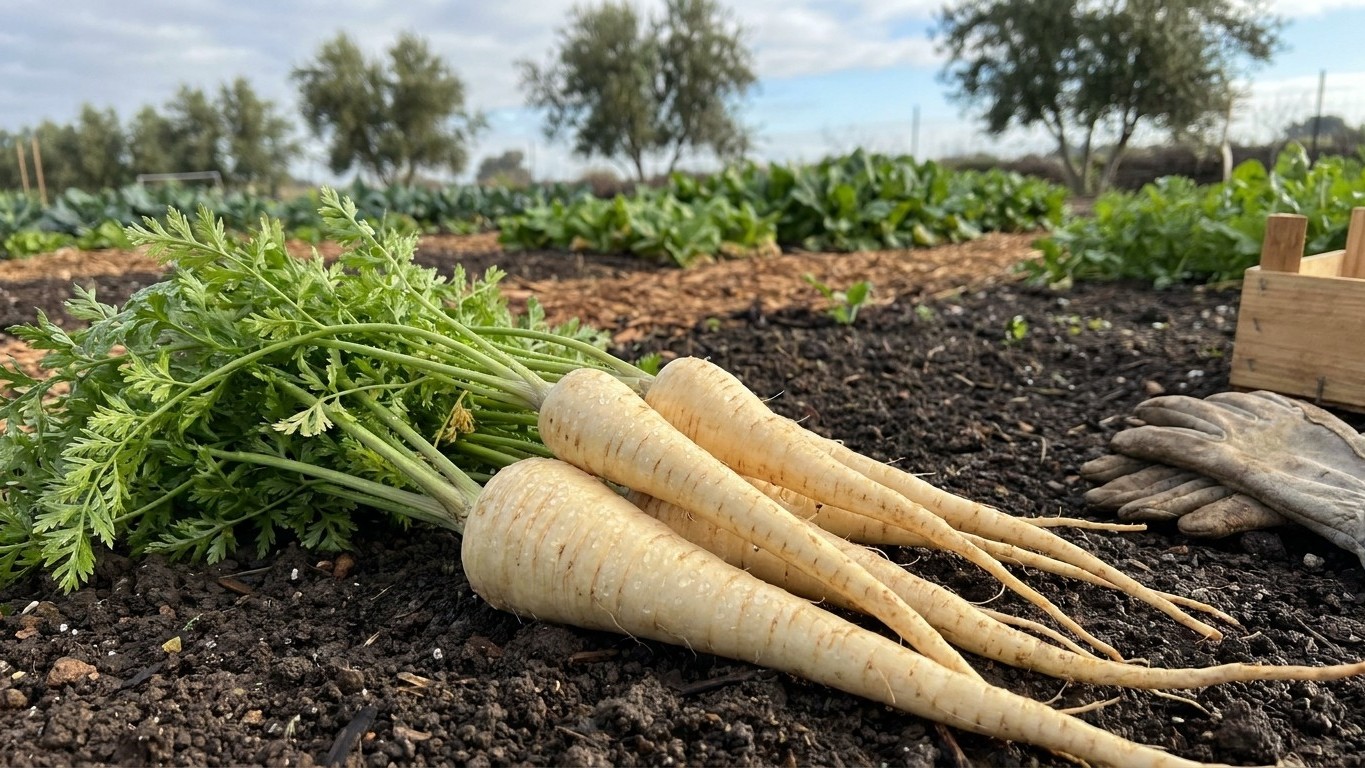

Lift parsnips in Nova Scotia after they have sat through several weeks of frost. In an average year that means late November at the earliest. Roots can then come out as the ground allows, all winter, or be pulled and stored. Stored properly, they keep four to six months. Most home cellars and kitchens can’t hold those conditions, and one common storage mistake turns the roots bitter.
The short answer
Does Nova Scotia deliver several frosty weeks? It does. The mean daily minimum of the coldest month at the Halifax reference station is -10.4 °C, according to Environment and Climate Change Canada. That is the typical overnight low in the deepest part of winter, not a record cold snap. A parsnip sown in place in spring will finish growing, and the cold that follows will sweeten it rather than leave it merely large.
The sweetening is the whole reason to wait. Utah State University Extension notes that parsnips taste best after several weeks of cool, frosty weather, which converts stored starch to sugar. The trigger is exposure to frost on your own ground. A comfortable hardiness zone says nothing about how many frosty weeks a given winter delivers. Here the frost is dependable, so the rule is simple: don’t dig in October because the tops look big. Give the roots weeks of cold first.
The Halifax station sits on the coast near sea level. Inland and upland districts tend to run weeks behind it in spring and frost earlier in fall, so the dates in this article are a midpoint. Count your weeks from the first hard frost on your own ground, and ask your county extension office or a neighbour with an old garden what the local pattern looks like.
Lifting itself comes down to ground you can still dig. A thick blanket of straw or leaves laid over the row after the first hard frosts keeps the soil from locking solid, so you can pull roots through winter as you need them. Where the ground freezes hard, lift a good share in a mild spell before it does. Parsnips are not chilling sensitive, so cold itself does them no harm in storage. Dig carefully with a fork set well off to the side, because a stabbed root rots.
Storage is where good parsnips get ruined. USDA Agricultural Handbook 66 gives four to six months at 32 to 34 °F (0 to 1 °C) with 98% relative humidity. That is a long keeper by any standard, but it assumes those conditions held steady, which almost no house does. The handbook also reports that low levels of ethylene in cold storage cause bitterness. Ripening fruit gives off that gas, and apples are the usual culprit. A parsnip kept in the same cellar or crisper drawer as apples can turn bitter even at the right temperature. Top the roots after harvest, but do not trim into the crown. The full chapter is in the USDA Handbook 66.
For the full growing picture, start with Growing Parsnips in Nova Scotia. The mechanics of the cold-weather flavor change are covered in Will Parsnips Sweeten in Nova Scotia?
Does the season fit?
Parsnips need 100 to 120 days from seeding, and they are sown directly in the garden, so the count starts the day the seed goes in. Here is how that plays out against the frost window at the Halifax station.
- Pick the sowing date. The mean last spring frost is May 7. That is the midpoint of a window, and in one year out of two the last frost falls later. Sowing two to three weeks ahead of it points to about April 16 to 23, if the ground is workable. A cold, wet spring pushes that back, and a sowing in early May still fits.
- Wait out germination. Parsnip seed is slow to come up, even in good conditions. Bare soil for the first two to three weeks is normal. Don’t dig it over and re-sow. Marking the row with a stake saves you from doing exactly that.
- Count the growing time. A sowing in late April reaches full size in late summer. A sowing in early May finishes later, toward early autumn. Either way, the roots are mature weeks before fall frosts begin.
- Check the fall window. The mean first fall frost is October 18, again a midpoint, and in one year out of two it arrives earlier. The reference station has about 164 frost-free days between the mean last spring frost and the mean first fall frost. A crop needing 100 to 120 days fits comfortably inside that.
- Let the frost do its work. Maturity is not the same as sweetness. The roots turn sweet during the weeks of cold after October 18, which puts the first good digging in late November in an average year. Pull one root, scrub it, and taste it raw or roasted. If it is still starchy and bland, give the row another week or two.
The season fits comfortably, with room to spare at both ends. A late start does not sink the crop here, though a sowing pushed into June starts cutting into the weeks the roots need to size up before frost. Because upland and northern districts frost earlier, a gardener there should aim for the early end of the sowing range.
What goes wrong here
Parsnips are a patient crop, and most failures trace to the ground, the water, or the calendar. These are the ones that show up in Nova Scotia gardens, each with its fix.
- Forked roots from heavy or stony ground: parsnips want deep sandy soil, and Utah State University Extension says heavy soil must be double dug. Clay or rocky ground makes the root split around whatever it meets. Dig the row two spades deep, pull out the stones, and loosen the bottom layer before sowing. Where the ground can’t be improved, grow the roots in a raised bed filled with loose soil.
- Forked roots from overwatering: this is a separate cause, and it happens even in good soil. Constant wet encourages side roots and rot. Water deeply and less often, and let the top inch dry between waterings once the seedlings are up.
- Bare soil mistaken for failure: parsnip seed is slow to germinate, and a gardener who digs up the row too soon wastes the sowing. Wait the full three weeks before deciding anything, and keep the seedbed evenly damp so the surface doesn’t crust.
- A season that runs out: sowing that slips into June leaves too little time for 100 to 120 days of growth before cold arrives. Sow as soon as the soil can be worked, and treat the early May mean last frost as a midpoint, not a green light. Check the seed packet dates and thin early.
- A winter too mild to sweeten: Nova Scotia’s coldest month is dependable, but a winter with little frost, or roots mulched so heavily they never feel the cold, can leave them starchy. Mulch after the first hard frosts, not before, and let the roots take several frosty weeks.
- Bitterness in storage: ethylene from apples or other ripening fruit makes parsnips bitter, even at the right temperature. Keep roots in a separate cold space, topped but not trimmed into the crown. For pests that feed on the roots, read What Eats Parsnip in Nova Scotia, and When.
Common questions
Can parsnips stay in the ground all winter in Nova Scotia?
Yes, where the soil stays diggable under a thick mulch of straw or leaves. Lift the rest before spring growth starts, because roots left too long send up new tops and the quality drops. Where the ground freezes hard, pull what you want to store before it locks.
How do I know parsnips are ready to lift?
Taste one. After several weeks of frost, a root should be noticeably sweet, even raw. If it tastes starchy, wait another week or two. Counting days from the first fall frost on your own ground works better than reading the tops.
Can I store parsnips with apples?
No. Apples and other ripening fruit give off ethylene, and low levels of it in cold storage turn parsnips bitter. Keep them in a separate space or a separate part of the refrigerator, and cut the tops off after harvest without trimming into the crown.
How long do parsnips keep?
Four to six months at 32 to 34 °F (0 to 1 °C) with 98% humidity held steady, according to USDA Handbook 66. Most kitchens and cellars run warmer or drier, so expect a shorter keeping time. A cold, damp cellar away from fruit comes closest to what the handbook describes.