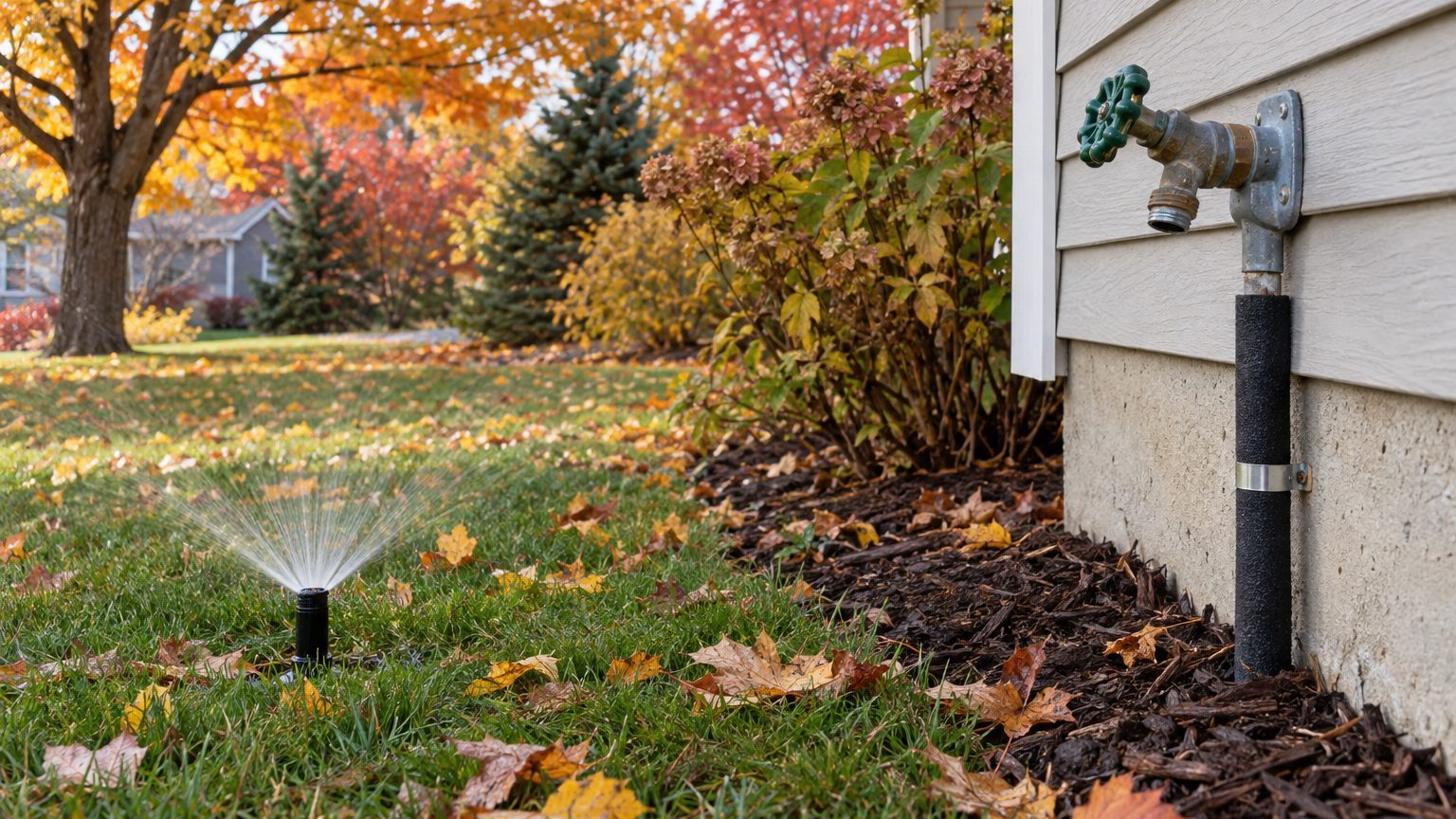

Drain your sprinkler system and shut down outdoor faucets in the weeks before your first hard freeze. Treat the first light frost as a warning, not the deadline. In Utah the calendar runs earlier the higher and farther north you live, and later in the warmer south. Salt Lake City supplies the one hard benchmark we have, and everything below is built around it.
When to do it in Utah
In the Salt Lake City valley, plan to have sprinklers drained and outdoor faucets shut off ahead of the October 18 to October 29 window, the stretch when NOAA’s 1991-2020 Climate Normals put the first 32°F freeze (the band where the odds of having hit it run between 30 and 70 percent). The rule is before the first hard freeze, not after the first light one, and colder, higher ground gets that freeze sooner than the valley floor does.
Here is the line worth copying onto the calendar: finish before the October 18 to October 29 first-freeze window, and move the whole job earlier if you live above the valley floor. That is a deadline, not a start date. Anyone with more than a handful of sprinkler zones will want a weekend or two of slack.
Why a light frost is a warning, not a deadline
Early-fall frosts in Utah often come as a brief dip followed by mild, dry weeks. That pattern fools people. A light frost that melts by mid-morning rarely harms anything buried, but it tells you the season has turned. The freeze that does damage is the one that holds for hours overnight, and it tends to show up on a night when nobody has the forecast in mind.
The parts that fail first sit above or near the surface: the backflow preventer, exposed pipe running up to it, shallow valves, sprinkler risers, and the hose bib on the side of the house. Buried mainline sits deeper and is more forgiving, which is why damage so often turns up in the fittings and not along the pipe run.
Winter itself leaves no room for gambling. NOAA’s 1991-2020 normals for Salt Lake City show a mean daily minimum of 24.2°F in the coldest month. That is the average overnight low, not a record, so a typical night in deep winter sits below freezing for hours. Freezing is the default here, and a sprinkler system left full is a system waiting to split.
Adjusting for where you live
Salt Lake sits in a relatively mild valley. Most of Utah is higher and colder, and the USDA Plant Hardiness Zone Map (2023 edition, built on the average annual extreme minimum temperature) runs from 4a to 9a across the state. A homeowner at a higher or more northern address should read the October 18 to October 29 range as a late estimate and finish the job ahead of it. Cold air arrives earlier up there, and fall tasks like draining move earlier with it.
Southern Utah is warmer, so the window slides later there. A warmer climate is still not a frost-free one, though, and the verified numbers here come from the Salt Lake City station. Check a local frost-date source for your town, and keep the forecast open in the final weeks before you commit to a date.
One trade-off deserves a mention. Fall in much of Utah is dry, and trees, shrubs and new plantings still want water into October. Give them a last deep soak, then drain. A hose can cover thirsty spots until the day you disconnect it. The rest of the fall routine for turf, including the final mowing and feeding, is covered in Winterizing a Lawn.
Sprinkler lines: drain or blow out
Water that sits in a sprinkler line has nowhere to go when the temperature falls. Ice takes up more room than the liquid it came from, so the pipe, a fitting, or the body of a valve gives way. Polyethylene tubing and PVC are tougher than they look, but a joint, a threaded riser or a plastic valve body is a different story. The frustrating part is that the break stays hidden. A cracked fitting under frozen soil leaks nothing in January and gushes in April, when you turn the water back on.
Three ways to empty the system
Systems are emptied by gravity, by built-in valves, or by compressed air. They differ in effort, in how much water they actually remove, and in what can go wrong.
| Method | How it works | Weak spot |
|---|---|---|
| Manual drain | You shut the supply and open drain valves at the low points of the system, letting gravity pull water out | Works only if the pipes were laid with slope toward those valves; pockets of water remain in dips and around heads |
| Automatic drain | Spring-loaded valves at low points open on their own when line pressure drops | A stuck or debris-clogged valve fails silently, and the system may not have been laid to drain well |
| Compressed-air blowout | An air compressor pushes water out through the sprinkler heads, one zone at a time | Too much pressure or too much time on one zone damages heads and fittings, and it is a safety risk for whoever runs it |
Manual and automatic drains rely on terrain and design. Compressed air does not, which is why it is the method installers reach for when a yard has flat runs, dips, or heads that sit lower than the pipe feeding them.
Which one Utah calls for
Given a coldest-month mean minimum of 24.2°F in the NOAA normals for Salt Lake City, relying on gravity alone is a gamble. Automatic drains can do the job on a system designed around them, and a yard with real slope may drain well by hand. For everything else, a compressed-air blowout is the safer call, and more so as you climb into colder country.
The sequence matters more than the gear. Shut off the water supply to the system first. Drain the backflow preventer and any exposed pipe. Then work through the zones one at a time, running air until the heads stop spitting water and mist, and no longer. Air with no water to carry heats up rotor internals and spray heads, so a long blast does its own damage. Wear eye protection, stay clear of the heads while they fire, and never exceed the pressure rating on the lowest-rated component in the system. The manufacturer’s literature for your heads and valves is the place to find that rating.
Plenty of homeowners do this job themselves with a rented or owned compressor. A professional is the sensible choice if the system is large, if you can’t confirm what pressure its parts tolerate, if you have never seen the backflow assembly shut down properly, or if your water provider requires a certified person to service it. A pro with the right equipment can clear a whole yard in far less time, and the visit costs less than a cracked valve manifold. Book that visit, or do the blowout yourself, before the October 18 to October 29 window arrives, because installers fill up as the first cold forecast gets close.
Last, set the controller to its off or rain mode instead of unplugging it. That keeps your programs saved for spring and stops it from sending watering signals to a dry system.
Outdoor faucets and hoses
An outdoor spigot is the most exposed plumbing on the house, and freezing water in it can split a pipe inside the wall where nobody sees it until the thaw. The routine takes a few minutes per faucet and requires nothing beyond turning valves and unscrewing hoses. For the longer version of that routine, see Winterizing Outdoor Faucets Before the First Freeze.
The routine, valve by valve
The steps run in a fixed order, and skipping one defeats the others:
- Disconnect every hose, splitter, timer and nozzle from the faucet.
- Find the interior shutoff valve for that line, usually in a basement, crawlspace or utility room, and close it.
- Open the outside tap fully so the water between the two valves can drain out.
- If the interior valve has a small bleeder cap, open it to let the last water out, then close it again.
Leave the outside tap open for the winter. That lets any leftover water expand without pressure and keeps a dripping valve seat from filling the pipe again. Drain, coil and store the hoses, because a hose left full of water on the ground freezes solid and splits along its length. If the house has no interior shutoff valve on a given outdoor line, stop there and call a plumber. Adding or replacing valves, cutting pipe or swapping a spigot is plumbing work, not a fall chore.
Why a frost-free faucet still fails with a hose attached
A frost-free faucet puts its valve seat deep inside the heated part of the wall, at the end of a long barrel that slopes slightly downward. When you shut it off, the water in the barrel runs out through the spout and leaves the exposed section empty. That design is why people trust it, and the trust is earned when it’s used properly.
Attach a hose, even one with the nozzle left open, and the water in the barrel can no longer drain. The hose holds the spout closed, the barrel stays full, and the exposed end freezes. The break often happens inside the wall. You find out in spring, when water sprays from behind the siding or stains a ceiling below. Frost-free outdoor taps need the hose off just as much as old-style ones do, so remove it before the October 18 to October 29 window and keep it off.
The decision to write down for this section: take hoses off every faucet and shut the interior valves ahead of the October 18 to October 29 window in Salt Lake City, and earlier at higher elevations.
What goes wrong here
Utah’s cold arrives in ways that catch tidy people off guard. Three failures show up again and again, and each leaves a clear signature in spring.
The early cold snap and the forgotten hose
The early cold snap is the classic. The first freeze arrives in the October 18 to October 29 band on average, but averages describe the middle of a spread. Some years it comes sooner, and the home that planned to drain “next weekend” meets it with full lines. In spring the evidence is a geyser from a riser or head, a zone that never builds pressure, a wet patch that keeps growing, or a backflow assembly with a cracked body. Prevention is boring: choose a drain date inside or ahead of the window, and treat any forecast of a hard overnight freeze as a signal to act that same day.
The forgotten hose is the quieter killer. One hose left on a spigot behind a shrub or a stack of firewood is enough. Its signature is a faucet that drips inside the wall or a damp patch on interior drywall once the water is back on, sometimes with a spray from the faucet when the valve opens. Walk the whole house perimeter, not just the front. If a pipe did freeze and you’re unsure, the signs and next steps are laid out in Frozen Pipes, and any repair beyond turning a valve belongs to a plumber.
The valve box that floods
Zone valves live in plastic boxes set into the ground, and those boxes collect water from rain, snowmelt and leaks. If they fill and the contents freeze, the valve bodies can crack. In spring the box may hold standing water, a zone may refuse to shut off, or a zone may not turn on at all. Keep lids on and seated, clear gravel or debris from the bottom so water can soak away, and make sure the system is drained so little water is in the valves to begin with. Check every valve box and hose bib again after the first hard freeze, and before the first deep snow covers the lids.
Common questions
Is it too late if the first frost has already happened?
No. A first frost is a warning, and plenty of fall weather after it stays above freezing. Drain anyway, as soon as you can, and do the same for faucets and hoses. If a freeze has already hit before you drained, leave the water off and look for leaks when you recommission the system in spring.
Can I just turn off the water and the controller?
That stops new water from entering, but it leaves whatever is already in the pipes, valves and heads where it sits. Those trapped pockets are what split fittings. Close the supply, then actually empty the lines by drain valves, automatic drains or a blowout, and set the controller to off so your schedule stays saved.
Does southern Utah need to winterize?
The warmer south gets its first freeze later, so the window slides later too, but it is not a frost-free zone by default. The verified numbers here come from the Salt Lake City station, and the USDA 2023 map runs from 4a to 9a across Utah. Look up local frost dates for your town and keep an eye on overnight lows in November before deciding to skip any step.
When should I turn everything back on in spring?
Wait until hard freezes are behind you, and keep an eye on the forecast for a stray cold night. Open the supply valve slowly so air escapes from the lines instead of slamming through them, then run each zone and look for geysers, wet patches and heads that won’t pop up. More Utah timing advice lives in the Utah guides.