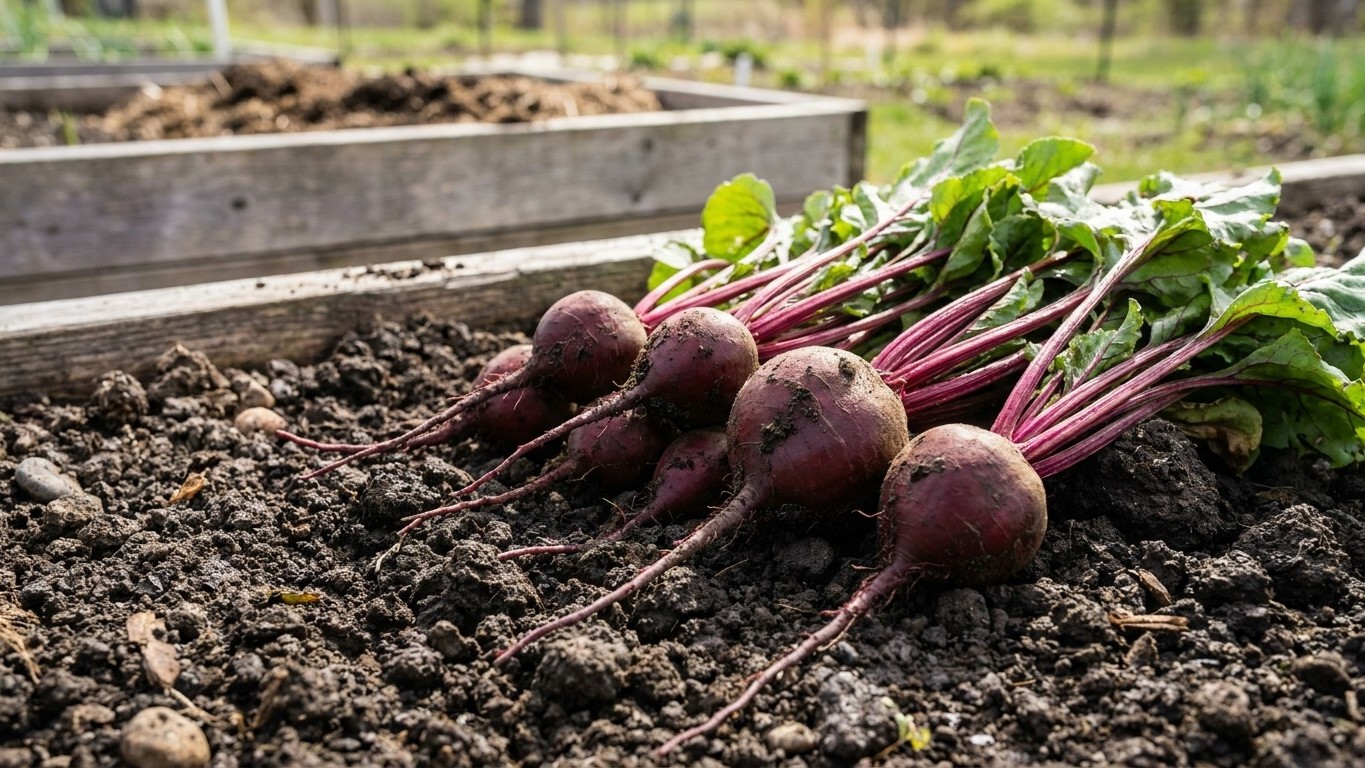

In Utah, beets lose ground to two failures that look alike from the garden path. Thirst in the first six weeks sends plants to flower early. Heat above 85 F combined with water stress turns the root woody. A third loss comes after harvest, when roots stored too cold develop black spot and rot. Timing separates them: bolting is a spring problem, woodiness a late-season one, and storage a fall decision. This page covers each in that order. Growing Beets in Utah covers the crop as a whole.
The short answer
Start with the ground. The soil USDA lists as representative of Utah is the Mivida series, an Aridisol, which means a dry-climate soil, usually alkaline and often carrying salts. Its surface layer is sandy: 72 percent sand, 9 percent clay and 19 percent silt, with organic matter around 1.5 percent and a surface pH about 8.1. It is well drained. Those are the representative values USDA records for the surface horizon of the major components of the series as mapped (24 components), not a reading from a worked garden bed.
For a beet, that is half good news. Utah State University Extension says beets want deep, sandy, well-drained soil rich in organic matter. Sand and drainage are already there. Organic matter is the weak spot, since 1.5 percent is thin. Sandy ground sheds water quickly, so roots rarely sit wet, but the root zone also empties fast, and Extension ties water stress in the first 6 weeks to premature flowering. Extension caps the fix at no more than 1 inch of composted organic matter per 100 sq ft. That is a light dressing, not a mountain of compost.
One caution before going further. Utah spans hundreds of soil series, and Mivida is a starting point, not a diagnosis. River bottoms, foothill benches and any lot a builder has scraped or filled can differ completely from it. The only number that counts is your own bed’s, so a soil test comes first. Beet Soil in Utah: What the Root Will Meet goes deeper on what to do with the result.
Heat is the second half of the answer. Extension says heat above 85 F with water stress makes the root woody. How many days a year Salt Lake City passes 90 F is not published in the figures behind this page, so I won’t hand you a number that isn’t there. What can be said is that Salt Lake sits in a mild valley. Most of Utah is higher and colder, and southern Utah is warmer, so the count of hot days, and the date woodiness becomes a risk, moves a lot with your address.
Keep the two failures apart, because the remedies differ. Bolting comes from early thirst, in the first six weeks after seeding. Woodiness comes from later heat paired with water stress, once the root is bulking up. A bed that was watered perfectly through May can still turn out woody roots in July. A bed that dried out in April can bolt before summer arrives. Beets are sown in place, so the 60 to 80 days to harvest run from seeding, never from a transplant.
The six weeks that decide it here
Sowing 2 to 3 weeks before the last frost puts the first six weeks of a beet’s life in a predictable stretch of the calendar. For the Salt Lake City station, NOAA NCEI climate normals put the last spring freeze between April 12 and April 29 (the 30 to 70 percent probability band for a 32 F freeze). Count back 2 to 3 weeks and the sowing window runs from about March 22 to about April 15, depending on where in that band your garden sits. When to Sow Beets in Utah turns this into dates for colder and warmer parts of the state.
Six weeks after those dates lands you between early May and late May. That is the stretch in which Utah’s spring has to cooperate, and it often does not do so evenly. The soil beneath most of the state is a dry-climate soil, and the Mivida series is the state’s representative example, so the ground starts out short on stored moisture. Spring weather here tends toward dry spells and temperature swings, with warm afternoons following cold nights. I don’t have a sourced rainfall figure for those weeks, so treat that as a general pattern, not a measurement.
Put that together with sandy soil and the bolting risk has a clear address. It sits in weeks three through six, after the seedlings are up but before the roots have gone deep. A sandy, low-organic-matter bed can go from damp to dry between one weekend and the next, and each dry spell is a bout of the water stress Extension links to premature flowering. Cold snaps that arrive after sowing are a separate worry, and the frost range above shows how wide that uncertainty is: a 17-day spread between the early and late ends of the band.
Woodiness belongs to a different window. A beet sown in late March and harvested at 60 to 80 days finishes between roughly late May and early June. One sown in mid-April finishes from mid-June into early July. The later the sowing, the closer the finish line sits to the first run of days above 85 F. Early sowing is partly a way to bring the roots in before that heat arrives, though in higher, colder parts of Utah the last frost comes later and the whole schedule slides with it.
What goes wrong here
- Bolting after an early dry spell. Water stress in the first 6 weeks causes premature flowering. Sandy ground makes it easy to miss a dry spell, so check moisture a few inches down, not just at the surface, and water deeply and steadily through those weeks. Test your own soil before assuming the state soil describes your bed.
- Woody roots in warm weather. Heat above 85 F with water stress makes the root woody. This is a separate failure from bolting. Even moisture through the bulking stage is the defense, and a sandy bed needs that attention longer than a heavier one would. Plan the sowing date so harvest falls ahead of the hottest stretch where you garden.
- Over-fixing thin soil. Low organic matter tempts gardeners to pile on compost. Extension’s limit is no more than 1 inch of composted organic matter per 100 sq ft. Stay under it, and let a soil test, not the state soil, tell you what your bed actually needs.
- Storing roots too cold. Colder is not better here. USDA Agricultural Handbook 66 reports more black spot and rot at 32 to 34 F than at slightly higher temperatures, and puts topped roots at 33 to 36 F and 98 percent humidity. The bottom of the refrigerator or a cellar near freezing can do harm. Pits and cellars should stay between 31 F and 41 F.
- Leaving the tops on. Bunched beets with leaves last about 10 to 14 days at 32 F and above 98 percent humidity, and no longer. For longer keeping, top them first, then store at the temperatures above.
- Storing the small ones. Large roots keep much better because they lose water and shrivel more slowly. Eat the small roots first and save the big ones for storage.
Common questions
When do beets bolt in Utah?
Bolting comes from water stress in the first 6 weeks after seeding, according to Utah State University Extension. With a last spring freeze between April 12 and April 29 at the Salt Lake City station and sowing 2 to 3 weeks earlier, those weeks fall roughly between late March and late May. Higher, colder parts of the state shift the dates later.
Why are my beets woody?
Heat above 85 F combined with water stress makes the root woody. It is a different problem from bolting, which comes from earlier thirst. Even watering during bulking and a sowing date that finishes before peak heat are the two levers. The number of days above 90 F at Salt Lake City is not published in the facts behind this page, so check local weather records for your own count.
Is the coldest part of the fridge best for beets?
No. Topped roots keep best at 33 to 36 F and 98 percent humidity. At 32 to 34 F, USDA Agricultural Handbook 66 reports more black spot and rot. Remove the tops first, because bunched beets with leaves last only 10 to 14 days. Keep the large roots for storage and eat the small ones first.
Do insects eat beets in Utah?
This page’s verified data covers soil, heat, water and storage, and holds no pest information, so I won’t name an insect or a timing for one. For identification and control, go to Utah State University Extension. The same source names five beet varieties but gives no data on any of them, so there is no basis here to rank one above another for Utah.