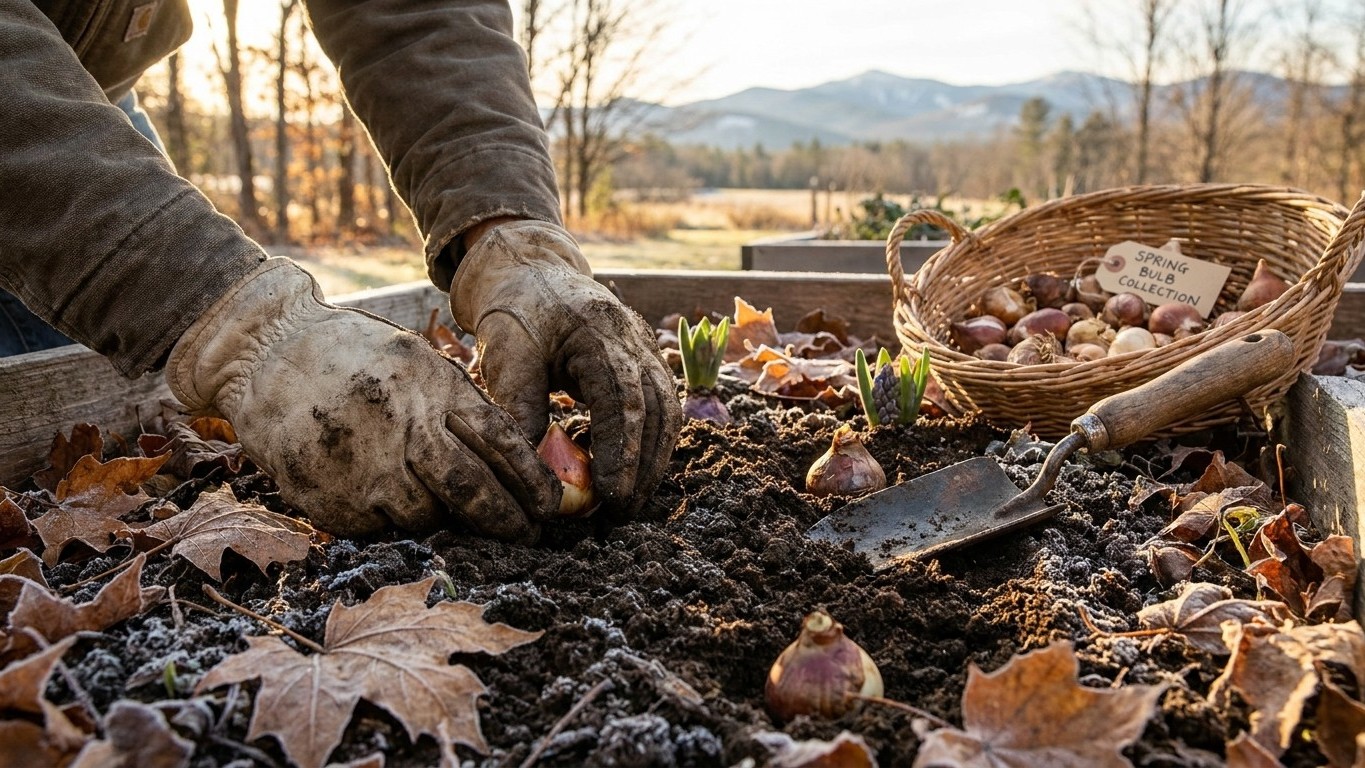

Plant Spring Bulbs in Vermont from mid-September through late October in most valley locations, earlier at higher elevations and in the Northeast Kingdom. The bigger question isn’t the date, though. It’s whether Vermont’s winter delivers enough sustained cold for a given bulb to flower at all, and for the varieties covered below, the answer is almost always yes. For gardeners without in-ground space, the same timing principles apply to Growing Spring Bulbs in Containers in Vermont, though pots demand extra attention to insulation against the cold. Gardeners who want blooms without waiting on the outdoor calendar at all can instead look into Forcing Spring Bulbs Indoors in Vermont, which relies on a refrigerator or cold room rather than the ground to deliver that same chilling period.
When to plant bulbs in Vermont

The planting clock in Vermont runs backward from the ground freeze, not forward from the calendar. Burlington’s average first fall frost falls somewhere between October 3 and October 13, based on 1991-2020 climate normals from the National Weather Service station at Burlington International Airport. That date marks the first light freeze of the air, not the day the soil locks up solid, but it’s the anchor point most Vermont gardeners work from, since ground freeze typically follows within a few weeks.
Count back roughly six weeks from that hard freeze, and the workable window lands in mid-September through late October across most of the state’s lower elevations, tapering earlier as you climb into the Green Mountains or move north toward the Kingdom, where frost and freeze both arrive sooner. Bulbs need that stretch of six weeks or so to grow roots before the soil goes cold enough to stop them, and root growth, not top growth, is the whole point of fall planting.
What happens at each end of the window
Plant too early, while soil is still warm from summer, and a bulb like a tulip or hyacinth can push green shoots above ground before winter arrives. Those shoots freeze and die back, and while the bulb underground usually survives, it’s wasted energy the plant needed for next spring’s bloom. Plant too late, after the ground has already gone cold and hard, and the bulb goes in without enough time to grow the root system it needs. The result the following spring is a weak, short stem, a flower that never opens fully, or no flower at all.
Treat the frost date as a guideline, not a guarantee. An average built from thirty years of data means roughly half of those years fell earlier than October 3, and half fell later than October 13. A gardener who waits for a specific calendar date rather than watching the actual weather and soil temperature is gambling on the wrong half of that average in any given year.
Whether your winter is cold enough
Every spring bulb needs a long stretch of cold before it can flower. Most varieties require twelve to fourteen weeks with soil temperatures below about 45°F. Skip that requirement and the bulb doesn’t die, but it doesn’t perform either: it puts out leaves with no flower, or a flower bud that never clears the soil line on a stem too short to see. This figure matters regardless of where you garden, because it’s the yardstick against which every bulb variety, and every catalog claim, has to be measured.
Vermont clears that bar with room to spare. The coldest-month mean daily minimum in Burlington runs 12.9°F, according to NOAA climate normals for 1991-2020, and the state’s USDA hardiness zones span 3b to 5b. That’s a winter cold enough to keep soil well below 45°F for months at a stretch, not weeks, since the frost season that opens in early October typically doesn’t loosen its grip until sometime in April across most of the state. A twelve-to-fourteen-week chill requirement is satisfied several times over before the ground even begins to thaw.
That margin buys Vermont gardeners something specific: they can plant standard spring bulbs, tulips, daffodils, hyacinths, crocus, straight into the ground and skip the refrigerator entirely. Pre-chilling, the practice of storing bulbs in a refrigerator for about twelve weeks before planting, exists for gardeners in warmer regions where winter soil never gets cold enough for long enough. It has to happen away from ripening fruit, since the ethylene gas apples and pears give off will kill the flower bud sealed inside a bulb. In Vermont, none of that applies to the bulbs covered on this page. The soil does the work on its own.
| Bulb | Weeks of cold required (below 45°F) | What Vermont delivers | Verdict |
|---|---|---|---|
| Tulip | 12-16 weeks | Cold soil roughly October through April | Works without pre-chilling |
| Daffodil (Narcissus) | 12-14 weeks | Same season-long cold | Works without pre-chilling |
| Hyacinth | 12-14 weeks | Same season-long cold | Works without pre-chilling |
| Crocus | 8-15 weeks | Same season-long cold | Works without pre-chilling |
| Allium | 8-10 weeks | Same season-long cold | Works without pre-chilling |
Which bulbs suit Vermont
The bulbs below have hardiness ranges that cover Vermont’s 3b-5b zones and cold requirements the state’s winter satisfies without effort. A hardiness range is a guide, not a wall, though: a bulb rated to zone 4 will often survive at the edge of zone 3b if it’s tucked against a south-facing foundation or under a tree canopy that traps snow cover, and the same bulb will struggle in an open, wind-scoured field even one zone warmer on paper.
- Daffodil / Narcissus — hardy zones 3-9
- Tulip — hardy zones 3-8
- Crocus — hardy zones 3-8
- Allium — hardy zones 3-9
- Grape hyacinth (Muscari) — hardy zones 3-9
- Snowdrop (Galanthus) — hardy zones 3-9
- Scilla — hardy zones 2-8
- Fritillaria — hardy zones 3-8
- Hyacinth — hardy zones 4-9, best sheltered in the coldest pockets of the state
A shorter list disappoints here, and it’s worth naming rather than glossing over. Anemone coronaria and ranunculus, both rated to zone 7 or 8 at the coldest, don’t survive a Vermont winter in the ground; sold as fall bulbs in some catalogs aimed at milder climates, they need to be treated as annuals or lifted and stored indoors. Freesia, hardy only to zone 9, fails the same way. Iris reticulata, rated to zone 5, sits right at the edge of Vermont’s range: it can bloom for a year or two in a protected raised bed and then vanish after an open, snowless winter, which is the more common failure pattern than an outright first-year loss. In each case the bulb doesn’t necessarily rot outright; it simply doesn’t come back the following spring, which is often more frustrating than a bulb that fails immediately.
What digs them up here
Squirrels and voles aren’t random about which bulbs they dig up. It comes down to chemistry. Daffodils and every bulb in the onion family contain compounds that make them toxic or simply unappetizing to rodents, while tulips and crocus are essentially rodent food, sweet and starchy with nothing to warn a squirrel off. That single fact explains most of the losses gardeners report after a fall planting.
- Bulbs squirrels and voles avoid: daffodil, allium, fritillaria, snowdrop, scilla
- Bulbs squirrels and voles target: tulip, crocus, hyacinth
For the vulnerable bulbs, the one measure that consistently works is physical, not chemical: lay galvanized wire mesh flat over the planting bed and pin it down, leaving it in place until the ground freezes hard enough that digging isn’t worth the effort. Repellent sprays and granules get pitched heavily every fall, but they wash off with the first rain or heavy dew and need reapplying constantly to do anything at all, which makes them a poor match for a bulb bed you plant once and then leave alone for the winter.
Where to check for your own county
Every figure on this page is anchored to Burlington, the reference city for Vermont’s National Weather Service climate data. Vermont stretches across several degrees of latitude and a hardiness range that spans from 3b to 5b, and a planting window built around Burlington’s lakeside microclimate can run two to three weeks early for a garden in the Northeast Kingdom or at elevation in the Green Mountains, where both frost and hard freeze arrive sooner.
The University of Vermont Extension maintains a network of county offices that track local frost patterns, soil conditions, and hardiness distinctions specific to Vermont’s terrain, and it’s the resource worth checking before finalizing a planting date for a garden well outside the Burlington area. Find the statewide office and county contacts through UVM Extension.