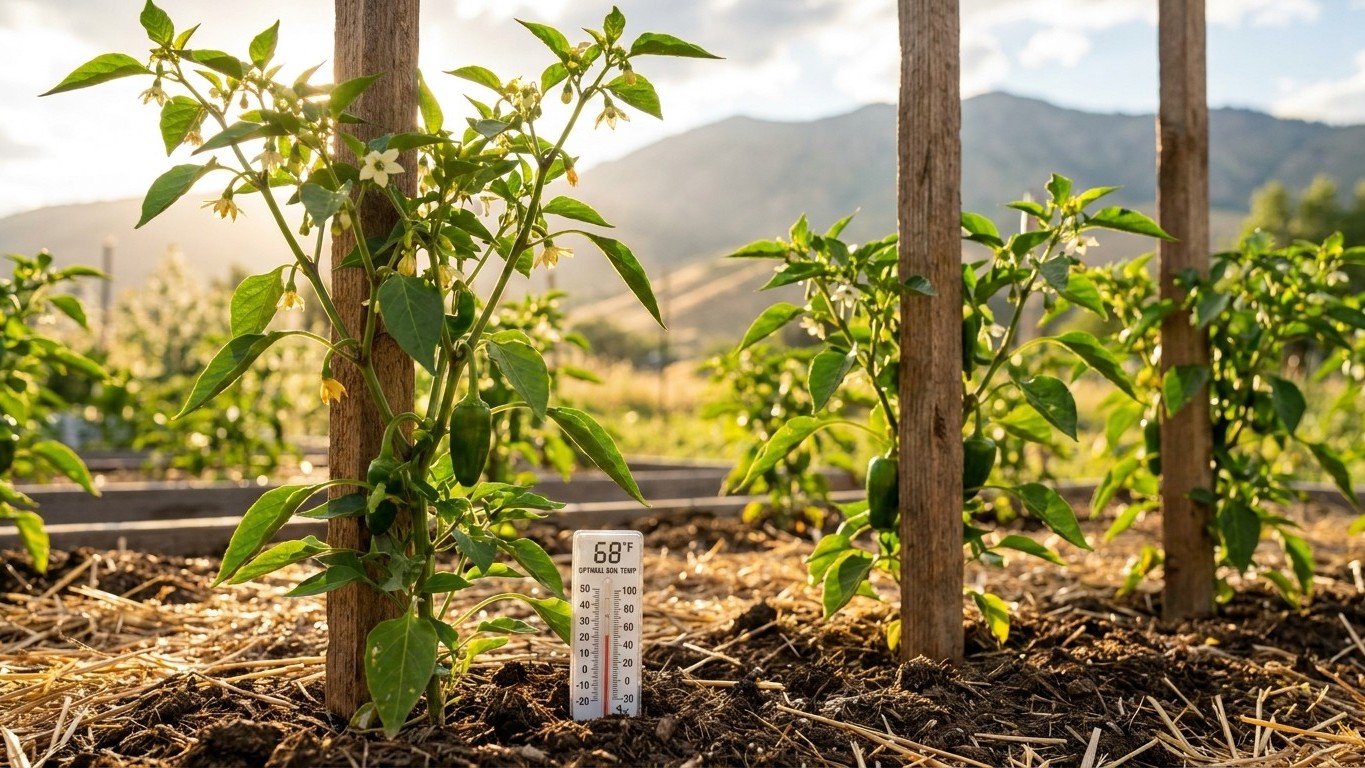

Vermont peppers ripen inside a short, cool-leaning window that rewards early starts and close attention to two thresholds, not one. The state’s heat load is thin, so blossom set rarely fails from excess warmth. What fails it more often is cold, and that’s the number this page can’t hand you: your own summer night lows.
The short answer

Burlington’s reference station logs an average of 5.4 days a year at or above 90 F, based on NOAA’s 1991-2020 Climate Normals. That’s a thin margin. Compare it to a Mid-Atlantic or Southern garden, where 90-degree days stack up by the dozen through July and August, and you start to see the shape of a Vermont pepper season: mild, short on extreme heat, and rarely brutal enough to shut down flowering on its own.
That matters because pepper fruit set has a ceiling. Utah State University Extension’s guidance on peppers is blunt about it: blossoms drop when daytime highs push past 90 F, because the plant redirects energy away from reproduction and into survival. With only 5.4 days a year crossing that line in the Burlington area, and likely fewer in the hills and valleys further from the lake’s moderating effect, heat-driven blossom drop is a real but occasional problem here, not a season-long fight the way it is in warmer states.
The other end of that failure window is cold, and it’s just as absolute. Peppers stop setting fruit when nights fall below 55 F, regardless of how warm the days get. A 78-degree afternoon means nothing to a pepper plant if it’s followed by a 50-degree night. This is where Vermont’s geography works against the grower more than its daytime heat does. Valleys, low spots, and anywhere air pools and cools overnight can sit well under that 55-degree mark even in July, long after the calendar says summer is in full swing.
Here’s the limit of what climate data can tell you: this site tracks days above 90 F because that’s a published, station-based normal. It does not track summer night minimums, and there isn’t a reliable way to infer them from latitude, from the date of the last frost, or from how cold January gets. Night temperatures in July depend on elevation, air drainage, tree cover, and how close you are to open water, none of which show up in a statewide or even county-level average. The only real fix is to watch your own thermometer through the growing season, ideally with a min-max reading, so you know whether your garden is closer to the lakeshore’s mild nights or to a cold-air pocket a few miles inland that behaves nothing like the official station.
When to start seed here
Pepper seed starting in Vermont works backward from two conditions that have to be true at the same time: the frost risk has to be gone, and the soil has to be warm enough for roots to grow instead of sit and rot. Utah State’s guidance sets that soil threshold at 60 F, measured at planting depth, not air temperature. Here’s how the arithmetic runs for a Vermont calendar.
- Start with the frost window. NOAA’s 1991-2020 Normals put Burlington’s 32 F freeze probability, the standard last-spring-frost marker, in the April 30 to May 10 range. That’s the mildest corner of the state, sitting right on Lake Champlain, where the water buffers temperature swings on both ends of the season.
- Adjust for where you actually garden. The Green Mountains and the Northeast Kingdom run their frost-free date substantially later than the lakeshore. If you’re gardening in one of those higher, colder pockets, treat the April 30 to May 10 range as a floor, not a target, and lean toward the later end or beyond it based on your own frost history.
- Confirm soil temperature separately from air temperature. A sunny 65-degree day doesn’t mean the soil four inches down has caught up. A simple soil thermometer, checked in the morning before the sun warms the surface, is the only way to know the ground has actually reached that 60-degree mark peppers need to root well.
- Set transplant date at the later of the two conditions. If your last frost falls around May 5 but your soil doesn’t hit 60 F until May 20, plant on May 20. Frost-safe soil that’s still cold will stall a pepper transplant for weeks, and a stalled transplant rarely catches up over the rest of a short season.
- Count back 8 to 10 weeks for indoor sowing. Utah State’s guidance gives that window for starting pepper seed indoors before transplant. From a mid-to-late-May transplant target, that puts indoor sowing somewhere in the second half of February through mid-March, depending on which end of that 8-to-10-week range you use and how late your own frost date runs.
- Re-run the math for your county, not the state. Because the lakeshore and the highlands differ so much on frost timing, the safest approach is to pull your own area’s frost data, add the 60-degree soil check, and count back from there rather than borrowing Burlington’s dates wholesale.
What goes wrong here
- Blossom drop from a hot spell. On one of Vermont’s rare 90-plus days, pepper plants can shed flowers outright. There’s no way to raise the ceiling on a heat wave, but afternoon shade cloth over the row and consistent watering the day before a forecasted hot stretch reduce the stress that triggers the drop.
- Blossom drop from a cool night. This is the more common failure in Vermont, especially in low-lying gardens. A stretch of nights under 55 F, even with warm days between them, will stop fruit set without any visible damage to the plant. Raised beds, black plastic mulch, or row cover pulled over the plants at night in cooler pockets all help hold a few extra degrees of warmth around the foliage.
- Sunscald on exposed fruit. When strong summer sun hits a pepper directly, especially after a leaf drops or a plant is pruned hard, the fruit can develop a pale, papery patch that eventually turns leathery. Keeping the plant’s natural leaf cover intact, and avoiding heavy pruning once fruit has set, is the simplest prevention.
- Blossom-end rot. This shows up as a dark, sunken spot at the fruit’s bottom end and traces back to inconsistent watering rather than a soil calcium shortage in most home gardens. Even soil moisture, achieved with mulch and a regular watering schedule instead of feast-or-drought cycles, is the standard fix.
Common questions
Can peppers ripen fully in a Vermont growing season?
Yes, provided the transplant goes in after both frost has passed and soil has reached 60 F, and the plant gets the full run of the frost-free season to flower and fill out fruit. The state’s low count of extreme-heat days, 5.4 a year on average, works in the grower’s favor for fruit set; the bigger variable is making sure a plant is set outdoors early enough to have time left in the season.
Do I need to worry about heat stress in Vermont peppers?
Less than gardeners in hotter states do, but not never. With only 5.4 days a year crossing 90 F at the Burlington reference station, heat-driven blossom drop is occasional rather than constant. Watch the forecast for those rare hot stretches and water deeply the day before.
Why do my peppers stop setting fruit even when the days feel warm?
Almost always a cool-night problem. Pepper fruit set fails below 55 F at night regardless of daytime warmth, and Vermont’s valleys and low spots can drop under that mark even in mid-summer. Since this varies block by block based on elevation and air drainage, track your own overnight lows rather than assuming a warm afternoon guarantees a warm night.
How far apart are the last frost date and safe pepper transplant timing?
They’re not the same date. NOAA’s Normals put Burlington’s last-frost window at April 30 to May 10, but that’s only the frost threshold. Soil still needs to reach 60 F separately, which usually happens later, so the real transplant date is typically after the frost date, not on it.