
Autumn spinach in Vermont goes into the ground in the second half of July into mid-August, once midsummer soil has cooled and there’s still enough calendar left for the crop to mature before frost. That window is narrow because two different obstacles bracket it: soil that’s too warm to sprout seed on one side, and the season’s first hard freeze on the other.
The short answer
Burlington sees 15 hours and 22 minutes of daylight on the longest day of the year. That number matters more than it looks, because spinach flowers, or “bolts,” in response to long days combined with warm weather, not because it’s starving for light like some crops. A cool summer doesn’t rescue the plant here. Once the calendar pushes past the solstice and days stretch that long, spinach is going to try to flower whether the thermometer cooperates or not.
Vermont’s saving grace is that heat itself is a minor player. The state averages just 5.4 days a year at 90F or above at the reference station, which is a modest heat load compared to most of the country. So the ceiling that matters for spinach, 75F, doesn’t get blown past for long stretches the way it does farther south. That means Vermont’s limiting factor for the spring crop is mostly day length, not heat. Long days force the plant to flower even in a mild July, and there’s not much a gardener can do about that once the calendar rolls forward.
For the fall crop, the equation flips. By late summer, day length is already shortening, which works in spinach’s favor. What stands in the way instead is residual heat in the soil itself. Seed germination drops once soil warms above 80F, and in Vermont that threshold is usually crossed sometime in mid-summer, staying elevated into early August depending on the year and the site. So the fall sowing decision isn’t about daylight hours at all. It’s about waiting for the ground to cool down enough to let seed sprout, while still leaving enough days before the first freeze for the plant to size up.
Put plainly: day length limits the spring window, heat (acting through the soil, not the air) limits when you can start the fall window, and both windows are squeezed by how quickly the calendar moves from “too warm to germinate” to “too cold to grow” in a state where autumn arrives early.
How long the spring window really is
- Start with the last frost. Vermont’s last spring freeze at the reference station falls between April 30 and May 10, and spinach seed goes in the ground two to three weeks before that date, meaning a mid-to-late April sowing for gardeners near Burlington. Higher ground in the Green Mountains and the Northeast Kingdom should expect that date to arrive noticeably later, since Burlington’s position on Lake Champlain makes it the mildest corner of the state.
- Cool weather works in the plant’s favor early. April and May air temperatures in Vermont sit comfortably below the 75F ceiling that spinach prefers, so germination and early leaf growth happen under close to ideal conditions during this stretch.
- The clock starts running as days lengthen. As the calendar moves toward the June solstice and daylight climbs toward that 15-hour-22-minute peak, spinach begins responding to day length itself, independent of how warm or cool the air happens to be.
- Heat adds pressure but isn’t the main driver. Because Vermont only averages 5.4 days a year above 90F, the air rarely forces the issue the way it does in hotter states. Day length does most of the work of ending the spring window here.
- The practical result is a short but usable stretch. Counting from a mid-to-late April sowing to the point where lengthening days push the crop toward bolting, gardeners get roughly six to eight weeks of good spring spinach before quality and flavor start to slide, with quality falling off as both the 75F growth ceiling and the bolting trigger start to overlap in early summer.
The autumn crop, and when the soil lets you sow
The fall sowing decision runs on two separate clocks, and both have to line up before seed goes in the ground.
Warm soil blocks germination
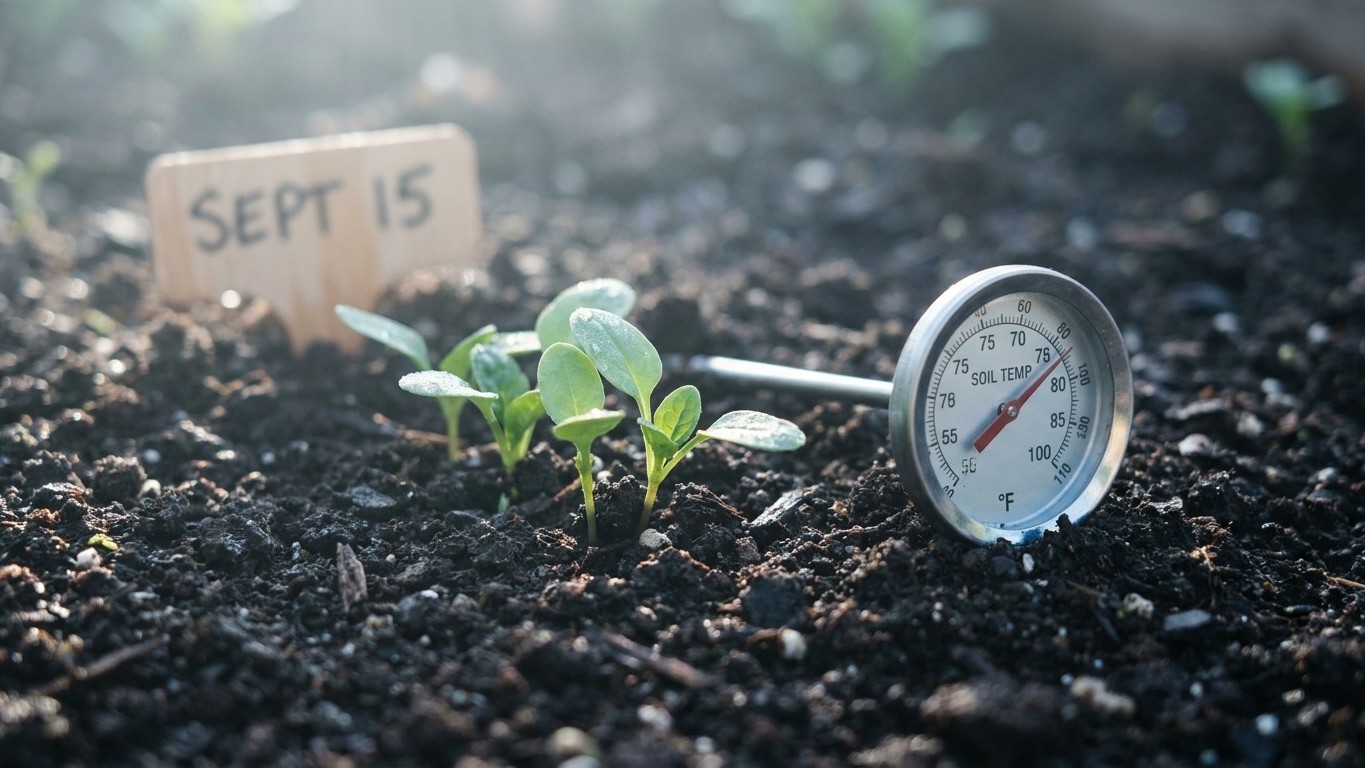
Spinach seed struggles to sprout once soil temperature climbs above 80F, according to Utah State University Extension. In Vermont, that’s less of a fight than it is in warmer states, since the region’s modest heat load (those same 5.4 days above 90F a year) means soil doesn’t stay pinned at germination-blocking temperatures for as long. Even so, midsummer sun can push the top few inches of soil past that mark for stretches in July, especially in exposed beds without mulch. Waiting for soil to cool, rather than watching the calendar alone, is the more reliable trigger for deciding when to sow. A simple soil thermometer pushed a couple of inches down settles the question faster than guessing from air temperature.
Four spinach varieties commonly grown for fall harvest are Bloomsdale, Melody, Teton, and Olympia. None of them come with published days-to-maturity figures from Utah State University Extension, and no seed company data is used here, so treat variety choice as a separate decision from the timing math below.
Counting back from the first frost
Utah State University Extension recommends sowing a fall crop 50 to 75 days before the date you want to harvest. Vermont’s first fall frost at the reference station falls between October 3 and October 13. Counting back from those dates gives a sowing window that runs from roughly July 20 through late August, depending on how close to frost you’re willing to harvest and how fast a particular planting matures.
| Reference point | Date range |
|---|---|
| First fall frost (Burlington) | October 3 to October 13 |
| 75 days before frost | around July 20 to July 30 |
| 50 days before frost | around August 14 to August 24 |
That gives a practical sowing window of late July into mid-August for most of the state, provided the soil has already cooled below the 80F germination ceiling by then. Gardeners in the Green Mountains or the Northeast Kingdom, where frost arrives earlier than at the lakeside reference station, should sow toward the earlier end of that range to keep enough growing days ahead of the freeze.
Common questions
Can I Sow Autumn Spinach earlier if I want a bigger harvest?
Only if the soil has already cooled below 80F. Sowing into soil that’s still warm from midsummer sun mainly wastes seed, since germination drops sharply above that threshold regardless of how much growing time is left before frost.
Does Vermont’s cooler climate mean I can sow spinach later in spring than warmer states?
No. The spring window closes because of lengthening daylight, not heat. Even in a cool Vermont June, long days push the plant toward bolting on their own.
Why does spinach behave the opposite of onions when it comes to day length?
The two crops respond to the same environmental cue in opposite ways. Long days trigger bulb formation in onions, which is a benefit in northern gardens. Long days trigger flowering in spinach, which ends the harvest window. Comparing day length across crops without noting which direction it works leads to bad timing decisions.
Is there a hard-freeze date I should plan around instead of the first frost?
The published data here covers the first fall frost window (October 3 to October 13) from NOAA NCEI climate normals at the Burlington reference station. No separate hard-freeze threshold is included in that data, so treat the first frost date as the planning line for fall harvest.