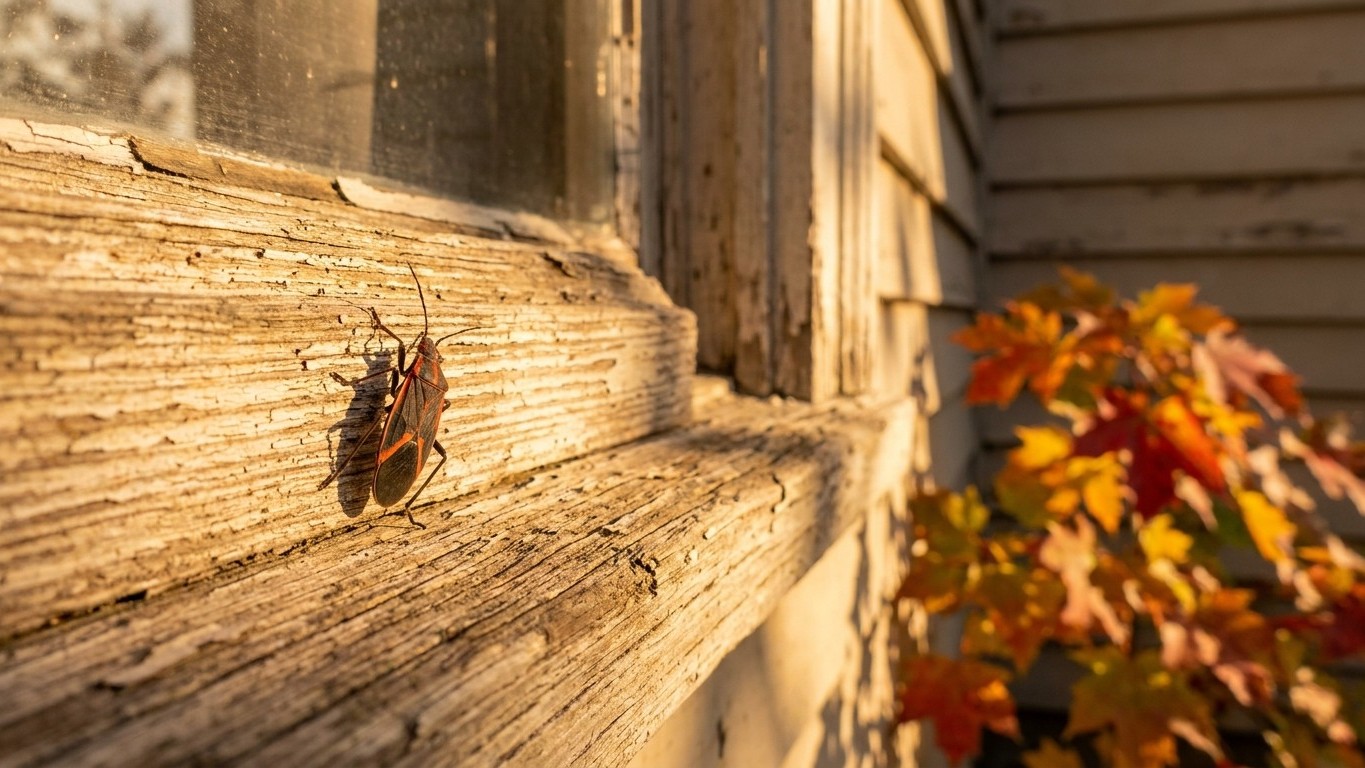

In Vermont, boxelder bugs show up twice a year with clockwork reliability: a spring emergence in April and May as overwintering adults leave their hiding spots, and a much larger fall swarm in September and October when new generations look for a place to spend the winter. Sealing gaps around windows, doors, and siding before that fall swarm begins is the single most effective way to keep them out of a house. Removing or managing female boxelder maple trees near the foundation cuts the problem at the source.
When boxelder bugs appear in Vermont, month by month

Vermont’s short growing season and long, cold winters actually work in a homeowner’s favor here. Unlike states with mild winters where boxelder bugs stay active longer, Vermont’s insects follow a tighter schedule tied to frost dates and daylight.
Adults that survived winter in wall voids, attics, or leaf litter start stirring as soon as daytime temperatures climb into the 60s, usually mid-April in the Champlain Valley and closer to early May in the Northeast Kingdom and higher elevations. They head straight for boxelder maples, ash trees, or silver maples to feed and lay eggs on developing leaves and flower clusters. This spring wave is usually small and easy to miss.
The real event happens in fall. Nymphs that hatched over summer mature by late August, and by mid-September, Vermont’s boxelder bug populations peak. Cooling nights push adults to seek warmth, and they gather by the hundreds on sun-facing walls, porch railings, and window frames, typically the south or west side of a house that catches afternoon sun. This behavior, called aggregation, is driven by heat and light, not by any interest in getting inside a home. But once temperatures drop toward freezing (which in most of Vermont happens by early October), those same bugs start squeezing through any crack they can find.
Why Vermont’s fall swarms feel worse some years
Population size swings from year to year based on the previous summer’s weather. A warm, dry spring followed by a hot summer lets more eggs hatch and more nymphs survive to adulthood, which means a bigger fall aggregation. Vermont recorded some of its warmer summer stretches in recent years, and pest control operators across Chittenden and Washington counties have reported heavier boxelder bug calls in years that followed those warm spells. A cool, wet spring has the opposite effect and tends to knock numbers down.
Why boxelder maples make Vermont a hot spot
Boxelder bugs (Boisea trivittata) are named for their preferred host, the boxelder maple, a fast-growing, weedy tree common along Vermont’s riverbanks, fence lines, and abandoned pasture edges. The tree tolerates wet soil and poor conditions better than most maples, which is exactly why it shows up uninvited in so many rural Vermont yards.
Only female boxelder trees matter here. The insects feed on and lay eggs in the seed pods that only female trees produce, so a property with a single male boxelder can host wandering bugs without ever becoming a breeding ground. Ash trees and silver maples serve as secondary hosts, which matters in parts of Vermont where ash was widely planted as a street tree before the emerald ash borer started killing them off statewide.
A property within 50 to 100 feet of a mature female boxelder maple is far more likely to see large aggregations than a home surrounded only by conifers or oaks. That range roughly matches how far the insects will fly or crawl to find a winter shelter, which is why removing a single problem tree near the house often makes a bigger dent in the population than any spray treatment.
What actually stops boxelder bugs in a Vermont home
Boxelder bugs don’t bite, don’t spread disease, and don’t damage wood or food. The entire problem is nuisance: swarms on siding, stained curtains and upholstery from crushed bugs (their body fluid can leave a reddish-orange mark), and the unpleasant smell they release when disturbed. That changes the calculus for control. Vermont extension entomologists and pest professionals consistently point to exclusion and habitat management over pesticide spraying, because chemical treatments on aggregating adults give short-lived results and do nothing to stop next year’s swarm.
Sealing the house before the fall swarm
Vermont’s older housing stock, plenty of farmhouses and homes built before 1980, tends to have more gaps than newer construction: loose window glazing, gaps around dryer vents and cable lines, unsealed sill plates where the foundation meets the wood frame, and torn or missing screens. Boxelder bugs are flat-bodied and can squeeze through openings as narrow as an eighth of an inch, roughly the width of a pencil eraser.
The window to act is late summer, before the September aggregation starts. Caulking gaps, replacing worn weatherstripping, repairing torn screens, and installing door sweeps on exterior doors closes off the entry points before bugs start looking for them. Waiting until bugs are already clustered on the siding means dealing with them one crack at a time instead of preventing the problem.
Managing the trees, not just the house
For a homeowner dealing with repeat infestations, the tree is usually the real target. Options include:
- Removing a female boxelder maple growing within 50 feet of the foundation, especially one planted close to a south- or west-facing wall
- Pruning seed pods off female trees in late summer before they mature, which reduces the food source that drives population growth
- Replacing problem trees with male boxelder cultivars or a different species entirely when replanting near a house
- Raking and removing leaf litter and mulch near the foundation each fall, since overwintering bugs hide there as readily as in wall voids
None of these steps require a permit for a single tree on private property in Vermont, though homeowners in designated shoreland zones along lakes and rivers should check with their town’s zoning office first, since Vermont’s Shoreland Protection Act restricts vegetation removal within 250 feet of many lakes.
Indoor cleanup: vacuum, don’t squash
Bugs that make it inside despite sealing efforts respond best to a shop vacuum or a vacuum with a disposable bag, emptied outside immediately afterward. Squashing them against curtains, walls, or upholstery is what causes the staining problem homeowners complain about most. A dustpan and broom work fine for larger clusters on hard floors.
Pesticide sprays labeled for boxelder bugs can help with a large indoor cluster, but Vermont pest control professionals generally treat exterior perimeter spraying as a short-term measure rather than a fix. Residual insecticides applied to foundation walls and around window frames in early September, just ahead of the aggregation, can reduce the number of bugs that make it inside that season. They won’t stop next year’s population if the host tree and entry points aren’t addressed.
Regional differences within Vermont
The Champlain Valley, with its longer growing season and higher concentration of maple and ash trees along the lakeshore, tends to see the heaviest boxelder bug activity in the state. Chittenden, Addison, and Franklin counties report the most calls to pest control services during the fall swarm.
Higher elevations in the Green Mountains and the Northeast Kingdom see lighter, later infestations, both because boxelder maples are less common in cooler, higher terrain and because the first hard frost, which often arrives by mid-September at elevation, cuts the aggregation period shorter than in the valley. Homeowners in towns like Island Pond or Craftsbury typically deal with a shorter, smaller version of the problem that valley residents face for a full month or more.
Timing exclusion work around the region’s own frost calendar makes more sense than following a fixed date. Watching for the first sustained stretch of 70-degree afternoons in September is a better trigger for final sealing checks than any specific date on a calendar, since Vermont’s fall weather varies enough from year to year to shift the whole swarm window by two or three weeks.