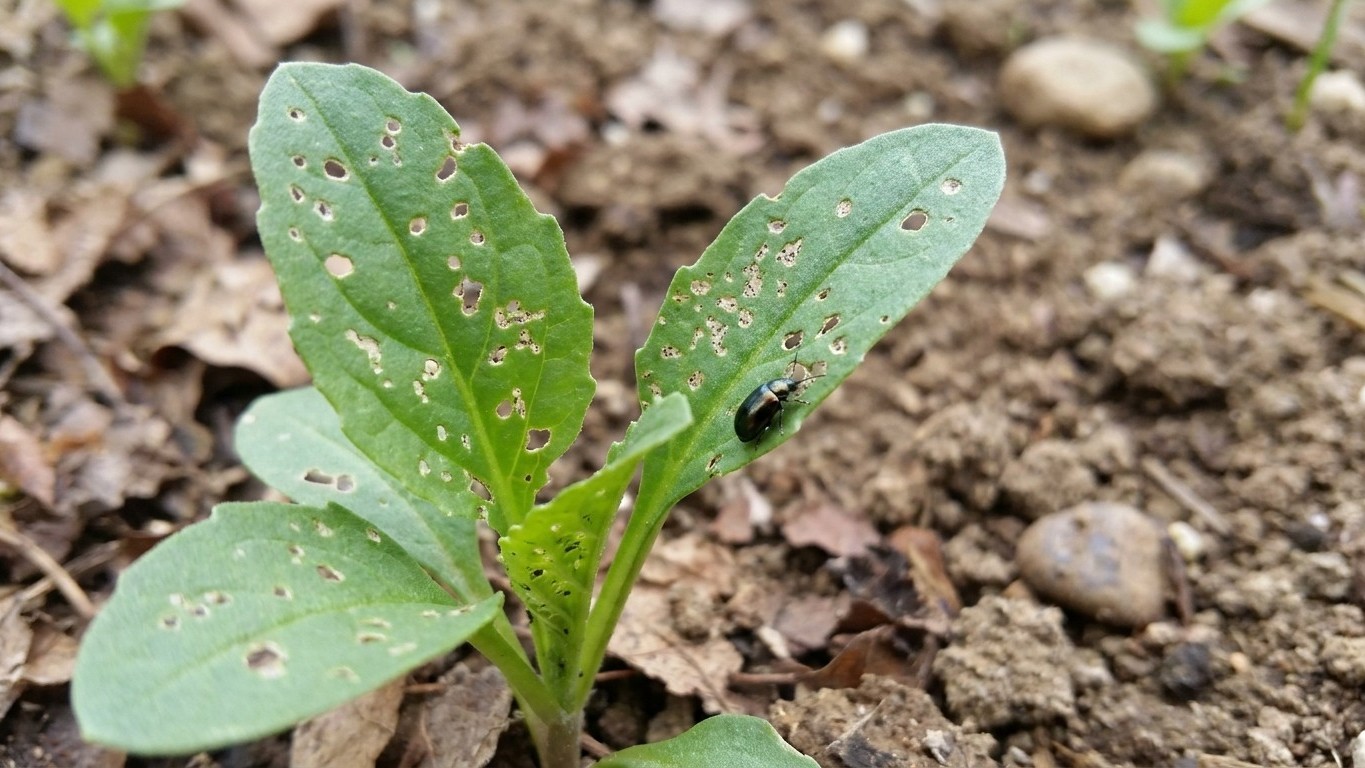

Flea beetles show up in Vermont gardens as soon as the soil hits roughly 50°F, which typically lands somewhere between late April in the Champlain Valley and mid-May in the Northeast Kingdom. What stops them is a mix of timing your planting around that emergence window, physical barriers like row covers, and knocking back the population before it reaches the two-generation threshold that turns a minor nuisance into a full leaf-shredding problem.
Vermont’s short, cool growing season actually works in gardeners’ favor here. Flea beetles need warmth to get moving, and the state’s clay-heavy soils in the Champlain Valley or the rocky ground up around St. Johnsbury hold cold longer than sandy soil farther south. That lag buys a week or two of protection if you know how to use it.
When Flea Beetles Actually Show Up in Vermont

Adult flea beetles overwinter as far as 4 to 6 inches deep in soil, leaf litter, and the edges of unmowed fields. They wait out the winter in a dormant state and start moving the moment soil temperatures climb into the upper 40s and low 50s. In practice, that means the first wave in Vermont hits somewhere between late April and the third week of May, depending on elevation and how quickly a given spring warms up.
The Champlain Valley, with its lake-moderated climate and longer frost-free stretch, sees activity earlier than the hills around Rutland or the higher terrain of the Northeast Kingdom. A backyard garden in Burlington might see the first shot-hole damage on radish leaves by the first week of May, while a garden in Craftsbury could stay quiet until closer to Memorial Day.
Vermont’s climate rarely supports more than one full generation before fall, but warm summers can push a partial second generation into late July or August. That second wave tends to hit later plantings of brassicas and can catch gardeners off guard because they’ve already stopped watching for the pest after the spring flush faded.
Cold Snaps Don’t Kill Them Off Completely
A late frost or a cold spell in early May slows flea beetles down but rarely eliminates them outright. Adults simply retreat into soil cracks and mulch until temperatures rebound. Vermont’s famously unpredictable spring weather, with its swings between 70°F afternoons and 30°F nights, means the emergence period can stretch out over several weeks rather than arriving all at once.
Which Vermont Plants Take the Worst Hit
Flea beetles aren’t picky, but a few crops common in Vermont gardens and small farms take disproportionate damage. Brassicas top the list, since kale, broccoli, and Brussels sprouts are staples in home plots across the state and are especially attractive to Phyllotreta species right after transplanting. The tiny shot-hole pattern they leave behind can skeletonize young seedlings within days if the population is heavy.
Potatoes come in close behind. Vermont has a long history with potato growing, and potato flea beetles (genus Epitrix) target the foliage of young plants just as they’re establishing root systems. Heavy feeding on potato leaves early in the season can measurably reduce tuber yield later, since the plant loses photosynthetic capacity right when it needs it most to build below-ground.
Eggplant is the third major target, and it’s the most vulnerable of the three. Eggplant seedlings grow slowly compared to tomatoes or peppers, giving flea beetles a longer window to feed on leaves before the plant can outgrow the damage. Gardeners who direct-seed eggplant, rather than transplanting larger starts, often see the worst losses because tiny cotyledons offer almost no buffer against feeding pressure.
What Actually Stops Flea Beetles in Vermont Gardens
Row covers remain the single most reliable physical barrier, and timing matters more than the material itself. Covers need to go on immediately after planting or transplanting, before adults find the row, and stay sealed at the edges with soil or landscape staples. Once flea beetles get under a cover, it traps them with the plants and makes things worse, so the cover has to go on clean and stay sealed until the seedlings are established enough to tolerate light feeding.
Delayed planting works surprisingly well for brassicas specifically. Pushing transplant dates back by even one to two weeks, until after the first heavy emergence wave has passed and started to decline, can mean the difference between a crop that shrugs off minor damage and one that gets shredded at the seedling stage. This trades a bit of harvest time for a much lower pest load, which for home gardeners is usually a fair swap.
Trap cropping gives flea beetles somewhere else to go. Planting a border of radishes, arugula, or other fast-growing brassica relatives a week or two before the main crop draws adults away from the plants you actually care about. Radishes germinate quickly and are cheap enough that losing the border planting to feeding damage doesn’t sting.
Kaolin clay, sold under various trade names as a spray-on particle film, coats leaves in a fine white layer that confuses flea beetles’ feeding and egg-laying cues without killing anything. It needs reapplication after rain, which in Vermont’s spring weather can mean spraying every few days, but it’s one of the few options that’s both effective and safe for pollinators.
Spinosad-based insecticides, derived from a naturally occurring soil bacterium, offer a targeted option when populations spike past what row covers and trap crops can handle. It’s most effective applied in the evening, since flea beetles are most active during warm daylight hours and residue breaks down faster in direct sun. Spinosad carries some risk to pollinators if applied while flowers are open, so timing sprays to avoid bloom periods matters for anyone growing squash, cucumbers, or other flowering crops nearby.
Soil Health Plays a Longer Game
Beneficial nematodes applied to soil in late summer or early fall target flea beetle larvae before they overwinter as adults. This is a slower, more preventive tactic than anything applied mid-season, but for gardeners dealing with repeat infestations year after year, disrupting the larval stage in the soil breaks the cycle more effectively than any spray applied to leaves in June.
Preventing Next Year’s Population Before This Season Ends
Sanitation after harvest matters more than most gardeners realize. Flea beetle adults overwinter in crop debris, weedy field edges, and undisturbed mulch, so clearing brassica and potato residue from the garden in fall, rather than leaving it to break down over winter, removes a chunk of the overwintering habitat before it gets used. Vermont’s cold winters won’t kill flea beetles hiding under leaf litter or in a compost pile insulated by snow, so the debris has to actually leave the garden, not just get pushed to the edge.
Crop rotation breaks the pattern flea beetles rely on. Moving brassicas, potatoes, and eggplant to a different bed each year, rather than replanting the same spot, forces emerging adults to travel farther to find a host plant. On a small suburban lot this might mean rotating between just two or three beds, but even that modest shift reduces how quickly a local population rebuilds.
Tilling in early spring, before adults emerge, exposes overwintering beetles to cold and predation from birds. This works best on beds that held heavily infested crops the previous season, since that’s where the highest concentration of overwintering adults will be sitting just below the surface.
Sticky traps in yellow, placed at plant height near vulnerable crops, won’t eliminate a population but they do give a useful early warning. Checking traps every few days starting in late April gives Vermont gardeners a data point for exactly when local emergence has started, which makes every other tactic on this list better timed and more effective.
Related guides
- Flea beetles in New Hampshire: When It Shows Up and What Stops It
- Flea beetles in Virginia: When It Shows Up and What Stops It
- Flea beetles in Washington: When It Shows Up and What Stops It
- Flea beetles in Ontario: When It Shows Up and What Stops It
- Flea beetles in Maryland: When It Shows Up and What Stops It