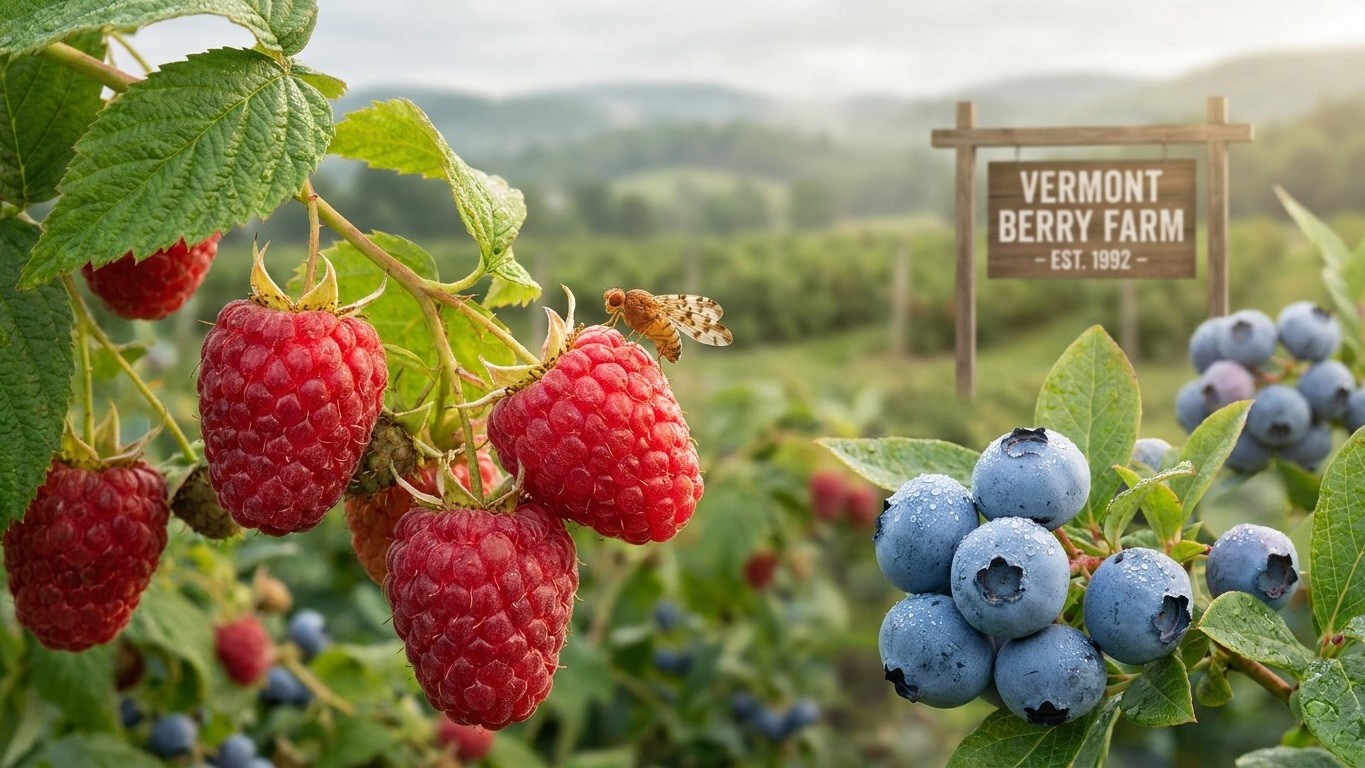

Spotted wing drosophila (Drosophila suzukii) shows up in Vermont like clockwork most seasons, with adult flies typically detected in traps by late June and populations exploding through July and August as raspberries, blueberries, and grapes ripen. What stops it isn’t a single spray or trap. It’s a combination of fast, frequent harvesting, sanitation in the field, exclusion netting for small plots, and targeted insecticide rotations timed to egg-laying windows. Vermont’s short but humid summers give this invasive fly exactly the conditions it needs, which is why timing matters more here than almost anywhere else in New England.
When Spotted Wing Drosophila Arrives in Vermont

This fly isn’t native to North America. It arrived from Asia and was first confirmed in California back in 2008, spreading east within a few years. Vermont growers started catching it in monitoring traps around 2011 and 2012, and it’s been a fixture of every summer since. Unlike common fruit flies that only bother rotting or damaged produce, the female SWD carries a serrated, saw-like ovipositor that lets her cut into firm, ripening fruit before it’s even ready to pick. That single anatomical difference is why this pest causes so much more economic damage than the fruit flies growers dealt with for decades.
Adults overwinter in leaf litter, stone walls, and brushy hedgerows across the state, tucking into protected spots once temperatures drop consistently below 50°F. Vermont winters are cold enough to kill off a large share of the overwintering population, but they don’t wipe it out completely. Enough flies survive in sheltered microclimates, especially along forest edges and near unmowed field borders, to restart the cycle once spring warms up.
Activity resumes when daytime temperatures hold steady above 50°F for several days in a row, which in most of Vermont means late April or May. Egg-laying accelerates fastest between 68°F and 77°F, a range Vermont hits reliably through July and into September. Interestingly, the fly’s reproduction actually slows once temperatures climb past 86°F, so the extreme heat waves that punish other pests barely dent SWD numbers here. Depending on the county and the season, Vermont typically sees somewhere between three and nine generations of the fly before cold weather shuts things down in October.
Which Crops and Regions Feel It Most
Soft-skinned fruit is the target list: raspberries, blackberries, blueberries, tart and sweet cherries, elderberries, and thin-skinned grape varieties. Strawberries get hit too, particularly late-season and day-neutral varieties still fruiting in July. Commercial orchards in the Champlain Valley and diversified fruit farms in Addison and Chittenden counties report some of the earliest and heaviest trap counts in the state, largely because that region combines warmer microclimates with dense fruit plantings.
Home gardeners in central and northern Vermont aren’t spared, either. Backyard raspberry patches and u-pick blueberry operations in the Northeast Kingdom see infestations too, just a few weeks behind the valley farms because of the cooler average temperatures. Wild hosts matter as much as cultivated ones. Wild blackberries, pokeweed berries, and even some ornamental honeysuckle varieties growing along fence lines and woodland edges act as reservoirs, letting the fly build up numbers well before it moves into a garden or commercial planting.
How Growers and Gardeners Detect an Infestation
Trapping is the first line of defense, and it’s simple enough for a home gardener to replicate. A plastic cup or deli container with small holes drilled near the top, baited with either apple cider vinegar or a yeast-sugar-water mix, catches adult flies that can then be checked under a hand lens for the male’s telltale wing spots. Females lack the spot but have that distinctive serrated ovipositor visible under magnification. Traps should go up by early June in southern Vermont and mid-June farther north, checked twice a week as fruit starts to color.
Once fruit is ripening, a salt flotation test tells growers whether larvae are already inside. Crushing a sample of fruit into a saltwater solution (roughly a quarter cup of salt per cup of water) forces any larvae present to float to the surface within 15 minutes. Finding even a few larvae in a sample means harvest intervals need to tighten immediately, because the fly’s life cycle from egg to adult can complete in as little as eight days during peak summer heat.
The University of Vermont Extension runs regional monitoring networks during fruit season, and many commercial growers rely on those weekly counts to decide when to spray rather than working off a fixed calendar. That kind of threshold-based approach, spraying only when trap counts justify it, has become the standard recommendation across most of the Northeast rather than blanket weekly applications.
What Actually Stops Spotted Wing Drosophila
No single tactic controls this fly on its own. The growers who keep losses manageable stack several tools together, starting with the cheapest and least disruptive ones.
Cultural controls that work first
Harvest frequency is the single biggest lever available. Picking ripe fruit every one to two days, rather than every three or four, removes the egg-laying sites the fly depends on before larvae have time to develop. Any dropped, overripe, or damaged fruit left on the ground or on the plant becomes a breeding ground, so removing and destroying that fruit (bagging it for trash pickup, not composting it on-site) cuts local populations noticeably within a couple of weeks.
Mowing field edges and cutting back wild blackberry and honeysuckle growth near plantings reduces the reservoir hosts that let populations build up early in the season. Pruning fruiting canes and bushes to open up the canopy also helps, since SWD prefers cool, shaded, humid conditions inside a dense canopy over sun-exposed fruit.
For small plantings, exclusion netting with a mesh size under 1 millimeter, installed before fruit starts to color and sealed at the ground, physically blocks adult flies from reaching the crop. It’s labor-intensive to install and remove, but for backyard raspberry rows or a handful of blueberry bushes it can eliminate the need for any spray at all. After harvest, refrigerating picked fruit within an hour or two slows larval development dramatically, since the fly’s egg and larval stages stall out below roughly 39°F.
When insecticides make sense
Cultural controls alone rarely hold the line on a commercial planting once populations build past a certain threshold, which is where insecticides come in as a supplement rather than the first response. Spinosad-based products are approved for organic production and remain effective against adult SWD when applied on a schedule tied to trap counts rather than the calendar. Conventional growers rotate between pyrethroids, spinosyns, and diamides to avoid building resistance, a real risk given how many generations this fly produces in a single Vermont summer.
Pre-harvest intervals matter enormously here because fruit is often picked within a day or two of ripening. Growers need to check label restrictions carefully, since some products carry pre-harvest intervals longer than the harvest window itself, effectively ruling them out for a crop being picked every other day. UVM Extension’s fruit and berry program publishes updated spray guides each season that account for these interval conflicts, and most commercial growers in the state check that guidance before finalizing a rotation.
A Practical Note on Timing
Vermont’s relatively short frost-free season, usually running from mid-May to late September in the warmer valleys, actually works slightly in growers’ favor compared to states with longer, hotter summers. Fewer generations mean less resistance pressure and a shorter window where intensive monitoring and harvest discipline are needed. The tradeoff is that the flies that do survive the winter tend to be concentrated in specific overwintering pockets, brushy hedgerows, stone walls, unmanaged field margins, making those exact spots the highest-value targets for early-season sanitation before fruit even sets.