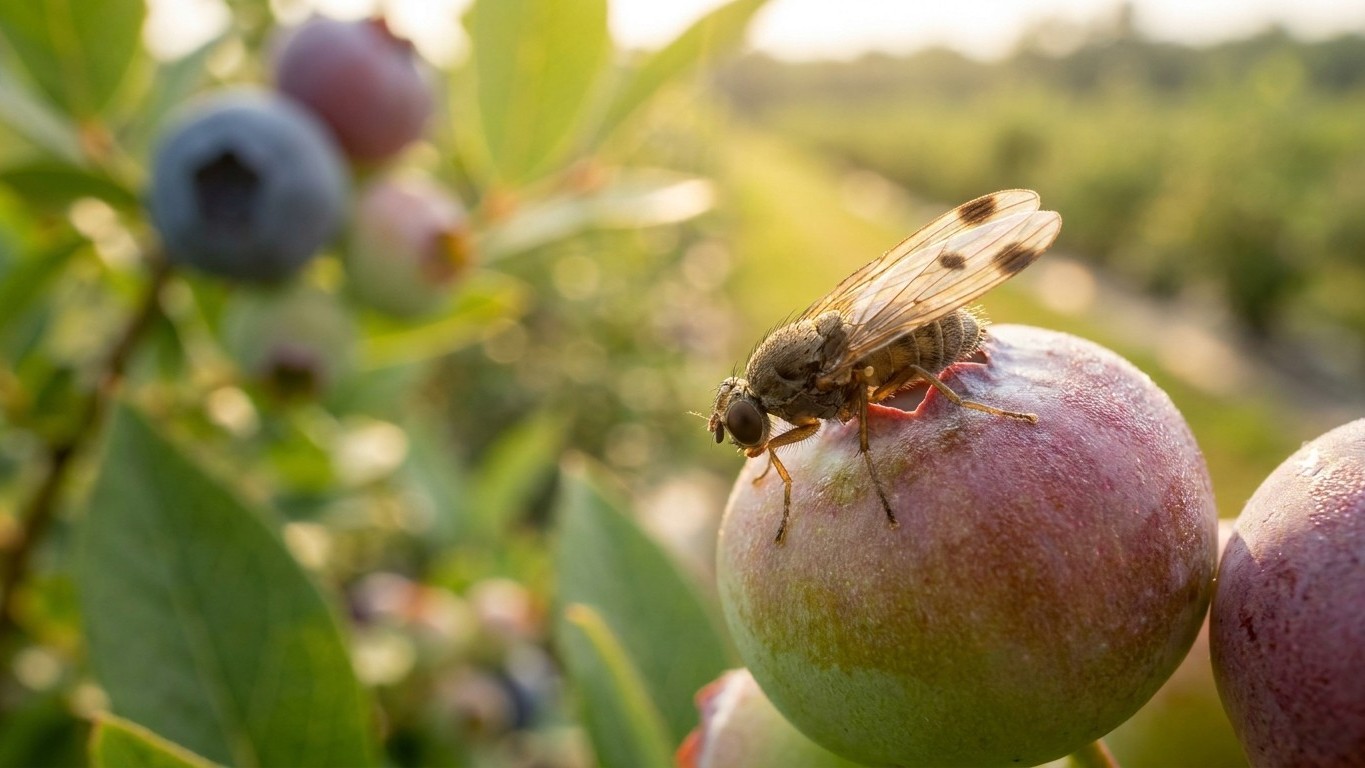

Spotted wing drosophila typically arrives in Maine by late May or early June, once daytime temperatures hold steady above 50°F, and its numbers climb fast enough that trap counts usually peak in August and September, right when wild blueberries, raspberries, and early apples are ripening. What stops it isn’t one product or one spray. It’s a combination of fast harvesting, cold storage, sanitation, and well-timed insecticide use, backed by weekly trap checks so growers and home gardeners know exactly when the fly is active on their property.
Why This Fruit Fly Is Different From the Ones in Your Kitchen

The fruit flies that show up around a bowl of overripe bananas can’t touch firm, healthy fruit. Their mouthparts and egg-laying anatomy only work on skin that’s already split or rotting. Spotted wing drosophila, Drosophila suzukii, breaks that rule entirely. Females carry a serrated, blade-like ovipositor that saws through intact skin on fruit that’s still firm and just starting to color up. That single anatomical difference is why this insect became an agricultural problem rather than just a kitchen nuisance.
The fly is tiny, roughly a tenth of an inch long, and males carry a single dark spot near the tip of each wing, which is where the common name comes from. Females have no wing spot but are identifiable under magnification by that saw-toothed egg-laying organ. It originated in East Asia and was first confirmed in the continental United States in California around 2008. Maine growers began reporting it within a few years after that, and by the early 2010s it was established in wild blueberry barrens and home gardens across the state.
What makes the pest hard to manage is speed. In warm weather, a single generation can complete its life cycle, egg to breeding adult, in as little as eight to ten days. Females can lay several hundred eggs over a lifetime. Depending on the summer’s temperature pattern, Maine can see anywhere from three to nine overlapping generations between spring emergence and the first hard frost, which means a small early infestation can turn into a heavy one within a few weeks if nobody’s watching.
Maine’s Seasonal Timeline, From Overwintering to Fall Decline
The flies don’t disappear over winter, at least not entirely. A “winter morph” of the adult, slightly darker and more cold-hardy than the summer form, hunkers down in leaf litter, hedgerows, and wooded edges near fruit plantings. Research from northern climates has shown these overwintering adults can tolerate brief cold snaps, but sustained deep freezes and repeated thaw-refreeze cycles kill off a large share of the population, which is part of why Maine’s winters actually help keep pressure lower than in milder mid-Atlantic states.
Survivors emerge as soon as spring temperatures stabilize, generally late May into June across most of the state, a bit later in northern Aroostook County. Early-season numbers stay low because wild host plants like honeysuckle, chokecherry, and pokeweed berries are still the main food source. The real population explosion tracks with the ripening of preferred fruit. Once wild lowbush blueberries start coloring in mid-to-late July, and cultivated raspberries and blackberries follow in August, trap counts across the state typically spike. September often brings the highest numbers of the season, right as fall raspberries and early apple varieties are coming off, before a sharp decline once nighttime temperatures drop into the 30s.
Which Maine Crops Take the Biggest Hit
Maine grows roughly 90 percent of the country’s wild lowbush blueberries, which makes the crop’s exposure to this pest a genuine economic concern rather than a backyard annoyance. But blueberries aren’t the only target:
- Wild and cultivated blueberries (lowbush and highbush)
- Raspberries and blackberries, both summer-bearing and fall-bearing varieties
- Strawberries, especially late-season and day-neutral plantings
- Sweet and tart cherries
- Grapes with thinner skins, and elderberries
Wild hosts growing along field edges, honeysuckle, wild grape, chokecherry, and pokeweed among them, matter more than most gardeners realize. They act as a bridge population, letting the fly survive gaps between when one crop finishes ripening and the next one starts. A homeowner who sprays a raspberry patch but ignores a wild blackberry thicket twenty feet away is really just managing half the problem.
What Actually Stops Spotted Wing Drosophila
No single tactic handles this insect well on its own. The approach that actually works layers several habits together, and most of them cost nothing but time.
Harvest frequency matters more than almost anything else. Picking ripening fruit every one to two days, rather than letting it sit an extra week, denies the fly the window it needs to lay eggs and complete development on the plant. Any fruit that’s overripe, split, or already dropped to the ground should be collected and destroyed, not left in the row or tossed in a compost pile sitting near the planting, since that fruit becomes a breeding reservoir.
Cold storage stops development in its tracks. Refrigerating harvested fruit at or below 40°F within a few hours of picking halts larval growth. This won’t remove larvae that are already present, but it prevents a light infestation from ballooning into a heavier one while the fruit sits on a counter.
Monitoring Before Spraying
University of Maine Cooperative Extension and similar programs in neighboring states rely on simple traps, often a plastic cup with drilled holes baited with a mix of apple cider vinegar and a splash of red wine or yeast-sugar solution, checked weekly starting in early June. The point of monitoring isn’t curiosity. It tells a grower or gardener exactly when the first flies show up in a given location and season, which is the trigger for starting an insecticide program rather than spraying on a fixed calendar date that may be a week too early or too late.
Once traps confirm the fly is active near ripening fruit, growers using insecticides need to rotate active ingredients to slow resistance and respect pre-harvest intervals listed on the product label, since many of these fruits are picked on a two-to-three-day cycle. Home gardeners spraying backyard berry patches should stick to products labeled for the specific crop and follow the same interval rules, because label instructions account for how quickly residue breaks down on soft fruit.
Exclusion and Sanitation for Small Plantings
For home gardens and small hobby plots, fine insect mesh netting, with holes smaller than one millimeter, draped over berry bushes before fruit starts to color can physically keep adult flies from reaching the crop at all. It’s labor-intensive to install and remove for picking, but it sidesteps the need for repeated spraying on a handful of backyard bushes.
Sanitation around the planting matters just as much as anything done to the fruit itself. Removing wild blackberry, wild grape, and honeysuckle growing within a hundred feet of a berry patch reduces the nearby population that would otherwise migrate in once the crop ripens. It’s not glamorous work, but pulling those wild hosts in early June, before they fruit, cuts off a food source the fly depends on to bridge the gap between spring emergence and the main harvest season.
Checking Fruit for Larvae at Home
A quick test can confirm whether harvested berries already carry larvae. Dissolve about a quarter cup of salt into four cups of warm water, crush the fruit gently into the solution, and let it sit for fifteen minutes. Larvae, if present, will float to the surface and become visible as small white specks against the dark liquid. This test won’t prevent an infestation, but it gives a clear answer before fruit gets served or preserved, and it’s the same basic method extension offices across the Northeast recommend to home growers who want to know what they’re actually dealing with before assuming the worst, or assuming everything’s fine.