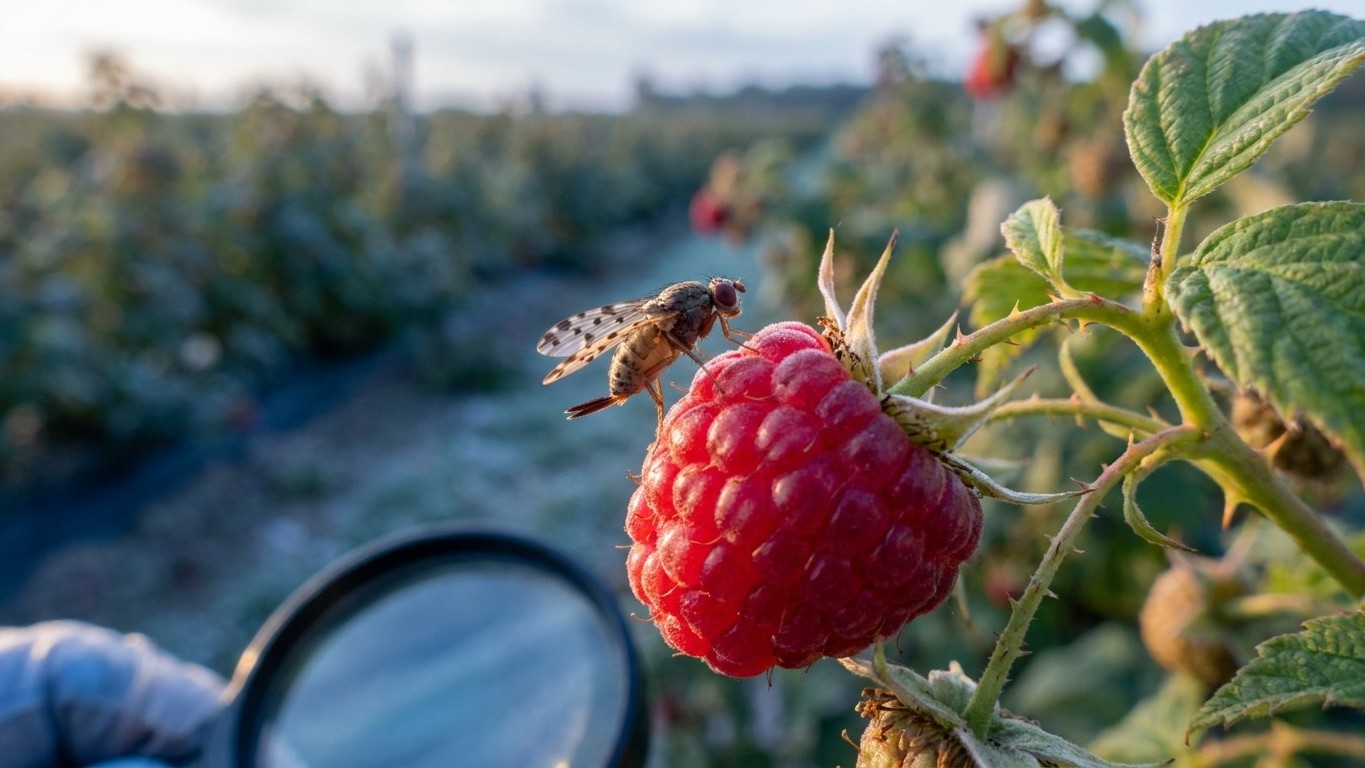

Spotted wing drosophila reaches Newfoundland and Labrador later than the rest of Atlantic Canada and builds up more slowly, thanks to the province’s short, cool growing season. Populations typically become a real threat to ripening soft fruit from mid-July through September, with risk peaking as berry harvest windows overlap with the last warm stretches before fall. Stopping it comes down to three things: early trap monitoring, fast fruit removal at harvest, and targeted insecticide timing when counts cross action thresholds.
What Makes This Fly Different From a Regular Fruit Fly

Most fruit flies you swat away from a bowl of overripe peaches only bother damaged or rotting produce. Spotted wing drosophila (Drosophila suzukii) skips that step entirely. The female has a saw-like ovipositor that cuts into intact, ripening fruit while it’s still firm on the plant, then lays eggs inside. The larvae hatch and feed from the inside out, so damage often isn’t visible until the fruit collapses or you bite into a soft spot days later.
Males are easy to spot under a hand lens: they carry a single dark smudge near the tip of each wing, which is where the pest gets its name. Females lack the spot but have a distinctly serrated egg-laying organ that separates them from native vinegar flies. This distinction matters for growers because native fruit flies are mostly a post-harvest nuisance, while spotted wing drosophila causes crop loss before the fruit ever leaves the plant.
The insect arrived in North America in 2008 and spread across the continent within a few years, reaching eastern Canada by the early 2010s. Newfoundland and Labrador’s isolation and cooler climate slowed that spread compared to Nova Scotia, New Brunswick, and Prince Edward Island, but monitoring programs on the island have confirmed its presence in soft fruit growing regions in recent seasons.
Seasonal Timing: When the Risk Window Opens
Adult spotted wing drosophila need air temperatures consistently above roughly 50°F to stay active and reproduce, with egg-laying and larval development speeding up as temperatures climb into the 68 to 77°F range. In much of Newfoundland, that window doesn’t open wide until mid-summer, and it closes fast once nighttime lows drop in September.
This compressed season changes the risk calculus compared to warmer provinces. In Nova Scotia, growers might watch for the pest from June through October. In Newfoundland, the practical monitoring period is narrower, often starting in early July and tapering off by early-to-mid October depending on the fall.
One quirk of the cooler climate: populations that do establish can build up quickly once temperatures cooperate, because the insect can complete a generation in as little as one to two weeks under warm, humid conditions. A mild, wet August can trigger a rapid jump in trap counts even if early summer numbers looked low. That’s why a single early-season trap check isn’t enough. Growers who monitor weekly catch the buildup before it hits fruit, while those who check monthly often find out only after damage appears.
Which Crops and Regions Face the Highest Exposure
Spotted wing drosophila targets thin-skinned, soft fruit, which lines up closely with what Newfoundland and Labrador actually grows and forages. The crops most exposed include:
- Cultivated strawberries and raspberries, especially on the Avalon Peninsula where most commercial small-fruit operations are concentrated
- Highbush and lowbush blueberries, both cultivated plots and wild barrens harvested commercially
- Partridgeberries (lingonberries), a wild crop with major cultural and commercial value in the province
- Bakeapples (cloudberries), though their firmer skin and boggy habitat offer some natural resistance
- Backyard raspberry canes and currant bushes, which often go unmonitored and can act as a reservoir population near commercial fields
Wild berry patches deserve particular attention because they’re rarely sprayed or monitored, yet they sit close to commercial fields and home gardens across the island. A patch of unmanaged wild raspberries at the edge of a farm can quietly host a growing spotted wing drosophila population all summer, then seed nearby crops once fruit ripens there too.
Coastal and sheltered valley locations with higher humidity, common along parts of the Avalon and the west coast near Corner Brook, tend to hold moisture longer in the fruit canopy. That humidity is exactly what the pest favors, so shaded, dense plantings in these areas often see higher trap counts than open, wind-exposed fields.
Monitoring: Catching It Before It Costs You a Crop
The standard trap is simple and inexpensive: a small container with holes drilled near the top, baited with apple cider vinegar or a yeast-sugar-water mix, and hung in the shaded lower canopy where humidity stays high. Traps should go up as soon as fruit starts to color, not after it’s ripe, since the goal is catching the first arrivals before egg-laying begins in earnest.
Checking traps weekly is the practical minimum during the active season. A jump from zero to a handful of flies in one week, especially after a stretch of warm, humid weather, is the signal to shift from watching to acting. Many extension programs across Canada use a simple threshold: once a trap consistently catches adult flies near ripening fruit, treatment decisions should follow within days, not weeks, because egg-to-adult development can complete in under two weeks in warm conditions.
A salt-water float test on harvested fruit backs up trap data. Crushing a sample of ripe berries into a saltwater solution forces any larvae inside to float to the surface within 15 minutes, giving growers and home gardeners a direct read on infestation levels rather than relying on trap counts alone.
Signs of Infestation in the Field
Fruit that looks fine on the outside but collapses or weeps juice within a day or two of picking is the classic tell. Raspberries in particular go from firm to mushy fast once larvae are feeding inside, sometimes within 24 to 48 hours of otherwise looking market-ready. Blueberries show it differently, with a soft, slightly sunken spot on otherwise intact fruit.
What Actually Stops It: Cultural, Biological, and Chemical Controls
No single tactic handles spotted wing drosophila on its own. The pest’s ability to attack fruit while it’s still firm and its short generation time mean control programs work best layered together, starting well before harvest and continuing through the season.
Sanitation is the highest-leverage, lowest-cost tool. Picking every ripe and overripe berry on a regular schedule, rather than letting fruit hang and soften on the plant, removes the egg-laying targets the pest depends on. Dropped or rotting fruit on the ground under bushes should be collected and destroyed rather than left to rot in place, since it acts as a breeding site even after commercial harvest ends.
Pruning for airflow reduces the shaded, humid microclimate spotted wing drosophila prefers. Opening up raspberry canes and blueberry bushes so sunlight and wind reach the fruiting zone lowers humidity inside the canopy, making the environment less hospitable even without any spray applied.
Exclusion netting, fine mesh draped over rows before fruit colors, physically blocks adult flies from reaching ripening berries. It’s labor-intensive to install and remove but has become a standard tool on smaller commercial plots and in home gardens where spray options are limited or unwanted.
When chemical control is warranted, insecticides labeled for spotted wing drosophila in small fruit, including products based on spinosad and several pyrethroid formulations, work best applied on a tight rotation once trap counts cross threshold, with attention to pre-harvest intervals since these are edible fruit crops with short times between spray and picking. Rotating between different modes of action helps slow the development of resistance, a documented issue with this pest in regions where it’s been established longer, such as parts of the Pacific Northwest and the Maritimes.
Cold storage adds a final layer of protection after harvest. Refrigerating picked berries at or below 34°F within a few hours of picking slows larval development inside any infested fruit that slipped past field controls, buying time before spoilage becomes obvious and giving processors a window to sort product before it reaches consumers.
Biological control remains limited in the province. Parasitic wasps that attack spotted wing drosophila in its native range in Asia have been studied for release in North America, but none are currently established as a management tool in Newfoundland and Labrador. For now, the fight stays squarely in the hands of trapping, sanitation, and well-timed sprays.
Related guides
- Spotted wing drosophila in Quebec: When It Shows Up and What Stops It
- Spotted wing drosophila in Nova Scotia: When It Shows Up and What Stops It
- Spotted wing drosophila in Ontario: When It Shows Up and What Stops It
- Spotted wing drosophila in Prince Edward Island: When It Shows Up and What Stops It
- Spotted wing drosophila in Vermont: When It Shows Up and What Stops It