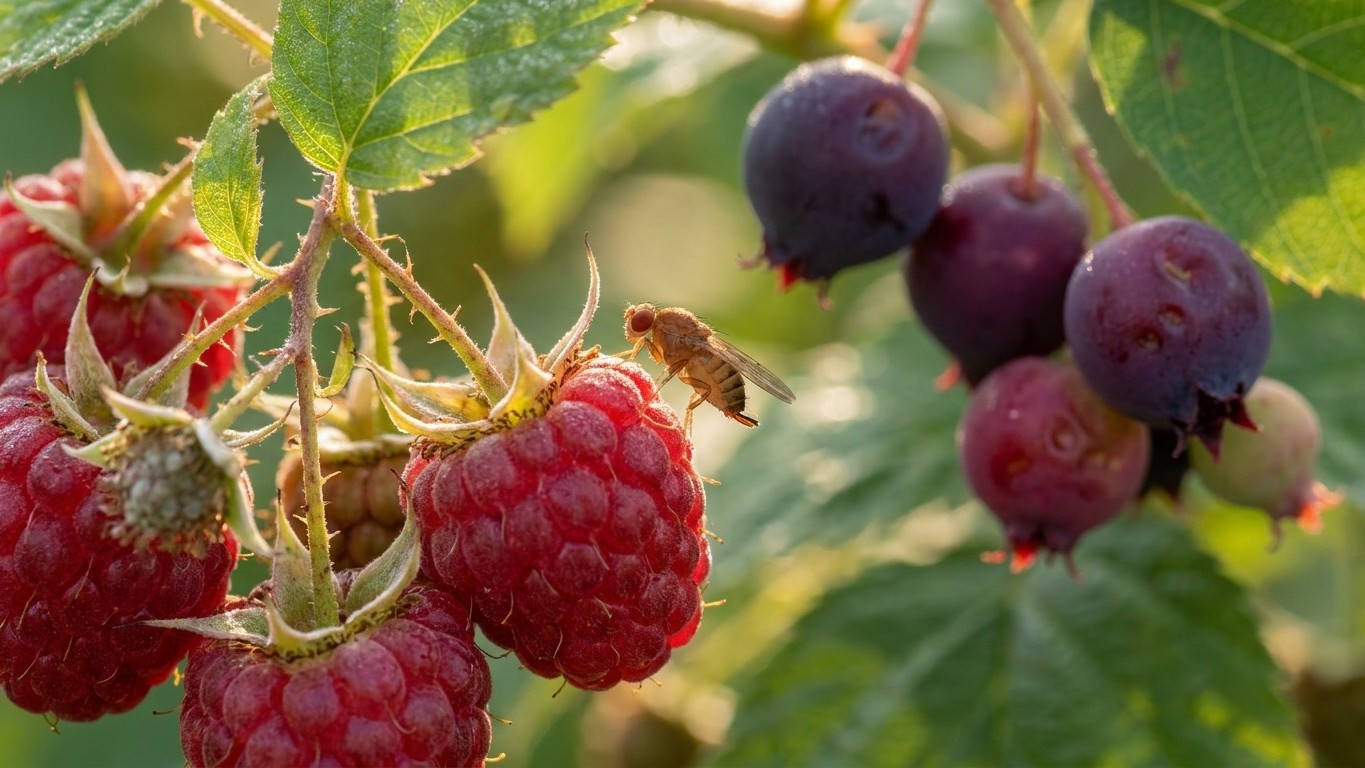

Spotted wing drosophila becomes a real threat to Manitoba berry crops from early July through the first hard frost, with the heaviest damage hitting raspberries, saskatoons, and haskap during the muggy stretches of August. The insect doesn’t wait for fruit to rot on the ground like a typical fruit fly. It cuts into fruit while it’s still ripening on the plant, which is exactly why growers and backyard gardeners across the province lose crops before they even notice a problem.
The Insect Behind the Damage

Spotted wing drosophila, or SWD (its scientific name is Drosophila suzukii), is a fruit fly native to Southeast Asia. It showed up in California around 2008, worked its way north through British Columbia within a couple of years, and eventually turned up in prairie monitoring traps during the mid-2010s. Manitoba’s climate isn’t its ideal habitat, but the province’s warm, humid summers give it just enough window to cause serious economic damage to soft-fruit growers.
What makes this fly different from the common fruit flies buzzing around your kitchen compost is a small but nasty adaptation: the female has a serrated, saw-like ovipositor. Regular fruit flies can only lay eggs in fruit that’s already soft, bruised, or overripe. SWD females saw straight through the skin of firm, ripening fruit and deposit eggs inside. The fruit looks fine on the outside for a day or two, then collapses from the inside as larvae feed.
Adults are tiny, about 1/8 inch long, tan to brown with red eyes. The trait growers look for is on the males: a single dark spot near the tip of each wing, visible with a hand lens or a decent phone camera zoom. Females lack the spot, which is why trapping programs rely on catching both sexes and checking for the telltale ovipositor under magnification.
Manitoba’s SWD Calendar: From Spring Wake-Up to Fall Shutdown
Unlike some pests that arrive on a predictable date, SWD activity in Manitoba tracks temperature and moisture more than the calendar. Adults overwinter in leaf litter, brush piles, and wooded edges near fields and gardens. As soon as spring temperatures hold steadily above roughly 50°F, usually by mid-to-late May in southern Manitoba, overwintered adults become active and start looking for early host plants like wild chokecherry or pin cherry.
Populations stay low through June because generation turnover is slow at cooler spring temperatures. The real jump happens once daytime highs settle into the 70s and 80s with decent humidity, typically from early July onward. Under those conditions, an SWD generation can complete an egg-to-adult cycle in as little as eight to ten days. That speed compounds fast: a small population in early July can explode into a damaging one by the time raspberries and saskatoons hit peak ripeness in late July and August.
Fall brings a second consideration. As temperatures cool in September, adult flies shift into a darker, more cold-tolerant form built to survive winter. This overwintering generation is why growers can’t just relax once the main harvest wraps up, late-season raspberries and fall-bearing varieties remain at risk right up until frost shuts everything down.
Why Manitoba’s Prairie Climate Slows It Down (a Little)
Compared to the Pacific Northwest or Ontario’s fruit belt, Manitoba’s shorter, drier growing season and colder winters keep SWD populations from reaching the extreme densities seen in wetter coastal regions. That’s the good news. The bad news is that even a moderate population arriving at the wrong time, right as raspberries color up, can wipe out a harvest window in days. Growers can’t count on climate alone to manage the pest.
Spotting the Damage Before It Spreads
By the time fruit visibly collapses, the damage is already done. Effective monitoring means catching adults before they lay eggs in significant numbers, and checking fruit for early signs while there’s still time to act.
Traps built from small containers with mesh lids, baited with a mix of apple cider vinegar and a bit of yeast-sugar solution (or commercial SWD lures sold through agricultural suppliers), give the earliest warning. Checking traps weekly starting in late June, before harvest even begins, lets growers know when the first wave of adults arrives in their area rather than finding out after fruit is already infested.
On the fruit itself, look for tiny puncture marks, a slight softening or “weeping” of the skin, and a faint sunken depression that wasn’t there the day before. Cutting open suspect berries and soaking them in a saltwater solution (about a tablespoon of salt per cup of water) for fifteen minutes will float any larvae to the surface, a simple check anyone can do at home without a microscope.
Raspberries and blackberries are usually the first crops to show damage in a Manitoba season because their soft flesh and clustered drupelets give larvae easy entry points. Saskatoons and haskap follow close behind. Strawberries, oddly, tend to see less pressure since most varieties finish fruiting before SWD populations peak in July.
What Actually Stops Spotted Wing Drosophila
No single tactic knocks this pest out on its own. Growers who manage it well combine sanitation, physical barriers, targeted trapping, and, when necessary, timed insecticide applications.
Sanitation and Harvest Timing
This is the least glamorous control method and also the most effective one. SWD needs ripe or ripening fruit to reproduce, so removing that resource cuts populations directly.
- Harvest fruit every one to two days during peak season instead of waiting for a full basket’s worth to ripen at once.
- Pick and destroy overripe, damaged, or fallen fruit immediately rather than leaving it on the plant or the ground, where it becomes a breeding site.
- Clear brush, wild berry patches, and hedgerow fruit near cultivated plots since these act as reservoir populations feeding the main crop.
- Keep the canopy pruned and open so fruit dries faster after rain; SWD favors the humid, shaded microclimate of a dense, unpruned bush.
None of this requires special equipment or spending, just consistency during the six to eight weeks when the pest pressure peaks.
Exclusion Netting and Traps
Fine insect mesh (with holes smaller than about 0.98 mm, the standard SWD-exclusion size) draped over rows or high tunnels physically blocks adults from reaching fruit. It’s labor-intensive to install and manage, especially for larger plantings, but for backyard growers with a handful of raspberry canes or a saskatoon hedge, netting is often the single most reliable non-chemical control available.
Mass trapping, setting out a dense grid of vinegar-baited traps around the perimeter of a planting, can reduce adult numbers enough to matter on a small scale, though research generally shows it works better as an early-warning tool than as a standalone control for larger commercial plots.
When Insecticides Make Sense
For commercial growers facing heavy pressure, insecticides remain part of the toolkit, but timing matters more than product choice. Sprays need to target the adult stage before egg-laying happens, since once larvae are inside the fruit, no surface treatment reaches them. Products containing spinosad are commonly used in organic and conventional programs alike because of their effectiveness against adult SWD and relatively short pre-harvest intervals, which matters for a crop being picked every couple of days.
Rotating between different insecticide classes, rather than relying on the same product all season, helps slow resistance development, a growing concern in regions with heavy SWD pressure like parts of the U.S. Pacific Northwest. Manitoba’s shorter season and lower overall pest density mean resistance hasn’t become the same problem here yet, but the same rotation principle still applies as good practice.
Manitoba Agriculture’s crop protection guides, along with regional extension offices, publish updated lists of registered products for berry crops each season, since approvals and pre-harvest intervals change and vary by crop. Checking those before spraying is the only way to know a product is both legal and safe for the specific fruit being treated.
One detail that surprises a lot of home gardeners: SWD doesn’t just target cultivated fruit. Wild chokecherries, pin cherries, and even ornamental Amur cherry trees planted for landscaping can host early-season populations that later move into garden raspberries and saskatoons once cultivated fruit ripens. Anyone dealing with recurring SWD trouble might get more mileage from checking, and cleaning up fruit drop under, nearby wild or ornamental trees than from another round of spraying the berry patch itself.
Related guides
- Spotted wing drosophila in Ontario: When It Shows Up and What Stops It
- Spotted wing drosophila in Minnesota: When It Shows Up and What Stops It
- Spotted wing drosophila in New Brunswick: When It Shows Up and What Stops It
- Spotted wing drosophila in Newfoundland and Labrador: When It Shows Up and What Stops It