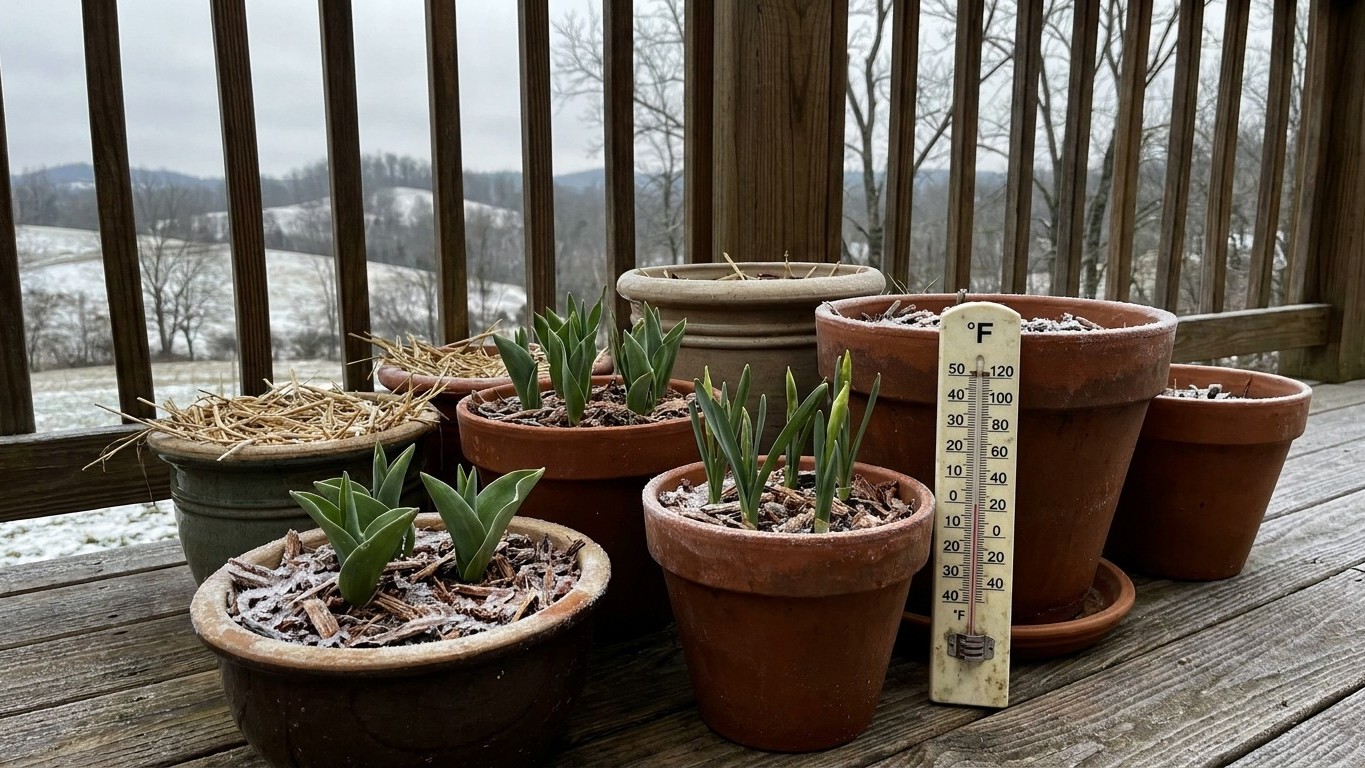

West Virginia’s winters run cold enough, most years, to satisfy a spring bulb’s dormancy requirement without any help from a gardener. The trouble for anyone growing in a pot isn’t a shortage of cold, it’s an excess delivered too fast, straight through soil with no buffer. The fix is either moving the container or matching the bulb to what a pot alone can survive outside.
Why this matters in West Virginia

The number that settles this is 26.1°F, the mean daily minimum of the coldest month at the NOAA NCEI reference station in Charleston, based on the 1991-2020 climate normals. That’s the average low on a typical night in January, not a record cold snap. A spring bulb needs roughly twelve to fourteen weeks below 45°F to break dormancy properly, and a Charleston-area winter clears that bar with room to spare. Nobody here needs a refrigerator to fake a winter their yard already delivers.
That settles the forcing question for garden beds. Containers are a separate problem entirely. The USDA Plant Hardiness Zone Map (2023, built on the 1991-2020 normals) puts the state across a 5a-7a range, and Charleston, the same station behind the temperature figure above, sits within that band. In a garden bed, soil eight to twelve inches down almost never freezes solid, even in a hard winter, because the ground insulates itself. A pot has no such insulation. Surrounded by air on every side, a container’s soil tracks the outside air temperature almost exactly, which means a bulb rated hardy to Charleston’s zone in open ground can freeze through, roots and all, in the same zone when it’s sitting in a pot on a porch.
This is the gap that trips people up. A tulip bulb tagged hardy to zone 5 will winter over fine in a Charleston garden bed. The identical bulb, in a terra cotta pot left on a deck through the same January, is effectively facing colder conditions than its rating, because the pot walls offer no thermal mass. Elevation makes this worse in the eastern mountains and better in the lower river valleys, since the 5a-7a range spans real differences in how cold a given night actually gets depending on where in the state you’re standing. The practical result: container growers here need to treat their pots as roughly two zones colder than the ground beneath them, and plan around that gap rather than around the zone number printed on a bulb bag.
How to do it here
Growing spring bulbs in containers in this state comes down to a sequence, and each step is one a gardener can check without guessing.
- Pick a pot with real drainage holes. Not a decorative liner, a container that lets water leave the bottom freely. Standing water in a freeze cycle is what kills roots, not the cold by itself.
- Plant at the depth the bulb tag specifies, in fresh potting mix, not garden soil. Garden soil compacts in a container and drains poorly; commercial potting mix doesn’t.
- Decide where the cold will come from. Since Charleston-area winters already run well below the 45°F threshold, an unheated garage or shed that still stays above freezing works as a chilling space for pots you want to control, or the pot can simply stay outside if it’s protected (see next step).
- If chilling indoors, use a spot that never sees ripening fruit. A refrigerator crisper drawer works, but apples, pears, and other ripening fruit release ethylene gas, and ethylene kills the flower bud forming inside a chilling bulb. Keep the drawer fruit-free for the full twelve to fourteen weeks.
- If leaving the pot outside, treat it as two zones colder than the ground. Group pots together against a wall, wrap the sides in burlap or bubble wrap, or sink the whole pot into a garden bed up to its rim and mulch over the top. Any of these narrows the gap between pot and ground temperature.
- Move indoors to bright, cool light (roughly 55 to 65°F) once the cold period ends. A sudden jump to a warm, dark spot is what produces weak, floppy growth later.
Which bulbs are worth it
Not every bulb pays back the trouble of a pot. Some finish their chilling requirement quickly and stay short enough to hold themselves up; others take too long, grow too tall, or simply don’t handle root confinement well.
- Crocus, short cold requirement, low growth habit that never needs staking in a pot.
- Muscari (grape hyacinth), same story, compact and forgiving of container life.
- Hyacinths, reliable bloom, sturdy stems that tolerate pot growing well.
- Daffodils, standard and dwarf varieties, dependable once chilling is met, though full-size trumpet types can lean in a lightweight pot.
- Tulips, force reliably and, since most hybrid tulips rarely rebloom well after a first season anyway in this climate, a container is a fine one-time use for them. Forcing costs nothing you weren’t already going to lose.
- Alliums, a long cold requirement combined with tall, top-heavy flower heads that tip pots over.
- Fritillaria, finicky about moisture in a container and prone to rot before bloom.
- Camassia, tall stems and a chilling window that doesn’t align well with typical pot management.
- Large trumpet daffodils in narrow or lightweight pots, the bulb forces fine, but the stem height overwhelms a small container’s stability.
What goes wrong, and when you can still fix it
Leaves but no flower
This means the chilling period ran short. The bulb produced enough energy for foliage but never finished the biochemical work that builds a flower bud. There’s no fix for the bulb this season; let the leaves die back naturally to feed the bulb, then give it a full twelve to fourteen weeks below 45°F next winter.
A flower stalk too short to see
This happens when the pot moved from cold to warm too fast, or into too much direct heat right after chilling ended. The stem never had time to elongate before the flower opened. This season’s bloom is what it is; the fix is a slower, cooler transition (that 55 to 65°F window) next time.
Soft, rotten bulbs in the pot
Rot almost always traces back to a pot that never drained, either from blocked holes or soil packed too tight. Rotted bulbs won’t recover this season or any other; they’re compost now. The lesson carries forward: confirm drainage holes are open before planting the next batch, and use a mix loose enough to let water pass through in minutes, not hours.