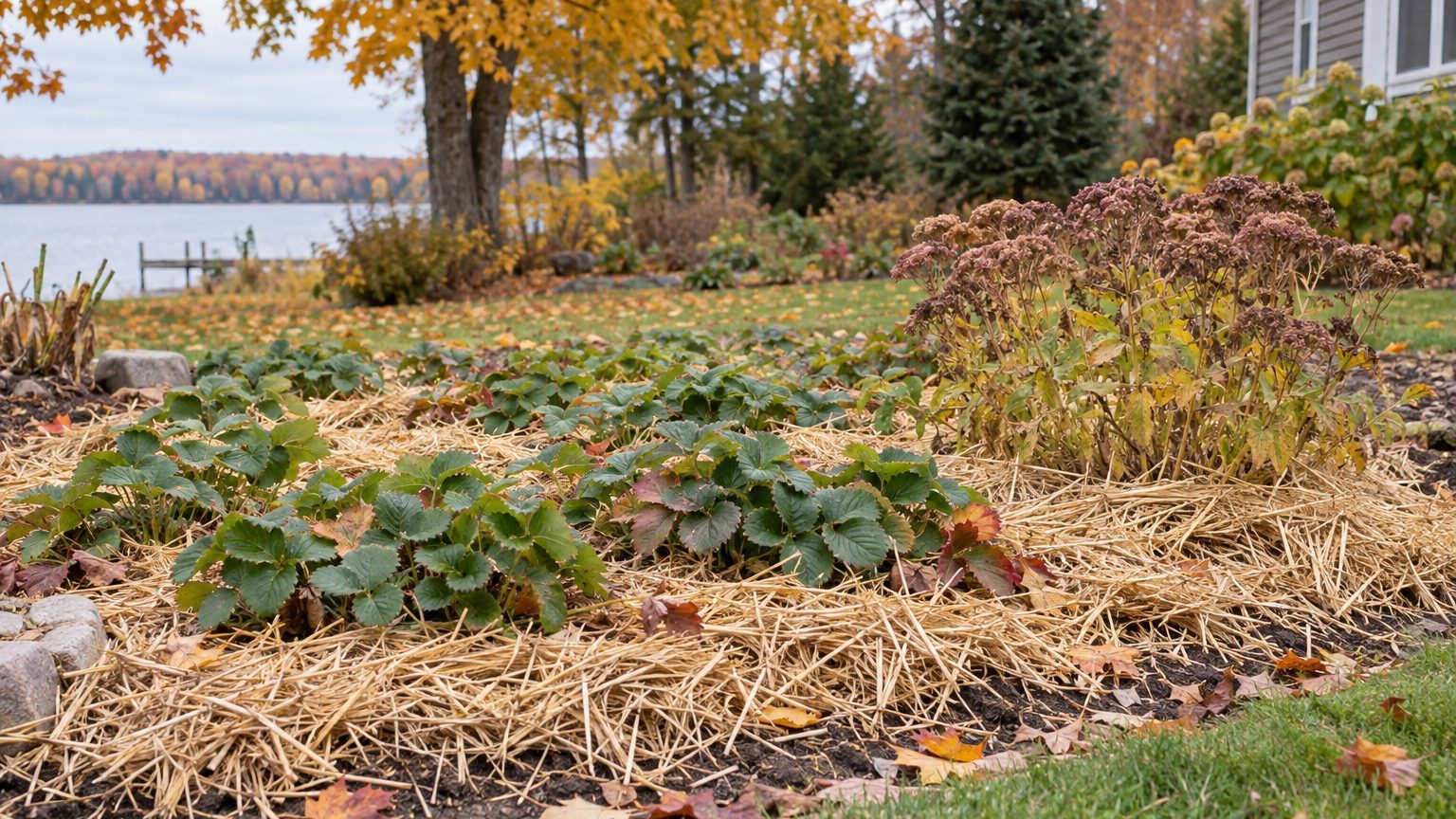

Winter mulch goes on after the ground starts to freeze. In Seattle, NOAA’s 1991-2020 Climate Normals put the first fall freeze between November 13 and November 30, so strawberries and perennials get their mulch in the weeks after that window closes. West of the Cascades, mulch mostly holds moisture and blocks weeds. East of the mountains, in the colder country, it keeps soil frozen through winter thaws.
When to put winter mulch down in Washington
The Seattle station sets the frame for western Washington. NOAA’s 1991-2020 Climate Normals (station USW00024233) give a 30 to 70 percent probability of a 32°F freeze between November 13 and November 30. In a typical year, the first freeze lands somewhere in that stretch of late fall. The same normals put the mean daily minimum of the coldest month at 37.1°F, which sits above freezing. Nights get cold, but the average low never reaches the point where soil locks up.
Does western Washington need winter mulch at all?
Not as a thick blanket. Soil in the Seattle-area lowlands does not stay frozen through winter, so watch the soil and dig when it is workable. Mulch there does three smaller jobs. It holds moisture in beds, it smothers the weeds that grow all winter in the wet season, and it gives you something to pull over a plant on the occasional clear, calm night that dips to 32°F.
The timing follows from that. Wait until the first fall freeze has passed (November 13 to November 30 at Seattle), then mulch in the weeks after. Mulch laid in October, while the soil is still warm and wet, holds that wetness against stems and crowns, and rot follows. Frost dates shift from town to town, so check the First and Last Frost Dates in Washington for your own area before you pick a weekend.
What changes east of the Cascades and at higher elevations?
Eastern Washington beyond the Cascades is high desert with a far shorter season, and the USDA Plant Hardiness Zone Map (2023 edition, built on 1991-2020 normals) runs from 4a to 9a across the state. One date cannot serve everyone. In the colder parts, the first fall frost arrives earlier than Seattle’s window, so the calendar date for mulching moves earlier too. The rule stays the same: let the soil begin to freeze first, then cover it so it stays frozen. A bed that freezes, thaws in a warm spell and freezes again is the one that damages plants.
| Situation | Does the soil freeze? | What mulch does | When it goes on |
|---|---|---|---|
| Seattle and the western lowlands | Not in a typical winter (coldest-month mean low of 37.1°F) | Holds moisture, suppresses weeds, covers plants on frost nights | In the weeks after the November 13 to November 30 first-freeze window |
| East of the Cascades and higher elevations | Usually, for at least part of winter | Keeps soil frozen and stops heaving | Once the soil starts to stiffen, which comes earlier on the calendar than in Seattle |
Farther north still, in places like Newfoundland and Labrador, the frozen-ground logic applies from start to finish. In a warm-winter state such as Mississippi, mulch is mostly a moisture and weed tool, much like it is in western Washington.
Strawberries
Why do strawberry crowns need winter mulch?
The crown is the short, thick stem at soil level where leaves and next year’s flower buds start. It sits right at the surface, exposed to cold air and to whatever the soil does underneath it. In places where soil freezes and thaws repeatedly, the crown gets pushed up out of the ground (heaving), roots snap, and the plant dries out. That is the east-of-the-Cascades and higher-elevation problem, and straw is the answer there.
In the Seattle lowlands, the coldest-month mean low is 37.1°F (NOAA NCEI Climate Normals, 1991-2020), so heaving is rare. Straw does lighter work. It keeps rain from splashing soil onto the plants, holds moisture, suppresses winter weeds and can be pulled loosely over the plants on a frost night.
Use clean straw. Hay carries seed heads and brings a fresh crop of weeds with it. Straw also stays fluffy, so air still reaches the crowns, where a soggy mat of wet leaves would hold water against them. If you are building a new bed or planning varieties, the notes on Growing Strawberries cover the rest of the year.
How deep should straw go, and when does it come off?
NC State Extension’s Gardener Handbook, chapter 11, says it this way: “A 2-inch to 3-inch layer of mulch suppresses most annual weed seeds and makes it easy to hand-pull any that do germinate.” Start inside that range. Straw settles over the winter, so a loose layer at the high end of the range ends up thinner by spring. More is not better, and a heavy pile holds wet against the crowns.
Apply it after the first fall freeze (November 13 to November 30 at Seattle) once the plants have slowed down for the season. In the colder parts of the state, wait for the soil to start freezing, then lay the straw over the whole bed, crowns included. The leaves will flatten under it and the crowns stay protected.
Spring is where people slip. Pull the straw back off the crowns as soon as new growth shows, then tuck it between the rows. In the western lowlands that can be late winter. In the colder country it comes later, after the soil has thawed for good. Leave the straw close at hand for the late frost, and use it in the aisles to keep the fruit clean.
Perennials and borderline plants
Which perennials benefit from winter mulch in Washington?
The USDA Plant Hardiness Zone Map (2023) is built on one number, the average annual extreme minimum temperature, and it runs from 4a to 9a across Washington. Seattle sits at the mild end, so established, well-rooted perennials in the western lowlands usually get through without a winter blanket. Other parts of the state differ, so look up your own zone through your county extension office before you decide.
The plants that benefit most are the ones with less margin:
- Perennials planted this fall, whose roots have not settled into the soil yet.
- Plants rated near the cold limit of your zone, where one hard night could set them back.
- Shallow-rooted clumps, which lose the most when soil heaves in colder areas.
- Evergreen herbs like rosemary and lavender, which handle cold well but dislike cold, wet soil around the crown. Keep them well drained and see Getting Perennial Herbs Through the Winter for what each one tolerates.
East of the Cascades and at elevation, the same list applies, and more plants qualify because the soil freezes. Mulch there goes on after the soil stiffens and keeps it frozen until spring.
How do you mulch around a perennial crown?
Think doughnut, not pile. Spread the mulch in a ring around the plant and leave a bare gap right at the crown. Mulch piled on a crown holds moisture against the stem and invites rot, and in colder areas it gives rodents a sheltered spot beside the plant. Shredded leaves, straw and composted bark all work.
For depth, NC State Extension’s Gardener Handbook says: “Provide a 3-inch layer of mulch to reduce water loss and maintain uniform soil moisture and temperature around roots.” That line is written about trees, and it gives the same order of depth as its weed-control line. It works for perennial beds, too. Stop at 3 inches and keep bare soil at the crown. The Mulching Without Killing the Plant page covers how a ring turns into a volcano and how to fix one.
What goes wrong
Most winter mulch failures come from the same few mistakes. Each one leaves a clear sign if you look for it.
- Mulching too early. Warm, wet soil under a fresh layer keeps crowns soggy. Stems turn soft and brown at the base and the plant sulks into spring. Prevent it by waiting until after the first-freeze window (November 13 to November 30 at Seattle), and in colder areas until the soil has started to freeze.
- Mulch that mats and rots. Whole leaves and wet grass clippings pack into a slick sheet. It smells sour, harbors slugs in the wet western lowlands, and rots whatever lies under it. Use straw or shredded leaves, fluff the layer if it packs down, and keep it off the crown.
- Voles nesting in the mulch. This is a problem for the colder parts of the state, where soil freezes and snow can cover a bed. Voles tunnel under a deep layer and chew crowns and bark, leaving runways and gnawed stems. Delay mulching until the soil begins to freeze, keep the layer within the 2-inch to 3-inch range and pull it back from the crown.
- Forgetting to uncover in spring. Plants buried under straw send up thin, pale shoots that reach for light. Check the beds every few weeks from late winter on, and uncover when new shoots turn pale yellow-green under the mulch. Keep the straw nearby for one more cold night.
The wet side of Washington has its own failure mode. A bed that stays soggy all winter loses more plants to crown rot than to cold, so mulch layers there stay thin and loose.
Common questions
Does Seattle need winter mulch for strawberries?
A light layer of clean straw helps with weeds and moisture, and gives you a cover for frost nights. A thick winter blanket is a northern ritual that the western lowlands rarely call for. The coldest-month mean low is 37.1°F there. For other seasonal jobs across the state, browse the Washington guides.
Is it too early to mulch in October?
Yes, in most of Washington. Soil is still warm and the fall rains have started, so mulch laid now holds wetness against crowns and stems. Wait until after the first fall freeze, November 13 to November 30 at Seattle by NOAA’s 1991-2020 normals, and in colder areas until the soil begins to freeze.
Can I use shredded leaves instead of straw?
Shredded leaves work. They break down over the winter and feed the soil. Whole leaves pack into a wet mat, so run them through a mower first. Keep the layer within the 2-inch to 3-inch range and leave the crown clear.
When do I take the mulch off?
Pull it back when new growth appears under it, which is often late winter in the western lowlands and later in colder areas. Rake it to the sides rather than hauling it away, so you can cover the plants again if a hard frost returns. Spring freezes can still catch tender new growth, and a handful of straw over the plants for one night takes care of it.
Related guides
- When to Mulch Strawberries and Perennials for Winter in Oregon
- When to Mulch Strawberries and Perennials for Winter in Idaho
- When to Mulch Strawberries and Perennials for Winter in West Virginia
Sources : extension.oregonstate.edu | missouribotanicalgarden.org