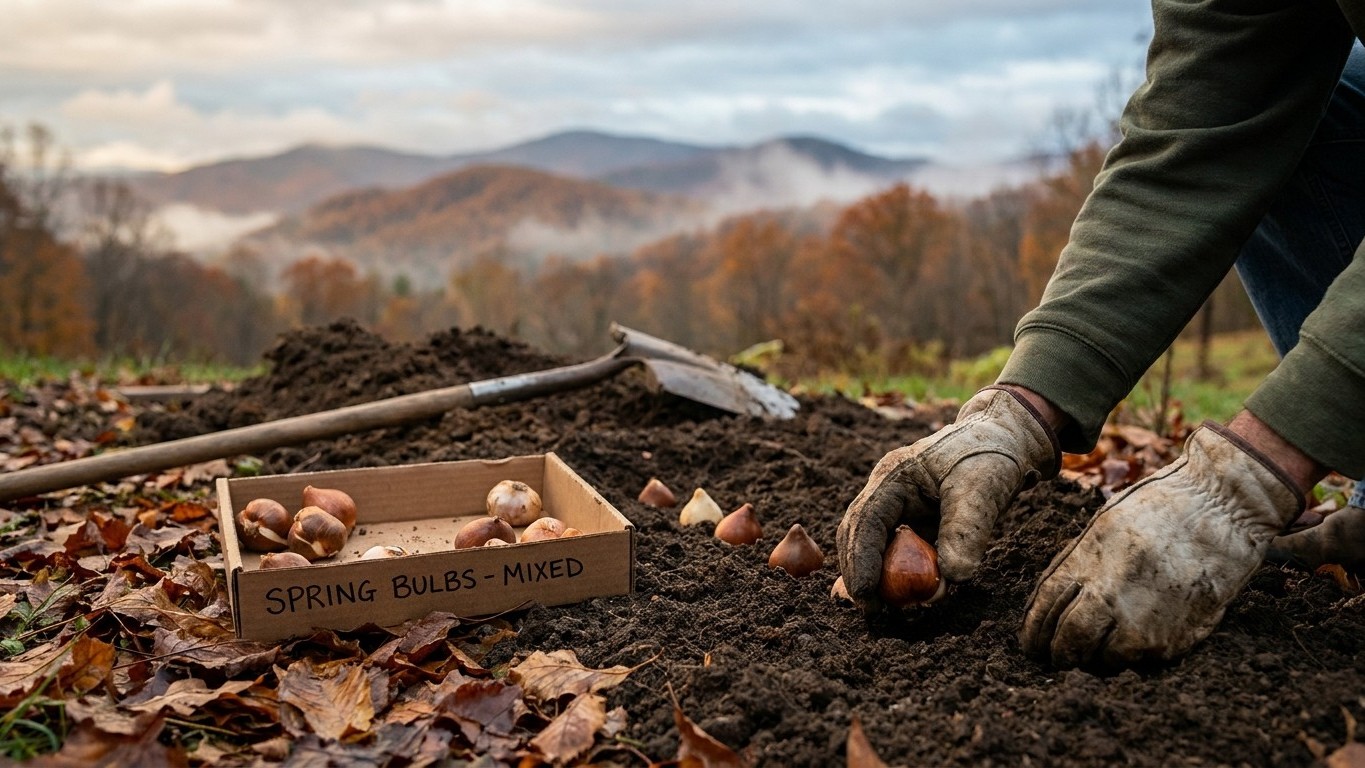

West Virginia’s mountain winters run cold enough to satisfy nearly every classic spring bulb, but timing and location inside the state matter more here than almost anywhere else. Plant by the calendar, check the cold your specific bulb needs, and skip the varieties that were bred for milder ground. For gardeners with rocky or poorly-draining yards, Growing Spring Bulbs in Containers in West Virginia offers a reliable workaround that sidesteps soil issues entirely.
When to plant bulbs in West Virginia

The planting window opens once soil temperatures drop into the 50s and closes before the ground locks up hard. In Charleston and similar valley locations, the first fall frost lands somewhere between October 18 and November 1, based on 1991-2020 NOAA climate normals. Work backward roughly six weeks from that date and you land in the sweet spot: bulbs going into the ground from late September through mid-October in most of the state, sliding into early November in the warmer river valleys.
That six-week cushion isn’t arbitrary. Bulbs need enough time in cool-but-unfrozen soil to grow a root system before winter locks everything down. Skip that step and the bulb spends the cold months sitting inert, unanchored, vulnerable to frost heave and rot once spring thaw arrives.
What happens at each end of the window
Plant too early, while soil is still warm from summer, and many bulbs push up green shoots before winter even starts. Those shoots get hit by the first hard freeze and the bulb wastes energy it needed for spring bloom. Plant too late, after the ground has started to firm up, and roots never get established. The bulb survives the winter in a kind of suspended animation, then comes up weak, short-stemmed, or not at all the following spring.
Worth saying plainly: that October 18 to November 1 window is an average. Half of all years in the historical record fall on one side of it or the other. A gardener at higher elevation in Pocahontas or Randolph County should expect frost two to three weeks earlier than someone gardening along the Kanawha River in Charleston. Watching the soil, not the calendar, is the more reliable method. Once nighttime lows settle into the 40s consistently, it’s time to dig.
Whether your winter is cold enough
This is the question that decides whether a bulb blooms at all. Spring bulbs aren’t just cold-tolerant, they’re cold-dependent. Most varieties need somewhere between twelve and fourteen weeks with soil temperatures below about 45F to complete the internal chemistry that produces a flower stalk. Skip that chilling period and the bulb often still grows leaves, sometimes vigorously, but the flower bud inside never fully forms, or it forms on a stem too short to clear the foliage.
West Virginia’s coldest-month mean minimum, measured at the Charleston reference station, is 26.1F. That’s a full 19 degrees below the 45F threshold bulbs are chilling against, and it doesn’t happen for just a few days. A typical West Virginia winter keeps soil well below the mark long enough to satisfy nearly any variety outdoors, but gardeners wanting blooms earlier than the ground allows can replicate that same chilling period in a refrigerator by Forcing Spring Bulbs Indoors in West Virginia 45F from mid-November into March, comfortably clearing the twelve-to-fourteen-week requirement for every common spring bulb with room to spare.
That margin matters practically: nobody in this state needs to pre-chill bulbs in a refrigerator before planting, the way a gardener in coastal Georgia or southern Texas might. Natural ground cold does the job. The one caution worth repeating for anyone tempted to try pre-chilling anyway, say for forcing bulbs indoors: keep them away from ripening fruit. Apples, bananas, and other fruit release ethylene gas, and ethylene kills the flower bud inside a chilling bulb just as effectively as a warm winter does.
| Bulb | Weeks of Cold Required (below 45F) | What West Virginia Delivers | Verdict |
|---|---|---|---|
| Tulips | 12-16 weeks | 16-18+ weeks, mid-Nov to March | Clears easily, no pre-chill needed |
| Daffodils | 12-15 weeks | 16-18+ weeks | Clears easily |
| Hyacinths | 10-14 weeks | 16-18+ weeks | Clears easily |
| Crocus | 8-15 weeks | 16-18+ weeks | Clears easily |
| Alliums | 8-10 weeks | 16-18+ weeks | Clears easily, wide margin |
A gardener anywhere else looking up this table for their own territory should be doing the same math: their coldest-month minimum against the weeks their specific bulb needs. In West Virginia, that math works out in the bulb’s favor across the board. The state’s winters aren’t just adequate, they’re generous.
Which bulbs suit West Virginia
The USDA Plant Hardiness Zone Map places West Virginia between zones 5a and 7a, based on average annual extreme minimum temperatures from the 1991-2020 normals. That range covers nearly every spring bulb sold at garden centers and through mail-order catalogs. The bulbs below are reliable choices, each hardiness range given so you can check your own bulb against it:
- Daffodils (zones 3-9): among the most dependable performers in the state, tolerating both the cold mountains and the milder valleys
- Tulips (zones 3-8): reliable, though many hybrid varieties fade after three or four years and benefit from replanting
- Crocus (zones 3-8): early bloomers, some of the first color of the year
- Hyacinths (zones 4-8): fragrant and hardy across the whole state
- Alliums (zones 3-9): tough, long-lived, and largely ignored by wildlife
- Snowdrops (zones 3-8): among the earliest to bloom, sometimes pushing through late snow
- Grape hyacinth / Muscari (zones 4-8): compact and reliable naturalizers
A hardiness range is never a hard line. A tulip at the cold edge of its range often survives fine in a spot sheltered by a foundation wall or a south-facing slope, while the same bulb in an exposed, wind-scoured field can fail even inside its stated zone.
Some bulbs sold in the same catalogs simply aren’t built for West Virginia winters, and the disappointment is predictable rather than random. Ranunculus and freesia, both rated for zones 8-10, need winters far milder than anything the state offers. Planted here, they either rot in the wet, freezing ground before spring or come up stunted from cold damage to the corm. Anemone coronaria behaves the same way: fine in a Pacific Northwest or Deep South garden, a losing bet in Appalachian soil. If a catalog description mentions “zone 8 and warmer,” skip it for anywhere in West Virginia, including the warmest river valleys.
What digs them up here
Squirrels and voles are selective, and the pattern isn’t random luck, it’s chemistry. Daffodils contain lycorine, a compound that makes them bitter and mildly toxic to mammals. Alliums carry the same sulfur compounds that make onions and garlic unappealing to rodents. Tulips and crocus have no such defense. Both are starchy, sweet, and high on the preferred-foods list for squirrels, chipmunks, and voles tunneling through fall soil.
- Bulbs rodents avoid: daffodils, alliums, snowdrops, hyacinths (less palatable, though not immune)
- Bulbs rodents target: tulips, crocus
For tulip and crocus plantings, the one method with a real track record is a physical barrier: lay galvanized wire mesh flat over the planting bed, pinned down at the edges, and leave it in place until the ground freezes solid. By the time it thaws in spring, the shoots have already emerged and the bulbs are no longer worth digging for. Repellent sprays and pepper flakes wash off in the first rain and need constant reapplication, which makes them unreliable for anything but the smallest, closely watched bed.
Where to check for your own county
West Virginia’s terrain runs from river valleys under a thousand feet in elevation to mountain ridges well above three thousand. That’s enough variation to shift both the first frost date and the length of the cold season by two to three weeks in either direction from the Charleston figures used above. A planting date that works perfectly in the Kanawha Valley can be too late for a garden in the Allegheny highlands and too early for one along the Ohio River.
The West Virginia University Extension Service maintains county-level offices across the state, and they’re the most reliable source for local frost dates, soil conditions, and bulb recommendations specific to your elevation and microclimate. A phone call or visit to your county office turns a statewide average into a planting date built for your actual backyard.