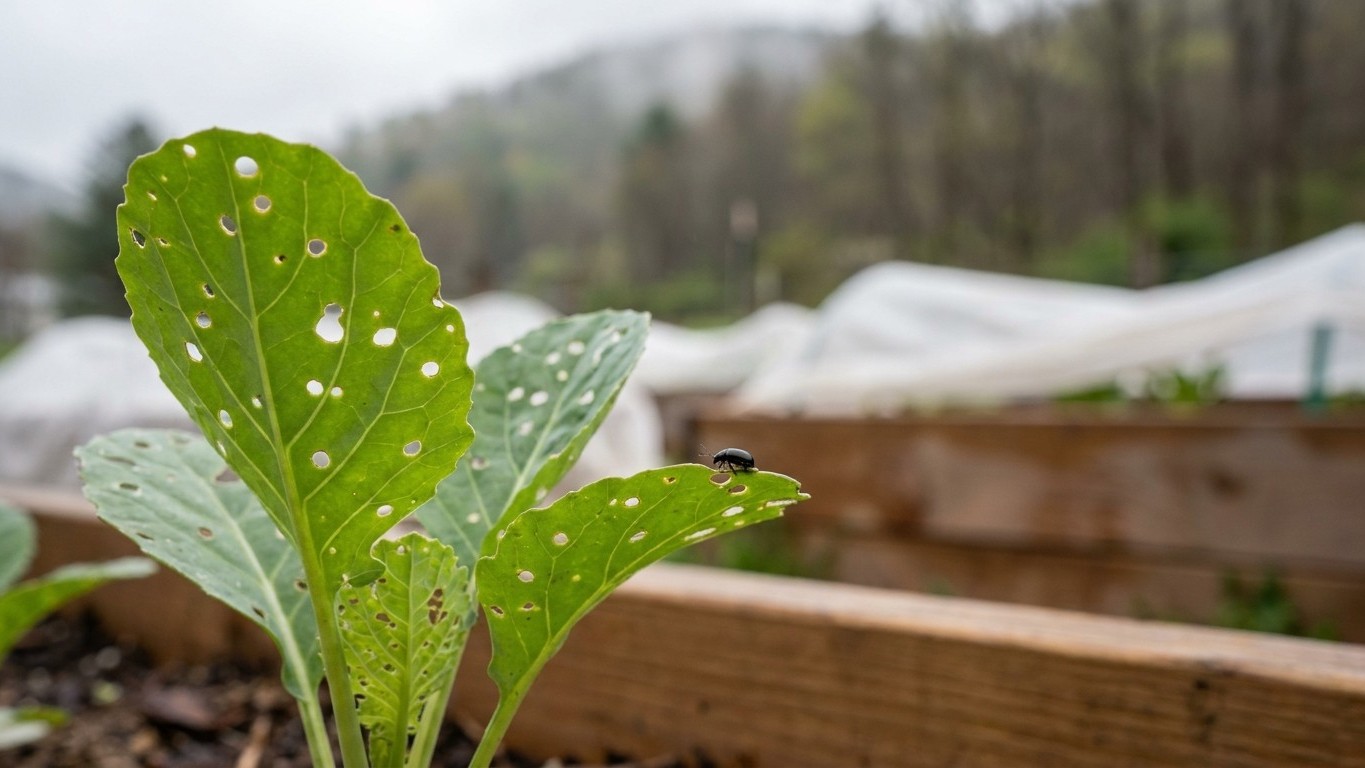

Flea beetles start chewing through West Virginia gardens as early as mid-April in the lower valleys and can hang around into October in a bad year. The tiny black insects hit hardest during two windows: right after transplants go in the ground each spring, and again in late summer when a second generation hatches. Row covers, delayed planting, and diatomaceous earth applied early are what actually keep populations down here, not late-season spraying after the leaves already look like lace.
Why West Virginia’s Terrain Changes the Timeline

West Virginia isn’t one climate. It’s several, stacked on top of each other. The Eastern Panhandle around Martinsburg sits in USDA zone 7a, while high elevations in Pocahontas or Randolph County drop into zone 5b. That gap matters for flea beetles because their emergence is tied directly to soil temperature, not the calendar.
Adult flea beetles overwinter in leaf litter, fence rows, and the edges of wooded lots, then become active once soil hits roughly 50°F. In the Ohio Valley lowlands near Huntington or Parkersburg, that threshold often arrives by the second week of April. Up in the mountains around Davis or Marlinton, the same beetles might not stir until early May, sometimes later after a cold, wet spring.
This staggered emergence explains why two gardeners three counties apart can compare notes and get confused. One person’s brassicas are already riddled with shot holes while the other’s seedlings look untouched. Both are right. The beetle didn’t skip a county, it just waited for warmer soil.
Two Generations, Two Waves of Damage
West Virginia typically sees flea beetles complete one full generation by early summer, then produce a second wave of adults from late July through September. The first wave targets young transplants and direct-seeded crops when they’re most vulnerable, thin leaves, tender stems, no size to spare. The second wave often does less visible damage to mature plants but can devastate fall brassica plantings like kale, turnips, and late cabbage if gardeners aren’t watching for it.
Which Flea Beetle Species Show Up Here
Three species account for most of the damage reported across the state. The crucifer flea beetle targets cabbage, broccoli, mustard greens, and radishes, leaving behind the classic pinhole pattern that makes leaves look like they’ve been hit with birdshot. The potato flea beetle goes after potatoes, tomatoes, and peppers, and its larvae can tunnel into potato tubers, creating shallow scarring that shows up when you dig the crop in fall. The eggplant flea beetle, smaller and often overlooked, concentrates on eggplant seedlings and can wipe out a young planting in a matter of days if left unchecked.
Identifying which species you’re dealing with matters less than most people assume. All three respond to the same basic control strategy: keep them off young plants during the first three to four weeks after emergence or transplant, because that’s when a few dozen bites can kill a seedling outright versus just scarring the leaves of an established plant.
What Actually Works Against Flea Beetles in West Virginia Gardens
Timing beats chemistry here. Delaying transplant dates by even ten days, until soil temperatures are already climbing past that 50°F threshold and beetle populations have started to disperse from overwintering sites, reduces the odds of a seedling getting hit hard right out of the gate. It’s not glamorous advice, but it’s the single most effective adjustment a home gardener can make.
Floating row covers remain the most reliable physical barrier. Laid over beds immediately after transplanting or seeding, and sealed at the edges with soil or landscape staples, they keep adult beetles from ever reaching the plants during that vulnerable early window. The catch: covers need to come off before flowering on crops that require pollination, like eggplant and some cucurbits, which means there’s a gap where beetles can move back in. For brassicas that don’t need pollinators for the harvestable part of the plant, covers can often stay on the entire season.
Diatomaceous earth, dusted lightly on leaf surfaces and reapplied after rain, works by damaging the beetle’s exoskeleton on contact. It’s most useful as a supplement to row covers rather than a standalone fix, since wind and rain wash it off fast in West Virginia’s humid summers. Trap cropping, planting a sacrificial row of radishes or mustard a few feet from the main crop, can pull beetles away from the plants you actually care about, particularly effective in larger garden plots where there’s room to spare a row.
For persistent infestations, products containing spinosad or pyrethrin offer a lower-toxicity chemical option, applied in early morning or evening when beneficial pollinators are less active. Neem oil has some repellent effect but tends to work better as prevention than as a cure for an active outbreak. Whatever product gets used, the label instructions on timing relative to harvest matter more in a short growing season than in warmer states where there’s more room for error.
Soil Health as a Long-Term Deterrent
Gardens with heavy mulch and consistent moisture tend to see less flea beetle pressure than dry, bare-soil plots. The beetles prefer dry conditions and open ground for overwintering and egg-laying, so a thick layer of straw or leaf mulch, combined with regular watering during dry spells (which West Virginia summers do produce, despite the overall humidity), makes a garden less hospitable to them season over season. It’s not an instant fix, but gardeners who mulch consistently often report smaller flea beetle populations by their second or third year.
What Puts a West Virginia Garden at Higher Risk
Certain conditions make an outbreak more likely. Gardens bordered by unmowed fields or brushy fence lines give adult beetles a place to overwinter close to the vegetable beds, so they’re the first plants hit come spring. Late frosts followed by a quick warm-up can also compress the emergence window, meaning a large beetle population shows up all at once rather than trickling in gradually, overwhelming young transplants before gardeners even notice a problem.
Crop rotation, or the lack of it, plays a role too. Planting brassicas or nightshades in the same bed year after year lets soil-dwelling larvae and pupae build up locally, feeding a bigger adult population the following spring. Rotating susceptible crops to a different part of the garden each year, even a modest 10 to 15 foot shift, interrupts that cycle enough to matter.
Signs of Damage and When to Act
The telltale sign is the “shot hole” pattern: small, round to irregular holes scattered across leaf surfaces, usually concentrated near the leaf edges first. On seedlings, this damage can escalate quickly from cosmetic to fatal, since young plants have so little leaf area to lose. Established plants generally tolerate flea beetle feeding better, showing scarred but functional leaves rather than collapsing outright.
Extension guidance from land-grant universities across the Appalachian region generally recommends acting once damage covers more than 25 to 30 percent of a seedling’s leaf surface, since that’s the threshold where growth and yield start to suffer measurably. Below that, most established plants recover on their own once the first-generation adults taper off in early summer. Gardeners in West Virginia can check current pest activity forecasts and management bulletins through the WVU Extension Service, which tracks regional pest pressure by county.
One detail that surprises a lot of first-time vegetable gardeners in the state: flea beetle damage often looks worse than it actually is. A cabbage leaf peppered with dozens of tiny holes can still photosynthesize and produce a head just fine, as long as the growing point wasn’t damaged early on. The real crisis moment is always those first two to three weeks after a seedling goes into open ground, not the cosmetic scarring that shows up on a mature plant later in the season.
Related guides
- Flea beetles in Pennsylvania: When It Shows Up and What Stops It
- Flea beetles in Maryland: When It Shows Up and What Stops It
- Flea beetles in Wisconsin: When It Shows Up and What Stops It
- Flea beetles in Wyoming: When It Shows Up and What Stops It
- Flea beetles in North Carolina: When It Shows Up and What Stops It