
Wisconsin gardeners won’t find a seedcorn maggot-specific calendar from the state’s extension service, but the pattern is clear enough to act on: watch the cool, wet weeks right after you plant, not the peak-season months most garden pests get blamed for. Row covers at planting time and a short delay until soil warms are what actually stop it.
The weeks to watch

Seedcorn maggot damage happens at planting time, in the cool, damp soil of spring, not during the general garden pest surge described for Wisconsin. The state’s own home garden pest guide, A2088 from the University of Wisconsin-Madison Division of Extension, sets the broad home garden pest season from April through September, and adds that most corn pests don’t become abundant until mid-August, with squash vines starting to wilt from vine borer in late July. None of that is about seedcorn maggot by name. The guide simply doesn’t isolate a window for this species, so the honest answer is that Wisconsin’s extension literature doesn’t publish one, and gardeners are left applying the general pattern of the pest’s known biology to the state’s climate.
Spring emergence
That general biology points the other direction from the mid-August and late-July dates above. Seedcorn maggot flies are drawn to cool, wet soil rich in decaying matter, conditions far more common in April and May than in August. The first generation is also the one that matters most, since it arrives while seeds are germinating underground and seedlings are at their most exposed.
Later generations
Additional generations follow through the growing season as the fly completes several life cycles, but once a stand is established with a few sets of true leaves, the vulnerable window has largely passed. Later flights matter far less to an established garden than that first one does.
Reading the calendar from your last frost

The one date most Wisconsin gardeners already track is the last spring frost, and for the station data covering the state it falls between April 16 and April 29. That’s a normal, not a promise, since any given spring can run warmer or colder than that band. Seedcorn maggot doesn’t answer to the calendar at all; it answers to soil temperature, so an early warm spell or a cold, wet stretch shifts the real risk window even if the frost date itself doesn’t move.
- Start from your local last frost date, somewhere in the April 16 to April 29 range.
- Expect the first one to two weeks after seeds go in the ground to be the period of highest risk, since that’s when germinating seeds and fresh seedlings sit exposed in cool, often damp soil.
That arithmetic is why row covers belong on the bed the day seed or transplants go in, not a week later. And it’s why they can come off once seedlings are past that early stage, once true leaves are established and the plant is no longer relying on a soft, vulnerable germinating seed underground.
What it attacks, and what the damage looks like

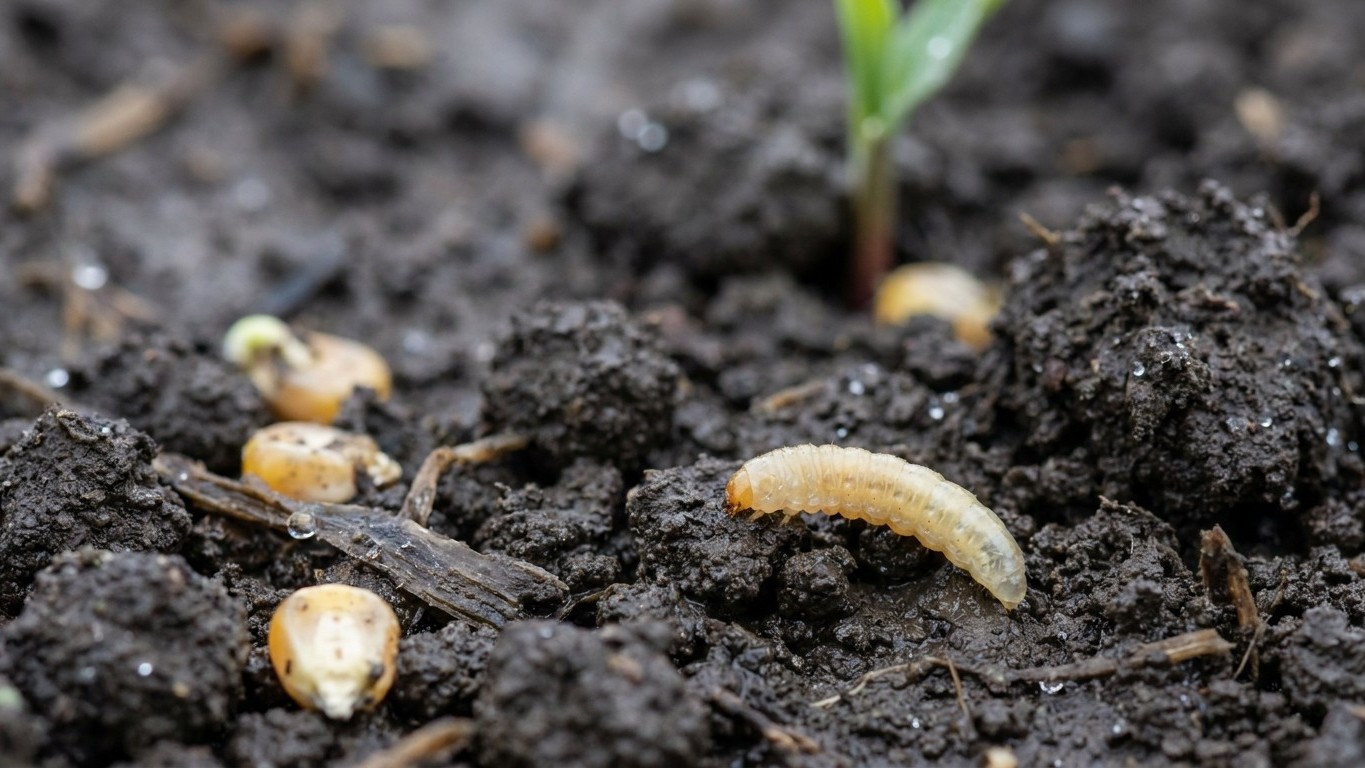
The giveaway usually isn’t a bug at all, it’s a gap. A row that should have sprouted evenly comes up patchy, with some seeds simply never emerging, or a seedling that does emerge wilts and collapses within days, its stem hollowed out at or just below the soil line. Pull a failed seed out of the ground and it may be soft, discolored, and tunneled through rather than simply rotted. The larva, a small yellowish-white maggot, is the stage doing all the damage; it feeds inside the seed or the germinating sprout before pupating in the soil, which means once it’s already inside, there’s nothing left to treat, only stands to replant.
Crops at risk include:
- Sweet corn seed and germinating seedlings
- Beans and peas, especially direct-seeded
- Cabbage family transplants and seed (cabbage, broccoli, cauliflower)
- Cucumber, squash, and other cucurbit seed
- Onion sets and seed
How Wisconsin sits in this pest’s range

Seedcorn maggot is a widespread species across the cooler, wetter parts of North America, and nothing in the available Wisconsin data suggests the state sits at an edge of its range or faces an unusually severe pressure compared with neighboring states. What the state’s extension literature doesn’t offer is any Wisconsin-specific ranking, severity rating, or trend for this particular pest, so none should be assumed. The honest picture is presence without a documented degree: the insect is known to occur in Wisconsin conditions, and its behavior tracks soil temperature and moisture rather than anything unique to the state’s geography.
That matters practically because it means the timing advice a gardener would use in a neighboring cool-climate state, cool wet spring soil as the highest-risk period, applies here too, even without a Wisconsin-specific study to cite chapter and verse. The absence of a state-specific number isn’t a sign the pest is rare here; it’s a gap in what’s been separately published for this one species.
What actually works against it

- Delay planting until soil has warmed and dried some. The flies are drawn to cool, damp soil for egg-laying, and seeds that germinate quickly spend less time exposed underground. This costs nothing but a little patience.
- Avoid planting directly into freshly worked soil heavy with manure or undecomposed plant debris. Decaying organic matter is what draws egg-laying females in the first place; if manure or crop residue needs to go in, work it in early enough that it’s broken down well before seed goes down.
- Use transplants instead of direct-seeding susceptible crops where practical. A transplant skips the vulnerable germinating-seed stage in open soil entirely.
- Cover the bed with row cover immediately at planting, sealed at the edges. This is a physical barrier against egg-laying adults; it only works if it goes on before the flies find the bed, and it can come off once seedlings are past the germination and early-seedling stage.
- Rotate susceptible crops to a different bed each year. This limits the buildup of pupae overwintering in soil that previously hosted an infested crop.
None of these measures do anything once a maggot is already feeding inside a seed or stem; at that point the plant either survives on its own or it doesn’t, and replanting the gap is the only real option.
Common questions
Does seedcorn maggot come back more than once in a season?
Yes, the species completes multiple generations through the growing season, but the first one, tied to cool spring soil, does the most damage since it coincides with germination and early seedling growth across so many crops at once.
Can I still plant seed that’s already been damaged by maggots?
No. A seed that’s been tunneled through won’t germinate reliably, and there’s no treatment that reverses that damage; the practical response is to replant fresh seed once conditions have improved rather than gamble on a compromised batch.
Is seedcorn maggot the same insect as cabbage maggot?
No, they’re closely related flies in the same family with similar habits, cool damp soil, decaying organic matter, and root or seed feeding, but they’re separate species. The prevention steps overlap heavily, which is part of why crop rotation and clean seedbeds help against both.