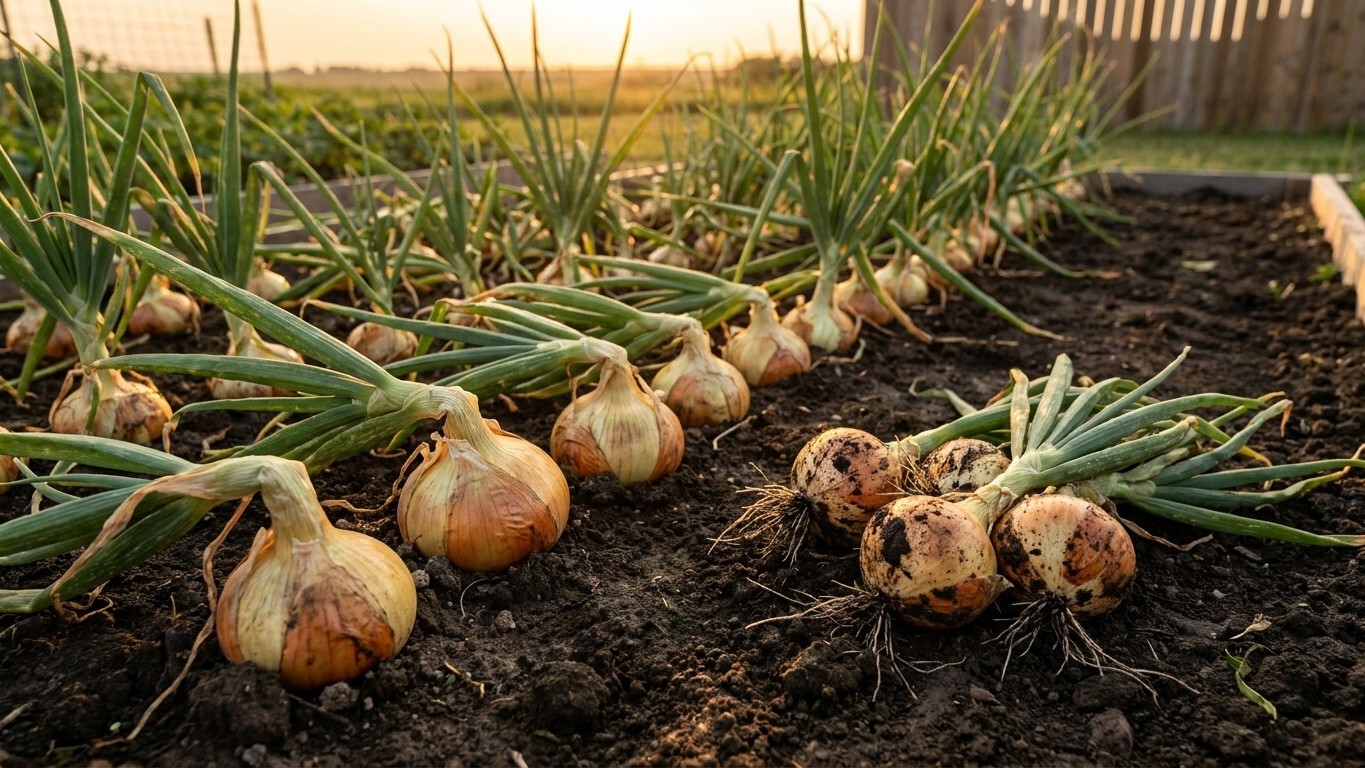

Lift onions in Nova Scotia once most of the tops have fallen over and the necks have gone tight, usually between late summer and early fall. Pull them on a dry day, then cure them in a shaded, airy spot until the necks are tight and the skins feel papery. Only cured bulbs go into storage. Good harvest and storage of onions in Nova Scotia depends on that order, followed by a cool, dry place that holds steady.
Keeping them, and for how long
Halifax Stanfield International Airport sits at 44.88 degrees north, and the longest day there gets 15 h 25 of daylight (a geometric figure, since real daylight runs about seven minutes longer). Day length, not warmth, tells an onion to stop making leaves and start swelling a bulb. Clemson Cooperative Extension puts the trigger for short-day varieties at about 12 hours. Long-day varieties wait for 14 to 16 hours, which Halifax clears around the summer solstice. Gardeners far from Halifax, on Cape Breton or down near Yarmouth, should check their own latitude, because day length shifts with it. The variety you grow sets when the tops fall and how well the bulbs keep, so start with the best onion varieties for Nova Scotia if you have not chosen yet.
How do you cure onions after lifting them?
Stop watering before you expect to lift, so the necks dry down on their own. When most of the tops have flopped and started to yellow, loosen the soil with a fork and ease the bulbs out. Pulling hard on the tops can tear the neck and open a door for rot.
Leave the tops attached. Spread the bulbs in a single layer on a screen, a slatted crate or an old window frame, somewhere with moving air and no direct rain. A covered porch, a barn aisle or a garage with the door propped open all work. Coastal Nova Scotia gets plenty of fog and damp fall weather, so if rain is in the forecast, move the bulbs under cover rather than hoping.
Curing usually takes a few weeks, and the bulbs tell you when it is done. The necks should be tight, with no moisture and no thick feel when you squeeze them. The outer skins should be dry and papery, and the roots should be wiry. Then trim the dry roots and cut the tops a short way above the bulb. Bulbs with a thick, green or wet neck are not ready, however good they look. That neck is where rot gets in.
What temperature and humidity keep onions longest?
Clemson Cooperative Extension’s Home & Garden Information Center says: “Ideal conditions are between 45 °F and 55 °F, and 50 to 60 percent humidity.” You can read the full guidance in its factsheet on onions, leeks, shallots and garlic. Onions want dry air. That is the opposite of carrots, beets and other roots, which keep best in cold, damp conditions, so one cellar cannot hold both well.
How long onions last depends mostly on the variety. Pungent, thick-skinned types hold for many months in good conditions, while sweet, mild types go soft much sooner. Any keeping time you read for a variety is a ceiling under ideal conditions, reached only with a sound, well-cured bulb in steady cool, dry air. A bulb nicked during lifting, or one with a damp neck, will fail well before that. If maggots or other pests marked your crop, what eats onion in Nova Scotia, and when explains what to look for and why those bulbs should be eaten first rather than stored.
Where in the house that actually is
A temperature range on paper does not tell you which room to use. The refrigerator is the obvious cool place, but it runs colder than the 45 °F floor of that range, and the crisper drawer holds moisture. Onions kept there tend to soften and can grow mold. Fridge space is better used for onions you have already cut.
The heated parts of the house have the opposite problem. A kitchen, a pantry beside the stove or a spare bedroom sits above the 55 °F ceiling for much of the year. Warm bulbs break dormancy sooner, and they sprout and soften. A hanging basket over the kitchen counter looks nice and shortens the life of the onions in it.
An attached garage or a shed swings with the weather. A Nova Scotia fall can bring sunny, mild afternoons followed by frost the same week, and winter nights go well below freezing. Bulbs that freeze and thaw turn to mush. A garage can hold onions in October, but by midwinter it is a gamble unless it stays above freezing.
The room that usually comes closest is an unheated but frost-free corner of the basement, a cool spare room or a closed-off back porch that stays in the 45 to 55 °F range. The coast adds a catch. Basements in Nova Scotia are often damp, and humidity above 60 percent invites mold and rot even when the temperature is right. Keep onions away from the furnace, the water heater and any wall that sweats.
Put a thermometer and a hygrometer in the spot before the onions go in. A cheap min-max thermometer records the coldest night and the warmest afternoon, which is what a single reading misses. If humidity runs high, a small fan for air movement or a dehumidifier running nearby can help. Store the bulbs in mesh bags, open crates or baskets, never sealed plastic. Check them every few weeks and pull out any that feel soft or smell sour, because one bad bulb spoils its neighbors. For a broader look at growing the crop here, start with onions in Nova Scotia.
Common questions
Can onions share a cellar with carrots and potatoes?
Not well. Carrots want cold, damp air, and onions want cool, dry air at 50 to 60 percent humidity. Keep the onions in the driest, best-ventilated corner and as far from the damp crops as you can.
What if it rains while the onions are curing?
Move them under cover right away and keep air moving around them. Wet bulbs cure slowly and the necks can rot. A covered porch, a barn or a garage with the door open is better than leaving them in the garden bed, and a fan can speed up drying in a damp spell.
Should I wash onions after lifting them?
No. Washing adds moisture right when the necks need to dry. Let the soil dry on the skins and brush it off gently once the bulbs are cured. Rub away loose soil, but leave the papery skins in place.
Which onions should I eat first?
Use the thick-necked bulbs, anything bruised or nicked, and any with pest damage or soft spots first. These are the ones most likely to rot and spoil the rest. Keep the sound, tight-necked, well-cured bulbs for the longest storage.