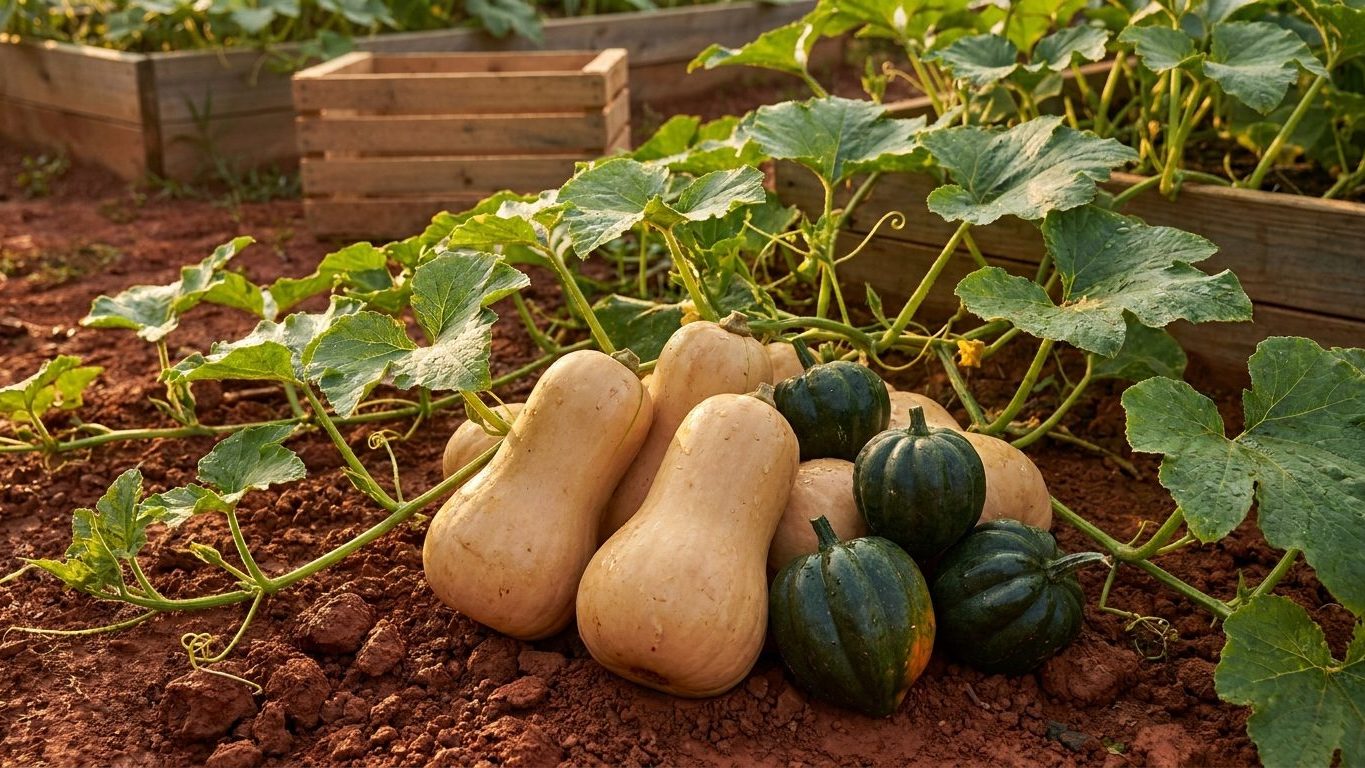

Yukon gardeners get one real shot at winter squash: the fastest bush-type varieties, acorn and delicata chief among them. Anything bred for a long, hot summer, butternut, hubbard, most spaghetti squash cultivars, is fighting a season that averages just 81 days between frosts and almost never sees real heat. The types built for cool, short summers are the only sound bet here.
The short answer for Yukon
The number that decides everything is 81. That is the gap between the mean last spring frost at Whitehorse A, June 5, and the mean first fall frost, August 25, from the 1981-2010 Canadian Climate Normals published by Environment and Climate Change Canada. Eighty-one days is close to the minimum some bush squash need just to size and cure fruit, and it assumes the frost dates hold. They only do half the time: in one year out of two, ECCC’s own data shows frost arriving later than the mean, which means the real safe window can run shorter than 81 days as often as it runs longer.
Heat, not just calendar days
Layer on the heat side of the ledger and the picture narrows further. Whitehorse averages 0.0 days a year at or above 90F. Winter squash ripen sugars and cure hard skins through accumulated warmth, not just days on a calendar, so a variety rated “80 days” in a hot Midwest garden can easily need 90 or more of Yukon’s cooler days to reach the same finish.
Given that math, the shortlist worth a bed in a Yukon garden is narrow:
- Acorn squash, particularly bush and semi-bush cultivars bred for short seasons
- Delicata, similarly quick to mature, with thinner skin that cures faster than a thick-shelled type
- Fast buttercup or kabocha selections specifically bred for short, cool summers, though these sit closer to the edge of what 81 days allows
Why bush habit matters as much as the days-to-maturity number
A sprawling vine spends part of its short season just extending runners before it sets fruit, and every day spent vining is a day not spent ripening. Bush and semi-bush acorn and delicata types set fruit closer to the crown earlier, which matters more inside an 81-day window than in a garden with a four- or five-month season to spare. None of this is a guarantee. It is a shortlist built from the season length and heat load this territory actually measures at its reference station, not a guess borrowed from a warmer province.
What will not work here

Butternut squash is the clearest failure case. Most cultivars want closer to 100 to 120 days and real summer heat to convert starches to sugar in the neck of the fruit. Whitehorse offers neither the days nor a single afternoon over 90F in an average year. Hubbard squash and giant pumpkin types fail for the same two reasons at once, long maturity and heavy heat appetite, and they add a third problem: their vines sprawl across far more ground than an 81-day season can afford to give them before fruit set. Most spaghetti squash cultivars sit close enough to the same edge that they belong in the same “don’t count on it” pile in this climate.
Long-season vines, twice punished
Any squash that needs to vine out before it flowers loses days it does not have. In a garden with a five-month season, a slow start barely matters. Here, a plant that spends its first three weeks just running instead of flowering can miss the fruit-sizing window entirely before the mean fall frost arrives.
Watering on autopilot
Summer rainfall at the reference station runs about 4.2 inches across June, July and August, with June, the month squash need to establish roots, the driest at 1.28 inches. Because Whitehorse also carries essentially no heat load, evaporative demand is low, so it is tempting to assume rainfall will simply cover things. It often will not, particularly during fruit set, when squash draw water hardest and a dry June can leave shallow roots short right when it matters. Treating this as a climate that “waters itself” because it is cool is the mistake; checking soil moisture by hand through June is the fix, and it costs nothing.
What changes across Yukon
The hardiness zone figure available for this territory is 1b, and it applies to one place: the Whitehorse A reference station, under Natural Resources Canada’s Plant Hardiness Site, built from 1991-2020 normals. That is a Canadian zone, calculated from seven climate variables rather than the single minimum-temperature figure the USDA system uses, so it should never be read against a USDA number elsewhere on this site, and it should never be assumed to describe the whole territory.
Yukon runs from communities near the British Columbia border to Old Crow above the Arctic Circle, across a landscape where elevation swings by thousands of feet between valley floor and mountain terrain. A single station’s zone rating cannot speak for that spread. A garden further north, or several hundred feet higher, is very likely working with fewer safe growing days than Whitehorse’s own 81, not more, while a low-elevation site in southern Yukon could conceivably have a touch more room. This page has no verified figure for either case, only for the reference station.
The honest move is not to guess a zone for your own community from Whitehorse’s number. It is to look yours up directly on Natural Resources Canada’s interactive Plant Hardiness Site at planthardiness.gc.ca and read the rating for the municipality closest to the garden in question.
Where to check this for your own county
Yukon does not divide into counties the way U.S. states do, but the principle holds just as firmly: a recommendation built from one climate station is a starting point, not a local forecast. This page is the territory-wide version. A community-level source will always beat it.
The federal Agriculture and Agri-Food Canada hub at agriculture.canada.ca/en is the resource to check next, and it is given here in place of the territorial department’s own site because that provincial-style page refused an automated check when this article was verified. That is not a judgment on its usefulness, only a note on why the federal link sits here instead.
On that federal site, look specifically for any linked frost and growing-season data closer to your own community than Whitehorse, and for bulletins naming varieties actually trialled in Yukon conditions rather than general Canadian averages. If a local greenhouse, territorial extension office, or community garden group publishes its own frost dates or variety trial results, that source outranks this page every time. This page can only report what a single reference station measured; a local trial reports what actually grew.
Checking this against your own garden
Every date on this page is an average from one station. A reader’s own garden outranks it, and three simple checks tell more than any calendar.
Feel the soil at planting depth before seeding. Squash germinate sluggishly in cold ground, and in a short-season territory like this one, seed sown into soil that still feels cool rather than warm at the end of a sunny afternoon is losing days it cannot spare. Wait for that warmth rather than for a date on a chart.
Watch the first flush of flowers. Male flowers usually open first and that is normal, not a problem. The real signal is the first female flower, recognizable by the tiny swollen fruit sitting behind the petals, and its arrival marks the start of the fruit-sizing clock that has to finish before the local first fall frost.
Note when the first true leaves appear after the seedling’s initial rounded leaves. Their timing relative to a typical year, earlier or later, is the plainest sign of whether this particular season is running ahead of or behind the territory’s own average, and it is the cue for recalculating, from that point forward, how many of the season’s days actually remain.