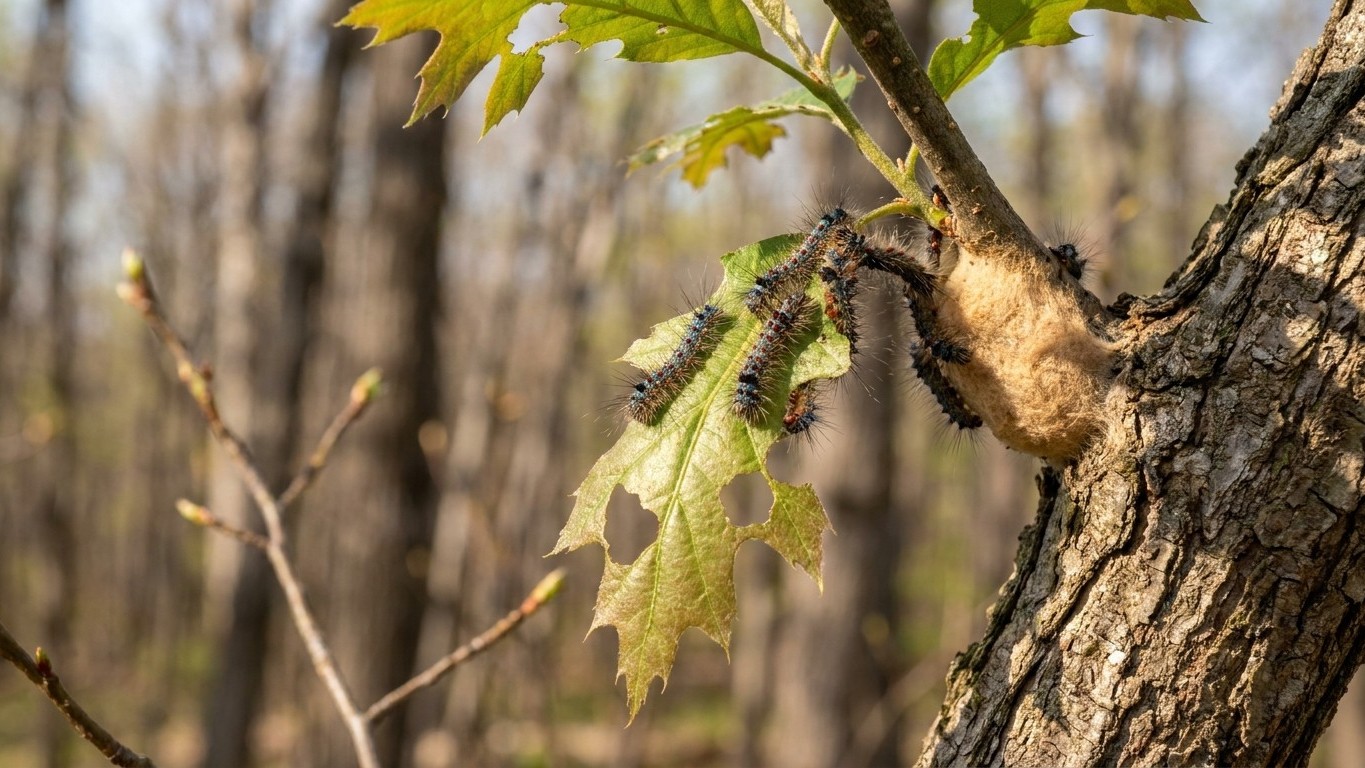

Spongy moth caterpillars start chewing through hardwood canopies in Quebec as soon as tree buds break, usually well before most gardeners have even finished their spring cleanup. The window to act runs from egg hatch through early summer, and it lines up loosely with the region’s last frost date, not a fixed day on the calendar.
Reading the calendar from your last frost

Environment and Climate Change Canada puts the average last spring frost at May 6 for the Montreal/St-Hubert A station, based on the 1981-2010 Canadian Climate Normals. That’s a mean, not a promise. In one year out of two, frost arrives after that date, so treat May 6 as the midpoint of a window rather than a line you can plan around with confidence. Northern and upland parts of the province run weeks behind this reading, since one weather station never represents an entire province.
Spongy moth doesn’t answer to a frost date at all. It answers to accumulated warmth in the soil and bark, which is why egg masses hatch close to the same time local hardwoods break bud, sometimes a few days before the last frost, sometimes a couple weeks after. An early, mild spring pulls hatch forward; a cold, wet one delays it. That single fact matters more for management than the frost date itself, because the caterpillars are most vulnerable, and easiest to control by hand, in the first few weeks after hatching, while they’re still small and clustered near the egg mass or newly ballooned onto nearby foliage.
For a gardener with young or newly planted hardwood trees, the practical takeaway is this: don’t wait for a fixed date to check trunks and lower branches. Start looking as soon as buds swell, and keep checking through early June, since the exact start shifts every year with the weather, not the calendar.
What it attacks, and what the damage looks like
Most people notice the damage long before they notice the insect. A healthy oak, aspen, birch, or maple starts showing ragged, irregular holes in its leaves in late May or June. Left unchecked, entire branches go bare in a matter of weeks, and by midsummer a heavily infested tree can look like it’s already dropping its leaves for fall. Oak is the preferred host in most infestations, but spongy moth caterpillars aren’t fussy feeders once populations build, and they’ll move into aspen, birch, willow, and even some conifers when their preferred food runs short.
The insect responsible is the caterpillar stage of the spongy moth, formerly known by a name now retired from common use in North American pest guidance. Young caterpillars are dark and hairy, barely noticeable at first, and they feed at night, hiding in bark crevices or leaf litter during the day. As they grow through their later instars, they become easier to spot: bluish and reddish paired spots run down the back, and they’re bold enough to feed in daylight when populations are heavy. This later stage does the bulk of the visible defoliation, because a mature caterpillar eats far more leaf tissue per day than a newly hatched one.
That timing detail matters for anyone hoping to intervene. Once caterpillars reach their final instars and start wandering to find pupation sites, physical controls lose most of their effectiveness. The damage is already done to that season’s foliage, and the insect is days away from becoming a moth that lays next year’s eggs. Egg masses themselves, tan and fuzzy, stuck to trunks, fences, or even outdoor furniture, are the other visible sign to watch for, and they’re present on the tree well before any leaf damage shows up at all.
How Quebec sits in this pest’s range

This pest is documented in 2 territories on this site, which points to a wide but not universal range. Where spongy moth is established, the difference between locations is mostly a matter of timing, when eggs hatch, when defoliation peaks, when moths fly, rather than whether the insect shows up at all. Quebec sits well within the species’ established range in eastern North America, alongside neighboring jurisdictions that share similar hardwood forests and comparable spring warming patterns.
The nearest guidance for home gardeners comes from University of Vermont Extension, across the border. Vermont shares enough climate and forest composition with southern Quebec that its hatch timing, host preferences, and hand-control recommendations translate reasonably well, though a gardener in the Laurentides or further north should expect events to run later than anything published out of a Vermont-based source.
This is worth saying plainly: a two-territory count on this site doesn’t rank Quebec’s infestation as worse or better than anywhere else, and it doesn’t establish a trend either. It only confirms that this is not an isolated or rare pest for the region, and that seasonal timing, not presence or absence, is the variable a local gardener needs to track from year to year.
What actually works against it
The cheapest and most effective control starts in fall or winter, well before any caterpillar hatches, and the options below are ordered from least to most effort.
- Scrape egg masses off bark, fences, and outdoor structures once leaves drop, because each mass can hold several hundred eggs, and destroying one in December is far easier than fighting off the caterpillars it would have produced in June.
- Band tree trunks with burlap or a sticky barrier once hatch begins, because younger caterpillars descend the trunk during the day to hide from predators and heat, and a band intercepts them on that daily commute; checking it every day or two and removing what’s caught keeps numbers down without any spraying, though this loses effectiveness as caterpillars mature and start feeding and resting higher in the canopy instead of making daily trunk trips.
- Hand-pick caterpillars wherever they’re reachable, which works at any stage but is realistic only on smaller trees or isolated branches, not on a mature oak with a full canopy.
- Keep the base of trees clear of leaf litter and debris, because this removes hiding spots where caterpillars and egg masses can overwinter undisturbed, and it makes egg-mass scraping easier the following fall.
None of these measures reach caterpillars once they’ve moved deep into an upper canopy or wandered off to pupate in bark crevices, fence posts, or nearby structures. At that point the current season’s defoliation is locked in, and the only leverage left is preventing that generation’s moths from laying eggs successfully, which loops right back to the fall and winter scraping routine as the next window of opportunity.
Common questions
Does spongy moth kill the trees it defoliates? A single season of defoliation rarely kills an otherwise healthy hardwood, since most trees can push out a second flush of leaves. Repeated defoliation over consecutive years, combined with drought or other stress, is what weakens or kills a tree over time.
When should I start checking my trees each year? Start as soon as buds begin to swell rather than waiting for a specific date, since hatch timing shifts with spring warmth and can run earlier or later than the average last frost.
Can I rely on Vermont guidance for my exact location in Quebec? It’s a reasonable starting point for southern Quebec given the shared climate, but expect all timing to run later the further north and higher in elevation your property sits.