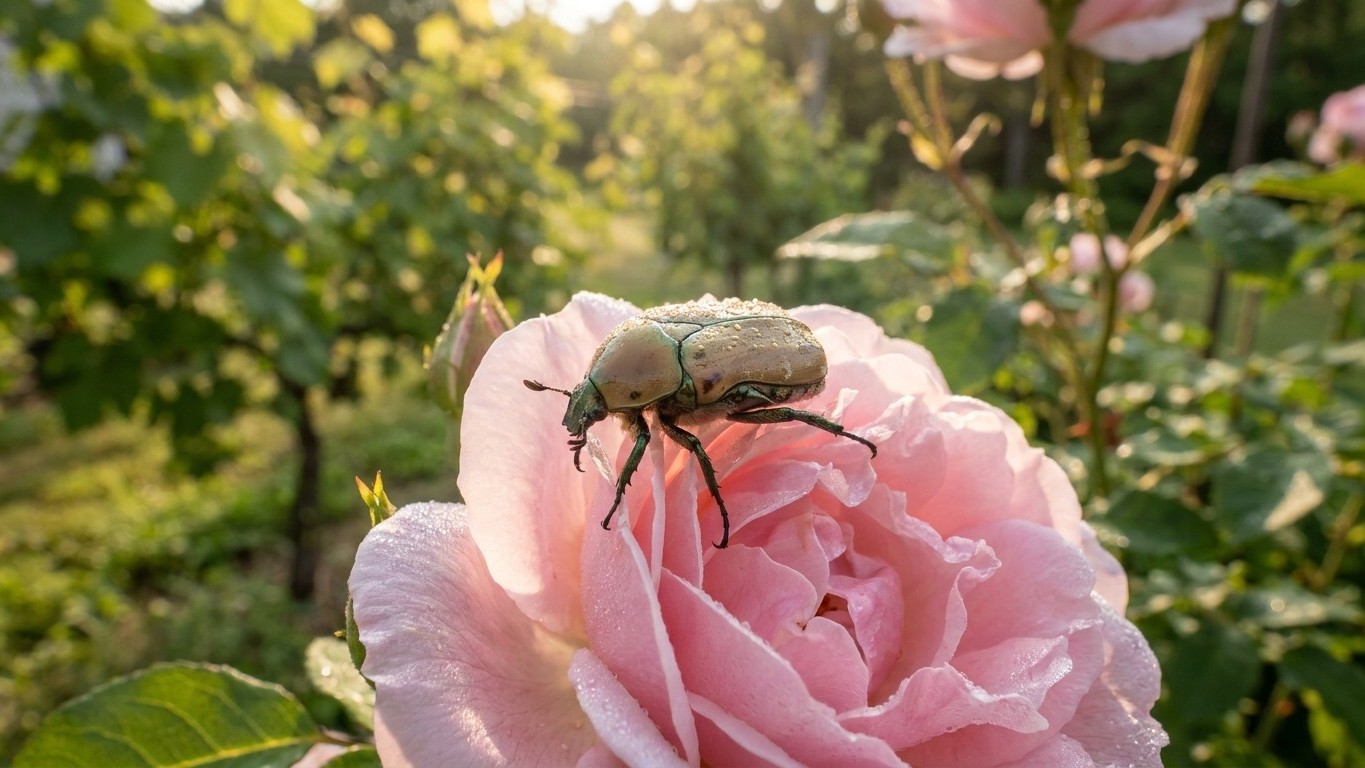

Rose chafers show up in New Hampshire gardens mid-to-late June, according to UNH Cooperative Extension, arriving right as roses bud out and grape leaves fill in. They’re gone by midsummer. Row covers and hand-picking, timed to that window, do the real work here.
When Rose chafer turns up in New Hampshire

UNH Cooperative Extension names a specific window for this insect: adults appear mid-to-late June. That’s a tighter window than some of its garden-pest neighbors get. Japanese beetle, for comparison, emerges later (late June to early July) and stays active clear through August. Squash vine borer moths show up around June 20 and peak July 10-15, with just one generation a year. Rose chafer’s spread is shorter, and that matters for how you time a defense.
The insect’s tan, long-legged adults feed for roughly three to four weeks once they emerge, then die off. There’s no second wave later in the season, unlike some of the ornamental pests UNH tracks on the same fact sheet. If you missed the mid-to-late June window and your roses look fine by the Fourth of July, you’re likely past the risk for the year.
Why this window is narrow but reliable
Rose chafer larvae live in soil, and adults emerge once that soil hits a threshold temperature in early summer. Because New Hampshire’s soil warms on a fairly predictable schedule most years, UNH’s mid-to-late June figure holds up better than a loosely worded “early summer” guess would. It’s still a range, not a single date, and a cold, wet spring can push the whole thing back by a week or two.
Reading the calendar from your last spring frost
The one date most New Hampshire gardeners actually plan around is the last spring frost, and NOAA’s 1991-2020 climate normals put that window at April 16 to April 27 for the reference weather station. That’s a range, not a promise, and it comes from an airport station. Gardens in suburban yards and rural valleys typically see their last frost run one to two weeks later than that airport figure, more at higher elevation. Check your own county’s frost record before you trust the airport number as your own.
Rose chafer doesn’t answer to the calendar. It answers to soil temperature. An early, mild spring can nudge emergence toward the front of that mid-to-late June window; a cold, wet one can push it back closer to July. That’s the same logic that governs the frost date itself, just applied a couple of months later in the season.
Do the arithmetic and you land somewhere useful: if transplants go in shortly after that April 16-27 frost window closes, damage from rose chafer typically shows up about eight to nine weeks later, right in the mid-to-late June range UNH publishes. That’s your cue for when a physical barrier needs to be in place, and roughly when you can safely take it off. Covering roses, grapevines, or peonies by early June and leaving the cover on through the first week of July covers the insect’s entire flight period in most years, with a little slack built in on both ends for a slow spring.
What it attacks, and what the damage looks like
Rose chafer damage shows up as a skeletonized leaf. Not the lace-like holes people often blame on Japanese beetle without checking, though the two do overlap in look. The distinguishing sign with rose chafer is the target: blossoms take the worst of it. Rose petals get chewed to ragged shreds, sometimes stripped to nothing but the center. Grape leaves and clusters take similar treatment, along with peonies, and a range of other ornamentals and small fruits.
Before you ever spot the beetle, you’ll likely spot the wreck it left behind: a rose bush in full bud that suddenly looks like it went through a shredder, or a young grape leaf reduced to a skeleton of veins with the green tissue eaten out from between them. That symptom comes first. The insect responsible, a slender, tan or fawn-colored beetle with unusually long legs, is easy to miss if you’re not looking for it directly on the flower.
Which life stage does the damage
Here’s the detail that decides what you can still do about it: the adult beetle is the one doing the eating, not the larva. The larvae live underground, feeding on grass roots in sandy soil, and they don’t touch your roses or grapevines at all. That means any treatment aimed at soil grubs misses the actual damage-causing stage entirely. Once you see chewed blossoms, you’re dealing with adults on the plant, in the open air, where physical removal and barriers are still options. Nothing happening below ground at that point will change what’s happening above it.
How New Hampshire sits in this pest’s range

This site currently documents rose chafer in 2 territories. That’s a narrow footprint, and it puts New Hampshire near an edge of what’s been published here rather than in the thick of a wide, well-mapped range. A pest tracked across dozens of territories usually differs from one place to the next mainly in timing, a week earlier here, a week later there, same insect, same damage. With only 2 territories on record, that comparison isn’t available yet for rose chafer the way it is for some other garden pests.
What is solid is the local guidance itself. UNH Cooperative Extension publishes the mid-to-late June window cited above, and that’s the figure worth working from if you garden in New Hampshire. No other territory’s number should stand in for it, and no rank or severity claim beyond “documented here” is supported by what’s published. If you’re gardening near the state line, it’s worth checking whether your neighboring state’s extension service has published its own local window, since soil warming and frost timing can shift meaningfully across even a short distance.
What actually works against it
Start cheap.
- Hand-picking. Rose chafers are sluggish fliers and slow crawlers, which makes hand-picking one of the most effective tools available to a home gardener. Knock beetles into a container of soapy water in the early morning, when cooler temperatures make them even less mobile. Do this daily during the mid-to-late June peak and you can keep numbers on a small planting low enough that blossom damage stays minor.
- Row covers. They work on a simple mechanism: physically blocking adult beetles from reaching the plant during their few-week flight window. Put covers on roses, grapevines, or peonies before early June, before the window UNH cites, and leave them on through the first week of July. The catch is that covers only work as exclusion. Once beetles are already inside the cover, or already feeding on an uncovered plant, the barrier has nothing left to prevent.
- Reducing exposed sandy soil near vulnerable plantings. Because larvae develop in sandy, well-drained soil (often turf areas near gardens), cutting down on that kind of ground can lower local larval numbers over a few seasons, though it won’t affect adults already flying in from elsewhere. Clearing plant debris and cutting back overgrown turf edges near roses removes some of that larval habitat too.
- Crop rotation. Useful against soil-dwelling pests that stay put, it does less here since adult rose chafers fly in from wherever their larvae developed, not necessarily from last year’s bed.
None of these measures reach an adult once it’s already chewing a blossom in the open, and none of them touch larvae once they’re established several inches down in the soil. Timing, covering before the window opens and removing beetles by hand once it does, is what actually moves the needle for a home garden.
Common questions
How long does rose chafer stay active in New Hampshire?
UNH Cooperative Extension’s window runs mid-to-late June, and adults typically feed for three to four weeks before dying off, with no second generation later in the season.
Do rose chafers damage vegetables the way they damage roses?
The fact sheet names roses, grapes, peonies, and other ornamentals as primary targets. Vegetable damage in the same UNH resource is attributed to other species, like flea beetles and squash vine borer, not rose chafer.
Is it worth treating the soil for rose chafer larvae?
Adults, not larvae, cause the blossom and leaf damage gardeners notice. Reducing sandy, exposed turf near plantings can lower larval numbers over time, but it won’t stop adults already feeding on a given day.