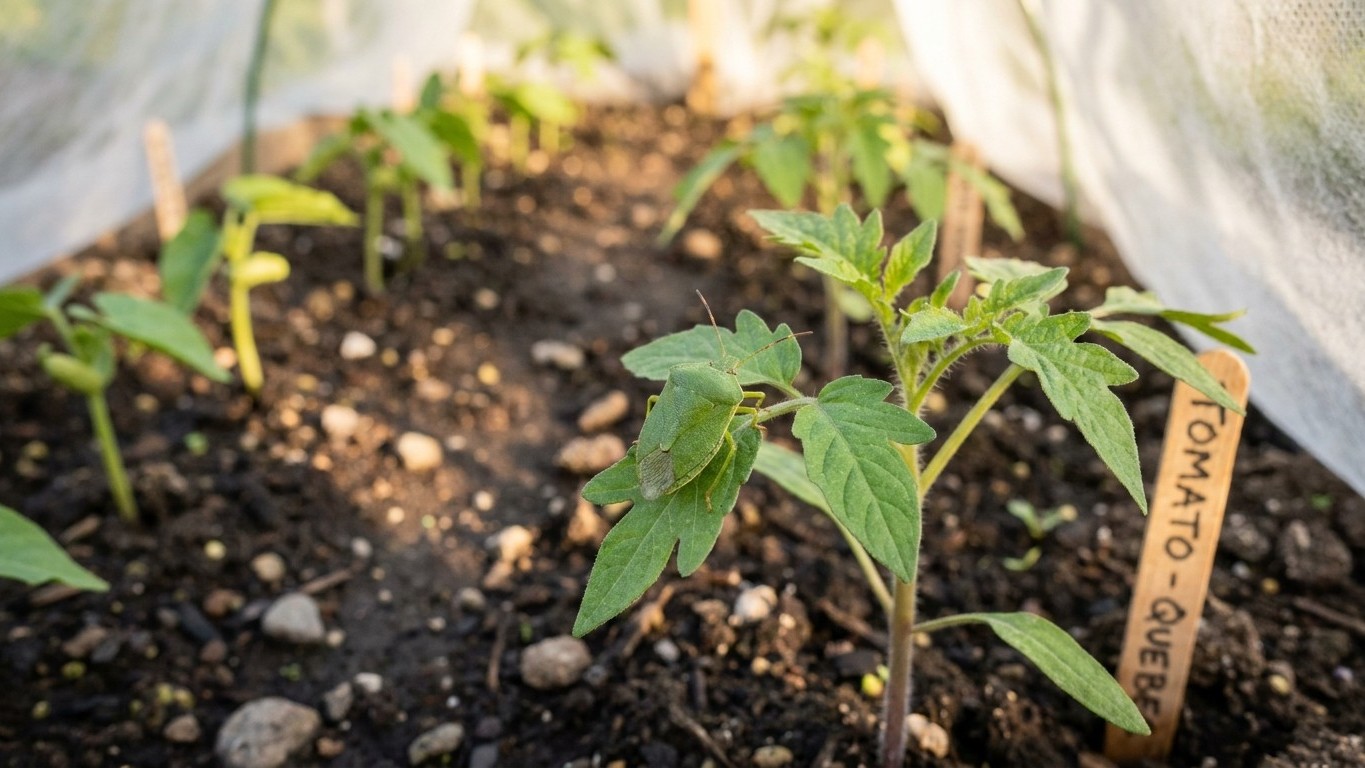

Green stink bugs show up in Quebec gardens once soil and air temperatures climb through late spring, usually a few weeks after tomatoes and beans go into the ground. There’s no fixed calendar date for their arrival, and no province-wide treatment either, but row covers, timely planting, and fall cleanup cover most of what a home gardener can control.
Reading the calendar from your last frost

The average last spring frost for the Montreal area sits at May 6, based on Environment and Climate Change Canada’s 1981-2010 climate normals for the Montreal/St-Hubert A station. That’s a mean, not a promise: in half the years on record, frost arrived later than that date. Treat May 6 as the midpoint of a window that can stretch into the third week of May, not a green light to plant tender crops without a backup plan.
Green stink bugs don’t watch a calendar at all. They respond to soil and air warmth, so a cold, dragging spring pushes their arrival back by a week or two, while an early warm-up brings them out sooner. What matters for a gardener is the gap between transplanting and first damage, which typically runs two to four weeks once seedlings are established outdoors. That’s the window when a row cover earns its keep.
The cover has to go on before the bugs find the plants, meaning right at transplanting or shortly after, and it has to come off once flowers open so pollinators can reach the blossoms. Miss that second date and you trade one problem for another: no fruit set. Because the frost date is a range and the pest‘s arrival is tied to temperature rather than the sheet on the calendar, no gardener can count backward from May 6 and land on a single, certain day for either the frost or the first bug sighting. Watch the plants and the weather, not just the date.
What it attacks, and what the damage looks like
Most gardeners notice the damage before they ever spot the insect. On tomatoes, look for cloudy, discolored patches just under the skin, sometimes with a hard, pale spot at the center, a symptom growers call catfacing when it distorts the fruit’s shape near the blossom end. On beans and soybeans, the tell is inside the pod: shriveled, discolored, or flattened seeds that never filled out properly, even though the pod itself looks fine from the outside. Peppers and sweet corn can show similar pinprick punctures with a faint halo of discolored tissue around each one.
Which crops are at risk
- Tomatoes and peppers, especially developing fruit
- Snap beans and soybeans, mainly at the pod-filling stage
- Sweet corn, on kernels near the tip of the ear
- Okra and some cucurbits, less commonly
The damage comes from piercing-sucking mouthparts, the same feeding style used by both nymphs and adults. Green stink bugs don’t go through a caterpillar-like larval stage that tunnels into stems or roots; they hatch as small nymphs that already resemble miniature adults and feed the same way their whole lives. That matters for treatment, because there’s no hidden, protected stage boring inside plant tissue the way a squash vine borer or corn earworm larva does. Every stage of this insect feeds out in the open, on the surface of leaves, stems, and developing fruit, which means physical barriers and direct removal stay useful right up until harvest, not just early in the season.
How Quebec sits in this pest’s range

This site currently documents the green stink bug in two territories, which puts Quebec near the edge of its published range here rather than in the middle of a wide, well-mapped zone. With only two territories on record, the honest comparison isn’t about severity or ranking; the numbers simply don’t support that. What can be said is that where this pest is documented, the difference between locations tends to be timing rather than presence, since the insect follows regional warmth rather than staying confined to one climate band.
For Quebec specifically, no dedicated provincial extension research on green stink bug thresholds or life-cycle timing was found. The nearest published guidance comes from the University of Vermont Extension, just across the border, which tracks the same species under a broadly similar northeastern climate. That’s a reasonable proxy for general biology and timing, but it’s Vermont’s data, not Quebec’s, and local frost dates, soil warm-up, and season length still differ enough to shift things by a week or two in either direction.
| Territory | Documented on this site | Local guidance source |
|---|---|---|
| Quebec | Yes | None found; nearest source is Vermont |
| Vermont (neighboring) | Yes | University of Vermont Extension |
What actually works against it
Start with timing, because it costs nothing. Pushing transplant dates a week later, once soil has warmed past the point where seedlings sit stressed and slow-growing, gives plants a head start before stink bug populations build up. Stressed, slow plants draw more feeding pressure simply because they stay in a vulnerable stage longer.
Row covers come next, and they work on a simple mechanism: they physically block adults from reaching the plant to lay eggs or feed. The cover has to go on before bugs arrive and come off before flowering, since a sealed cover also blocks pollinators. Once flowers need pollinating, this defense stops being an option, which is exactly why the timing question from earlier in this article matters so much.
Hand-picking is slow but genuinely effective, because there’s no hidden larval stage to miss, every feeding stage sits exposed on the plant surface. Check the undersides of leaves and the base of developing fruit clusters in the cooler part of the morning, when the insects move less. This stops paying off once populations climb into the dozens per plant; at that point, the time cost outweighs what hand-picking can remove.
Crop rotation and fall debris cleanup target the insect’s overwintering habit rather than the current season’s feeding. Adults shelter in leaf litter, garden debris, and the edges of wooded or brushy areas over winter, then move into gardens the following spring. Clearing that debris in fall reduces local overwintering sites, but it does nothing against adults flying in from a neighbor’s yard or a nearby field edge, since this species moves freely across property lines. None of these four measures reach an insect that has already reached your plants in high numbers; at that stage, only direct removal or destroying visibly infested plant material limits the damage that’s already underway.
Common questions
Does a hard frost kill green stink bugs outright?
Adults typically move into sheltered leaf litter or debris before the season’s first hard frost and survive there through winter, so a single frost date doesn’t eliminate the population; it just ends the active feeding season on garden plants.
Can I use the same row cover timing every year?
Not reliably. Since the insect follows soil and air warmth rather than a fixed date, and the local frost date itself is only an average, cover timing needs to shift with how early or late the season is running each year.
Is damage worse on plants grown near a wooded edge?
Gardens bordering brush, hedgerows, or wooded lots tend to see earlier and heavier pressure, since those areas serve as the overwintering and staging grounds adults move from as temperatures rise in spring.