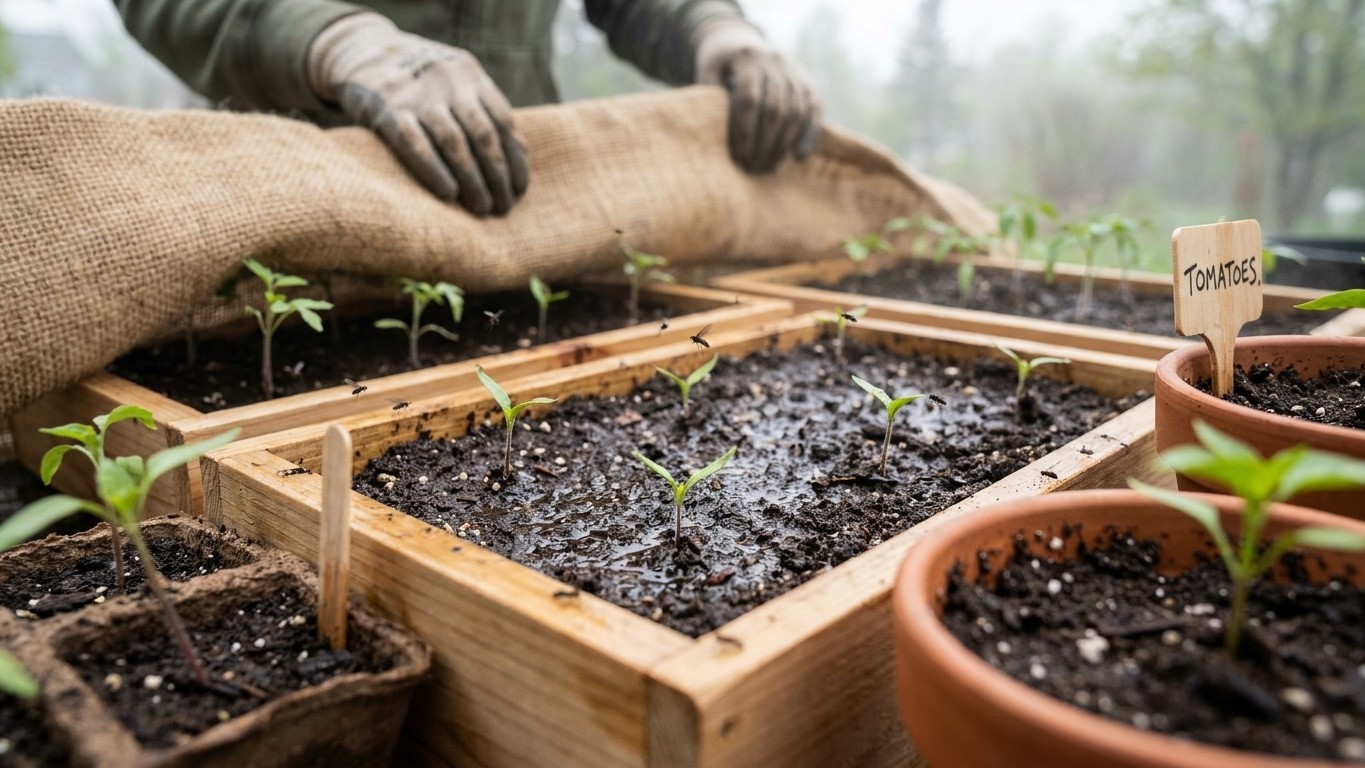

Dark-winged fungus gnats show up in Quebec once soil in seed trays, containers, or freshly turned garden beds stays consistently moist and mild, usually right around transplant time. They target root hairs and tender stem tissue at the soil line, and the fix is less about spraying and more about drying the surface and covering what you can.
Reading the calendar from your last frost

Gardeners around Montreal and the St. Lawrence lowlands plan their whole season around one number: the average last spring frost, pegged at May 6 by Environment and Climate Change Canada’s climate normals for the MONTREAL/ST-HUBERT A station. That figure is worth repeating carefully, because it’s a mean, not a promise. In roughly one year out of two, frost actually lands after May 6, so treating it as a safe planting date is a gamble dressed up as a fact. Northern districts, the Laurentians, and anywhere at higher elevation run behind this station by weeks, not days.
Dark-winged fungus gnats don’t check a calendar. They respond to soil that has warmed and stayed damp, which is exactly the condition created by transplanting seedlings into beds that are still being watered in. That means the pest‘s arrival tracks how early or late the ground actually warms that particular year, not a fixed week on paper. A cold, wet spring pushes both transplanting and gnat activity later; an early thaw pulls both forward.
For timing covers, the practical takeaway is this: damage often becomes visible within the first few weeks after transplant, while root systems are still small and vulnerable and the surrounding soil is kept consistently wet from transplant watering. That narrow window is when a floating row cover earns its keep, and it’s also the point at which the cover can safely come off, once seedlings have hardened past the tender root-hair stage and surface soil is allowed to dry between waterings.
What it attacks, and what the damage looks like
Most gardeners notice the plant before they ever notice the insect. A seedling that was upright the day before suddenly wilts despite moist soil. A transplanted lettuce or brassica stalls out, turns pale, and pulls up with surprisingly few roots attached. In containers and greenhouse flats, young ornamentals and vegetable starts show stunted growth and yellowing lower leaves that don’t respond to feeding or extra water, because the problem isn’t nutrition, it’s the root system underneath.
The crops most commonly affected in home settings are vegetable and flower seedlings started indoors or in cold frames, then also mature houseplants and greenhouse ornamentals kept in soil that’s watered heavily and rarely allowed to dry. Lettuce, brassica transplants, and any young plant grown in peat-heavy or compost-rich potting mix is a prime target, since that organic matter feeds the larvae directly.
Which life stage actually does the harm
This detail matters for anyone deciding whether it’s worth treating: the damage is done almost entirely by the larvae, the small legless maggots living in the top inch or two of soil. They feed on root hairs and can tunnel into the base of a stem at soil level, which is what produces the sudden wilting and the damping-off look in young seedlings. The adults, the small dark flies people spot hovering near the soil surface or crawling on leaves, don’t chew plant tissue in any damaging way. They’re mostly a nuisance and, in greenhouse settings, a potential carrier of fungal spores from pot to pot. Once larvae have already tunneled into a stem base, that plant’s root damage is done regardless of what happens above ground afterward.
How Quebec sits in this pest’s range

On this site, dark-winged fungus gnats are documented in 2 territories, and that’s a narrow footprint rather than a wide one. A pest cataloged across a wide range usually differs from one place to the next mainly in timing, not in whether it shows up at all. A pest documented in just a couple of territories, by contrast, tends to sit near the edge of where it’s been formally tracked and written up, which is closer to the situation here.
That narrow documentation also explains where the closest detailed guidance for Quebec actually comes from: the nearest published extension guidance is from University of Vermont Extension, across the border. Vermont’s climate, soil types, and greenhouse growing season are close enough to southern Quebec’s that its recommendations transfer reasonably well, but it’s guidance drawn from a neighboring state’s research programs, not from a Quebec-based extension service. That’s a meaningful distinction for anyone expecting locally calibrated thresholds or spray-timing charts, because none exist yet for this territory specifically.
Nothing in the available data supports ranking Quebec’s pressure from this pest as worse or milder than Vermont’s, or than any other place it’s been recorded. The honest position is simpler: it’s present, it’s been documented in a limited number of places so far, and the closest usable field guidance sits just across the border.
What actually works against it
The cheapest defense is also the most effective one: let the soil surface dry out between waterings. Dark-winged fungus gnat larvae need consistently moist organic matter in that top inch or two of soil to survive, so a dry surface layer breaks their life cycle before it starts. This works at every stage before larvae have already tunneled in, and it stops working once they have, since a dry surface does nothing for damage already done below.
Timing of planting matters almost as much. Holding off transplanting until soil has genuinely warmed and drained, rather than rushing seedlings out right around the average last frost date, reduces the stretch of time young roots sit in the cool, saturated soil that favors the larvae.
Floating row covers placed immediately after transplant block adult females from reaching the soil surface to lay eggs in the first place. That’s the mechanism, and it’s also the limit: a cover installed after adults are already present, or after larvae have hatched in the soil, does nothing, because the damage-causing stage is already underneath the cover with the plant.
A few more low-cost habits round this out:
- Clearing plant debris and spent compost from beds and containers removes the decaying organic matter larvae feed on between plantings.
- Rotating where seedlings and transplants go from year to year avoids reinfesting soil that already carries a larval population.
- Hand-picking or physically removing visibly wilted seedlings and their root balls stops that plant’s larvae from maturing and spreading to neighboring containers.
None of these steps are pesticide-based, and that’s intentional: for a home gardener, timing and moisture management do more real work here than anything sprayed on after the fact, especially once larvae are already established inside root tissue or a stem base.
Common questions
Do dark-winged fungus gnats survive a Quebec winter outdoors?
The available documentation for this territory doesn’t include overwintering survival data specific to outdoor Quebec conditions. What’s established is that the larvae need consistently moist organic soil to develop, a condition mostly created indoors, in greenhouses, or in the weeks right after outdoor transplanting rather than through an open Quebec winter.
Are the adult flies themselves harmful to plants?
No. The adults are the small dark flies seen hovering near soil or crawling on leaves, and they don’t feed on plant tissue in any damaging way. All the actual root and stem damage comes from the larval stage living in the top layer of soil.
Is it worth treating a plant once it’s already wilting?
It depends on how far the larvae have gotten. If they’ve already tunneled into the stem base, that plant’s root system is compromised regardless of what’s done afterward, and removing it protects nearby containers more than trying to save it. Catching moist, larvae-favoring soil conditions before wilting starts is the more useful moment to act.