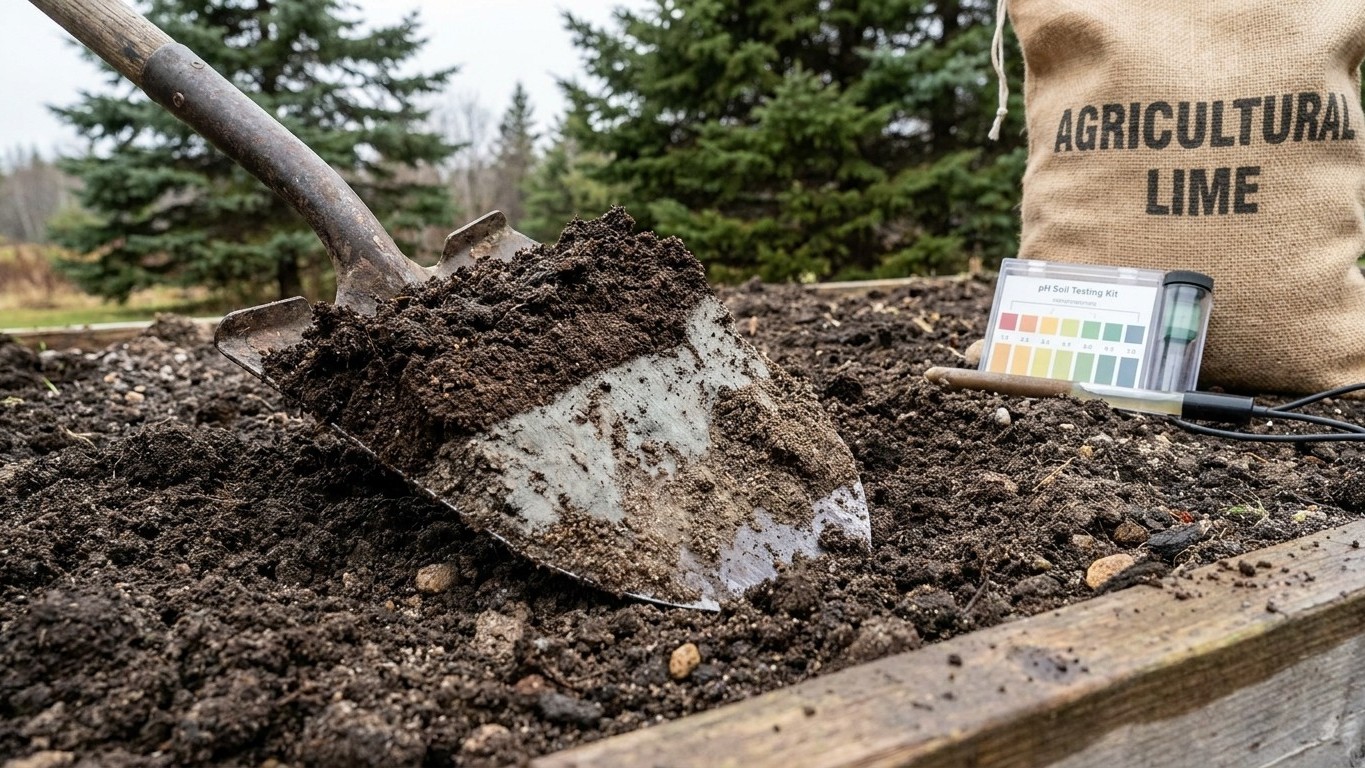

Nova Scotia’s ground is mostly Podzol: acid, leached, formed under centuries of spruce and fir. That single fact explains a lot of what happens (or doesn’t) in local gardens, and it points straight at what a test and a bag of lime or sulphur can fix.
What is under your garden

The soil that covers most of mapped Nova Scotia is a Podzol, the soil order that forms under conifer forest where centuries of rain have washed calcium and other bases down out of the topsoil, leaving it sour and often pale just below the surface. Podzol accounts for 53 percent of the mapped surface of the province. The runner-up, Gleysolic soil, the kind that sits wet and gray from poor drainage, shows up often enough to matter, especially in low ground and old field bottoms.
The numbers behind that Podzol are specific, and worth having in front of you before you dig anything. The median surface pH across the mapped soils runs about 5.2, which is strongly acid. Texture leans loam to silt: 52 percent sand, 10 percent clay, 38 percent silt. Organic matter sits around 2.1 percent. Drainage is classed imperfectly, meaning water moves through slowly enough that a heavy rain lingers.
| Property | Value |
|---|---|
| Surface pH (median) | about 5.2 |
| Sand | 52 percent |
| Clay | 10 percent |
| Silt | 38 percent |
| Organic matter | about 2.1 percent |
| Drainage class | imperfectly drained |
Why this number isn’t your number
These figures describe the median of 472 mapped soil components across the province’s agricultural regions, not the dirt three feet from your back door. A river bottom, a bog edge, or a lot where a contractor scraped the topsoil and dumped in fill will read nothing like a Podzol. The far north of the province, outside the agricultural survey area, isn’t represented at all. Treat this profile as a tendency, a way of saying “ground here tends to run acid and hold water a beat too long,” not a substitute for checking your own patch.
You can get a rough read in five minutes with two low-tech tests. For the ribbon test, wet a small handful of soil until it holds together, then squeeze it between thumb and forefinger, pushing it upward to form a ribbon. Sandy soil won’t ribbon at all and feels gritty. Loam forms a short ribbon, maybe an inch, before breaking. Heavy clay stretches out two inches or more and feels slick, almost soapy. For the jar test, fill a clear jar a third full of soil, add water to near the top, shake hard, and let it sit overnight. Sand drops first and settles as the bottom layer, silt settles next, and clay stays suspended longest, forming a fine layer on top. Compare what settles against the 52-10-38 split above and you’ll know within a few percentage points whether your yard tracks the provincial pattern or runs its own way.
Testing before you amend
Adding lime or sulphur without a test is a coin flip with your money. Soil pH and nutrient levels aren’t things you can eyeball from the color of the dirt or how weeds are doing, and dumping the wrong amendment on the wrong ground can lock up nutrients for a full growing season before you find out.
A representative sample matters more than people think. Walk the bed or lawn area and pull six to eight cores, not just one scoop, spaced evenly across the space. Dig to the depth where roots actually feed, roughly 6 to 8 inches for vegetable beds and lawns, a bit shallower for shallow-rooted ornamentals. Mix the cores together in a clean bucket, pull out stones and roots, and send in that composite sample rather than a single shovelful from wherever looked convenient.
When results come back, the pH number tells you which direction to push, and the nutrient readings (usually phosphorus, potassium, and sometimes magnesium and calcium) tell you what’s actually missing versus what’s already there in excess. Given that the province’s mapped median runs about 5.2, it’s reasonable to expect your result to land somewhere in acid territory too. But expecting isn’t knowing. Fill, compost history, and even the specific conifer or hardwood cover on a lot can shift a yard’s pH a full point or more from the regional median, and only a test catches that.
Amending it
The correction Nova Scotia gardens usually need follows straight from that median pH of about 5.2. That’s acid ground, and acid ground is where lime becomes the main tool, not sulphur. Adding sulphur to soil that’s already strongly acid pushes it further in the wrong direction and can stall plant growth outright. Acid soil ties up phosphorus so roots can’t reach it, and it makes life hard for brassicas in particular, since clubroot and poor calcium uptake both get worse as pH drops. Lime raises pH by neutralizing that acidity, but it works on a seasonal clock, not a weekly one. Ground limestone needs months of soil moisture and microbial activity to react fully, so a fall application is what shows up as workable pH by the following spring’s planting.
If a test comes back on the other end, above roughly 7.3, the instruction flips completely. Lime should never go on soil already that alkaline. The slow, honest fix there is elemental sulphur worked in over successive seasons, paired with regular additions of organic matter, which naturally buffers pH downward as it decomposes. High pH ground also locks iron out of reach of plant roots, and that’s exactly what shows up as yellow leaves with the veins still green, a classic iron deficiency symptom called interveinal chlorosis. It’s rare in a province whose median already sits acid, but it happens on old mortar rubble, concrete-adjacent beds, or ground limed too heavily in the past.
What the texture numbers ask for
The province’s 10 percent clay and 52 percent sand describe soil that’s light rather than heavy, but plenty of individual yards sit on real clay pockets, and the fix there is organic matter, full stop. Working sand into clay to “loosen it up” is a persistent piece of bad advice; the two together often set up like concrete rather than improving drainage. Never work clay soil while it’s wet, since that compacts it into clods that take a season to break down. On sandy ground, organic matter again does the heavy lifting, holding both water and nutrients that would otherwise wash straight through, paired with shorter, more frequent watering rather than one deep soak. As a rough timeline, compost and organic matter show visible improvement in soil structure within one growing season on most ground, while pH correction with lime or sulphur takes two to three seasons to fully settle.
Drainage and compaction
The province’s mapped soils carry an imperfectly drained rating, which in plain terms means water moves through slowly enough that puddles linger after a heavy rain and roots can sit wet longer than they’d like. Standing water an hour after a downpour is the visible sign; standing water a day later is the sign that something needs to change.
A percolation test settles the question for your own yard rather than the provincial average. Dig a hole about a foot deep and a foot across, fill it with water, and let it drain once to saturate the surrounding soil. Fill it a second time and time how fast the water level drops. A rate faster than 2 inches per hour is fast drainage, more suited to frequent light watering than deep soaks. Between 1 and 2 inches per hour is the workable middle ground most vegetable beds want. Below half an inch per hour, water is barely moving, and that’s poor drainage that will drown roots before it lets them establish.
When to build up instead of dig in
Compaction from foot traffic, wheelbarrows, and mower passes packs soil particles tight enough to squeeze out the air pockets roots need, and it happens faster on the province’s naturally imperfect drainage than on a well-drained sandy loam. Double digging, the old method of turning soil two spade-depths down to fight compaction, has fallen out of favor because it destroys soil structure and beneficial fungal networks right along with the compacted layer, often making the problem worse within a couple of seasons. On ground that tests below half an inch per hour, or on a lot where the topsoil turns out to be builder’s fill rather than anything resembling the province’s Podzol, a raised bed is the honest answer. Three years of organic matter and patience might improve native soil marginally; a raised bed filled with a proper growing mix solves the drainage problem the day it’s built.
Local help
Soil testing in Nova Scotia runs through the provincial agriculture department rather than a university extension office, and the process works the same way: mail in a composite sample, get back pH and nutrient numbers, and take those numbers to the county or regional office for a reading in plain language. Start at novascotia.ca/agri for current submission instructions and lab locations.
Common questions
Is all Nova Scotia soil acidic?
Most mapped agricultural soil trends acid, with a median surface pH around 5.2, but individual yards vary. Fill, old mortar, and heavy liming history can all push a specific lot toward neutral or alkaline, which is exactly why a test beats an assumption.
How do I know if my soil is clay or sand?
The ribbon test is the fastest check: wet a handful, squeeze it into a ribbon between thumb and forefinger, and see how far it stretches before breaking. Sand won’t ribbon; heavy clay stretches two inches or more. The overnight jar test confirms it by letting sand, silt, and clay settle into visible layers.
Should I add lime to my garden every year?
Only if a test says pH is still low. Lime takes months to fully react in soil, so annual applications without testing can overshoot and push acid ground into alkaline territory, locking up iron and other micronutrients in the process.
Why does water pool in my yard after rain?
It’s usually a combination of the province’s naturally imperfect drainage class and compaction from foot traffic or past construction. A percolation test tells you how bad it is; a reading under half an inch per hour usually means a raised bed will outperform years of amending in place.