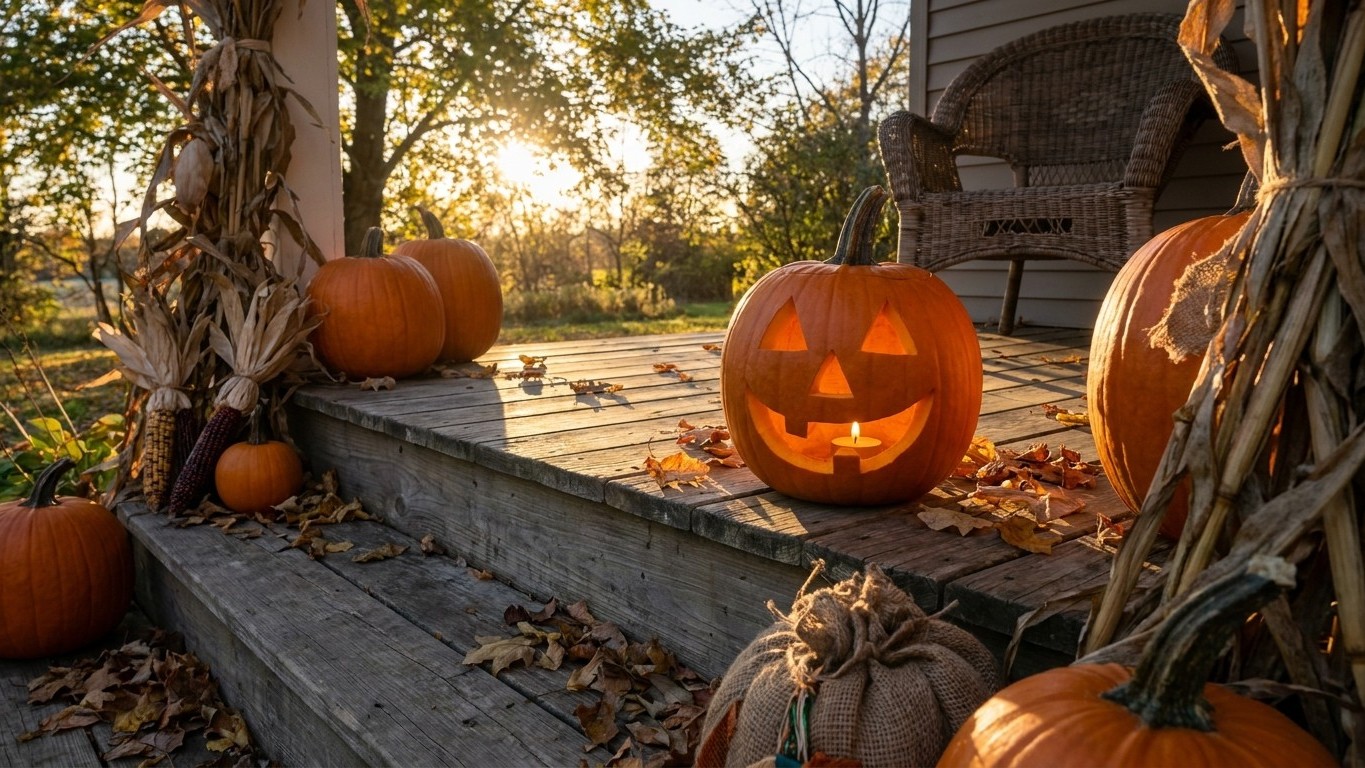

Arkansas pumpkin carvers get a rare gift: frost almost never shows up before Halloween. The state’s mean first fall frost lands between November 7 and November 20, weeks after trick-or-treaters go home. That means the porch pumpkin isn’t racing a freeze this year. It’s racing the calendar and the warmth still hanging in the air. Carve close to Halloween, not weeks ahead of it.
The short answer

If you’re wondering whether a jack-o’-lantern set out in early October will survive to Halloween night in Arkansas, the frost isn’t the threat. NOAA’s 1991-2020 Climate Normals for the state (station USW00013963) put the mean first fall frost around November 7 to November 20, depending on where in Arkansas you sit. That’s two to three weeks after Halloween, not before it. A pumpkin carved on October 20 isn’t going to get nipped by a 32-degree freeze while it’s sitting on your steps.
There’s a wrinkle worth knowing, though. NWS Little Rock tracks a lighter frost threshold, 36 degrees, separately from the hard 32-degree freeze, and that lighter frost date falls right around October 31 itself. So while a true freeze is off the table until well into November, a light frost brushing right at Halloween isn’t impossible in a cold snap year. It’s the exception, not the rule, and it’s nowhere near the storage-killing event a hard freeze would be.
What that means for the calendar on your kitchen wall: the constraint isn’t frost timing, it’s how long a cut pumpkin can hold up in October warmth. Arkansas Octobers don’t cool off the way a pumpkin actually wants. The safe move is to carve somewhere in the window of about three to five days before Halloween, close enough that heat and moisture loss don’t have time to work on the cut flesh, but late enough that you’re not wasting the pumpkin’s best days on a table that isn’t ready for guests yet.
None of this is a guarantee stamped by the weather service. A mean frost date is an average pulled from thirty years of records, not a promise for this particular October. Some years run colder, some run warmer. But for planning purposes, Arkansas carvers can treat frost as a non-issue for Halloween night and focus their planning on heat instead.
Frost or heat: which one gets it here
The cold end of the range
Start with the numbers. NOAA’s Climate Normals put Arkansas’s coldest month mean daily minimum at 30.9 degrees, using Little Rock as the reference station. That’s the average low on an average night in the coldest stretch of winter, not a Halloween-week figure, and not a record low either. It tells you Arkansas winters do get cold enough to matter for plant hardiness generally, but it says nothing about late October specifically. Combine that with the frost data above, a hard freeze doesn’t typically arrive until November 7 at the earliest, and the picture is clear: freezing temperatures are a November problem here, not an October one.
The warm end of the range
A whole pumpkin keeps best between 45 and 50 degrees, according to University of Illinois Extension. That’s a narrow band, and it’s cooler than what much of Arkansas experiences through most of October. Since frost doesn’t show up until well into November and even the lighter 36-degree threshold only appears right at Halloween itself, that leaves most of the month sitting above the pumpkin’s ideal storage range. In practical terms, warmth is the enemy here, not cold. A pumpkin left out on a warm Arkansas afternoon is losing moisture and softening faster than it would in a state where nights dip into the 40s by mid-October. That’s the real reason to hold off on carving until closer to the day, rather than any concern about an early freeze.
Where to keep it until you carve
Given that heat, not cold, is what works against a pumpkin here, the goal is finding the coolest, darkest, driest spot in the house or yard that still stays reasonably close to that 45-50 degree band. Few homes hit that exactly, but some spots come closer than others.
- An unheated basement or cellar. If you have one, this is usually the closest thing to ideal in an Arkansas home: below ground, shaded from sun, and insulated from the swings of an October afternoon.
- A detached or unheated garage, on the shaded side. Keep it away from any window or door that catches direct afternoon sun, which can push the space well above the target range even when the outside air feels mild.
- A screened or covered porch out of direct light. Fine for short-term storage in the days just before carving, as long as it’s shaded and not baking in sun for hours at a time.
- Away from the fruit bowl and the potato bin. Ripening apples, potatoes, and tomatoes give off ethylene gas that speeds up a pumpkin’s aging. Keep the pumpkin in its own space, not next to produce that’s actively ripening on a counter or in a pantry.
- Never the refrigerator for long-term storage of a whole pumpkin. Most refrigerators run colder than the 45-50 degree band and don’t have the space for it anyway; save the fridge, if you use it at all, for short stints closer to carving day.
When you pick the pumpkin at the patch, check the stem before anything else. University of Illinois Extension recommends looking for one to two inches of stem still attached. Once that stem breaks off, the spot where it was becomes an open door for spoilage. Never carry or lift a pumpkin by the stem, that’s exactly the kind of stress that snaps it. Shape doesn’t matter much, but weight does. A heavy pumpkin for its size, free of soft spots and blemishes, is the one that’ll hold up best through storage and into carving day.
One more point worth being straight about: no university extension publishes a number for how many days a carved pumpkin lasts, and none publishes a preservation protocol involving bleach dips or petroleum jelly. Those tips circulate widely, but they don’t come from research. What’s actually documented is simpler: choose a heavy pumpkin with an intact stem, keep it whole and stored properly for as long as possible, and carve it close to the day you plan to display it. That’s the reliable path, even without a magic number attached to it.
Checking this against your own county
Arkansas runs from the Ozark highlands in the north to the Delta lowlands in the east and the piney woods in the south, and frost timing shifts across that range. A pumpkin in Benton County can see frost days before one in Chicot County. For a reading specific to your address, the University of Arkansas System Division of Agriculture Cooperative Extension Service is the resource to use, and your county extension office can tell you how local elevation and microclimate shift the general statewide picture described here. Find your local office through the University of Arkansas Cooperative Extension Service.
Common questions
How long does a carved pumpkin last in Arkansas?
No extension service publishes an exact figure, so treat any specific day count you see elsewhere with skepticism. What’s documented is more practical: pick a heavy pumpkin with an intact one-to-two-inch stem, store it whole in a cool, dark spot until you’re ready, and carve it close to the day you want it displayed.
Does Arkansas actually get frost before Halloween?
Rarely. The mean first fall frost falls around November 7 to November 20, well after Halloween. A lighter frost threshold does sit right around October 31 in the Little Rock area, but a true freeze isn’t typical until the following weeks.
Can I carve early and refrigerate the pumpkin until Halloween?
Whole pumpkins store best between 45 and 50 degrees, a range most refrigerators run colder than, and that guidance applies to whole pumpkins, not carved ones. A cool, dark spot in the house, like a basement or shaded garage, works better for a short stretch than a fridge shelf.
What should I look for when buying a pumpkin to carve?
Weight over shape. A pumpkin that feels heavy for its size, with no soft spots or blemishes and one to two inches of stem still attached, is the one most likely to hold up from the patch to the porch.