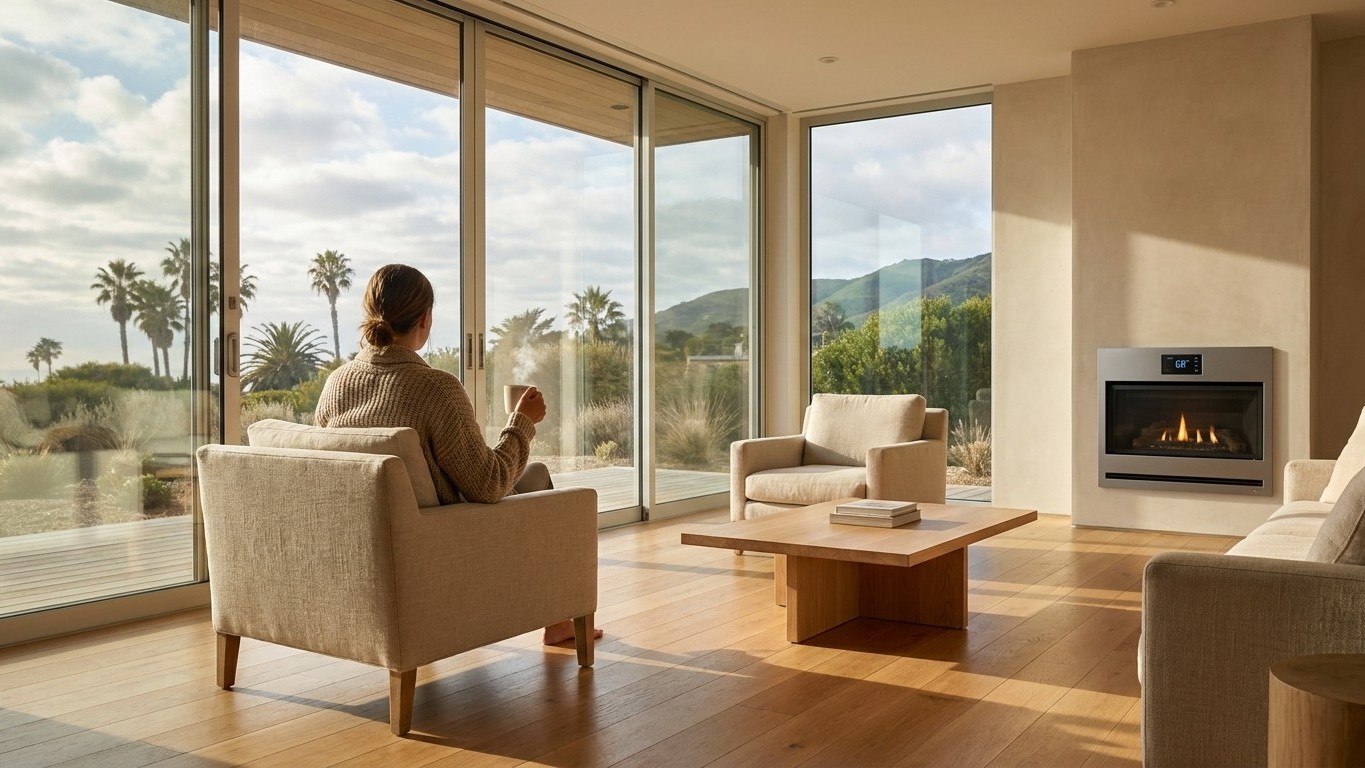

California winters don’t demand much from a furnace along the coast, and that single fact reshapes every heating decision that follows, from whether you need a woodstove at all to how much wood you’d actually burn if you had one. Here’s what the season really requires, and what a cord of wood is worth when you do need it.
How cold it gets, and for how long

In Los Angeles, the coldest month has an average daily minimum of 49.1°F. That’s the NOAA Climate Normals figure for 1991-2020, and it’s not a record low or some rare cold snap. It’s the typical overnight low during the coldest stretch of the year, and it barely dips below the mid-40s.
That number changes the entire conversation about home heating. A place where winter nights hover near 49°F doesn’t have a “heating season” in the way Minnesota or Vermont does, and When Does the Heating Season Start in California? is a fair question given how mild the state’s winters run. It has a few cool months where a furnace kicks on in the early morning and shuts off by mid-day, not a four-month grind where the system runs nonstop.
Compare that to a continental climate where the coldest-month minimum sits well below freezing for weeks at a time. There, a furnace or woodstove works constantly, moisture management matters for the wood supply, and insulation upgrades pay for themselves fast. Along coastal and Southern California, the math is different. Heating costs stay modest most winters, and many homes get by with a single space heater or a modest gas furnace cycling lightly.
This matters for equipment choices too. A woodstove sized for a brutal Midwest winter is oversized and inefficient in a California living room that only needs a few degrees of lift on a cold morning. Homeowners here often do better with smaller, more responsive heat sources rather than systems built for sustained, heavy output, and knowing When Can You Turn the Heat Off in California? helps avoid running any system longer than the mild season actually requires.
It also means the annual heating bill is a smaller slice of the household budget than it is in colder states. That’s worth remembering before spending on major upgrades. In some parts of the state, particularly at elevation in the Sierra Nevada or in interior valleys, winters run colder than the coastal reference station suggests. Local conditions vary widely across a state this size, which is exactly why the numbers below need a gut check with someone who knows your specific area.
What a cord of wood is worth here
Even in a mild climate, some households burn wood, whether for a fireplace insert, a backup heat source, or simply the ambiance on the handful of genuinely cold nights. If you do, the unit you’re buying matters more than most people realize.
A cord is a volume, not a weight: a stack measuring 4 feet by 4 feet by 8 feet, which works out to 128 cubic feet. That’s the whole trick of firewood pricing. Two cords can look similar in a truck bed and deliver wildly different heat, because denser species pack more actual wood mass into the same stack dimensions. A cord of oak carries far more burnable material than a cord of pine, even though both measure the same on paper.
| Measurement | Figure |
|---|---|
| Cord dimensions | 4 ft x 4 ft x 8 ft |
| Total volume | 128 cubic feet |
| Heat content (well-seasoned hardwood) | about 20 million BTU |
According to Michigan State University Extension, that 20 million BTU figure roughly equals the heat you’d get from 145 gallons of #2 fuel oil, or 215 gallons of LP gas. It’s a useful yardstick, not a promise. Species and moisture content swing that number considerably, so treat it as an average for well-seasoned hardwood rather than a guarantee for any particular load.
Given how mild the coldest month runs in California, one cord often stretches through an entire season of light, occasional burning, especially if wood heat is supplemental rather than the primary source. That’s a different math than a household in a colder climate zone burning through several cords by February.
Seasoning time matters just as much as species. Wood that hasn’t dried out spends its early burn boiling off internal water instead of producing usable heat, a mechanism covered in the next section.
How long wood takes to dry in California
Firewood needs to reach about 20 percent moisture or less before it burns efficiently. Green, freshly cut wood can carry over 60 percent moisture, according to Michigan State University Extension, and burning it before it dries wastes a real share of its heat potential just evaporating that water.
Seasoning time isn’t a universal number. It depends on humidity, summer heat, and how the wood is stacked. Split wood stacked so air can move through it typically reaches that 20 percent threshold after one full summer of drying, not left in rounds where the bark seals in moisture.
California’s dry summer heat, particularly inland and in the Central Valley, tends to favor fast seasoning compared to humid climates back east. Wood split in spring and stacked properly often dries well before the following winter in these drier zones. Coastal fog belts and higher-humidity microclimates will season more slowly, so don’t assume the whole state dries wood at the same pace.
One notable exception applies everywhere: red oak. MSU singles it out as a species that dries slowly because of its cell structure, so it needs more time than the general rule suggests, regardless of climate.
Burning wood before it’s properly seasoned isn’t just less efficient. It produces more creosote buildup inside the flue, which means a chimney needs sweeping sooner and carries more risk if neglected. None of this is cause for alarm, it’s simply the tradeoff for cutting the drying process short. A moisture meter, sold cheaply at hardware stores, takes the guesswork out entirely and tells you exactly where a given batch of wood stands before it goes in the stove.
Where to check before you buy
Everything above describes conditions around Los Angeles, the NOAA reference station used for California’s coldest-month figure. This is a large, geographically varied state, spanning coastal fog belts, interior deserts, and mountain elevations where winter behaves nothing like the coast. A homeowner in the Sierra foothills is dealing with a different climate than one in the Los Angeles basin, even though both fall under the same state-level statistics.
For species availability, local seasoning timelines, and current conditions in your specific county, the University of California Cooperative Extension is the right first stop. Extension offices track regional differences that statewide averages can’t capture.
Burn restrictions are worth checking separately, and often. Many California air districts impose seasonal wood-burning restrictions, sometimes tied to air quality alerts, and these rules are set locally rather than statewide. They change from year to year based on conditions, so what was allowed last winter isn’t a reliable guide to what’s allowed this one. Checking with your local air quality management district before stocking up on wood, or before lighting a fire on a given night, avoids an unpleasant surprise partway through the season.