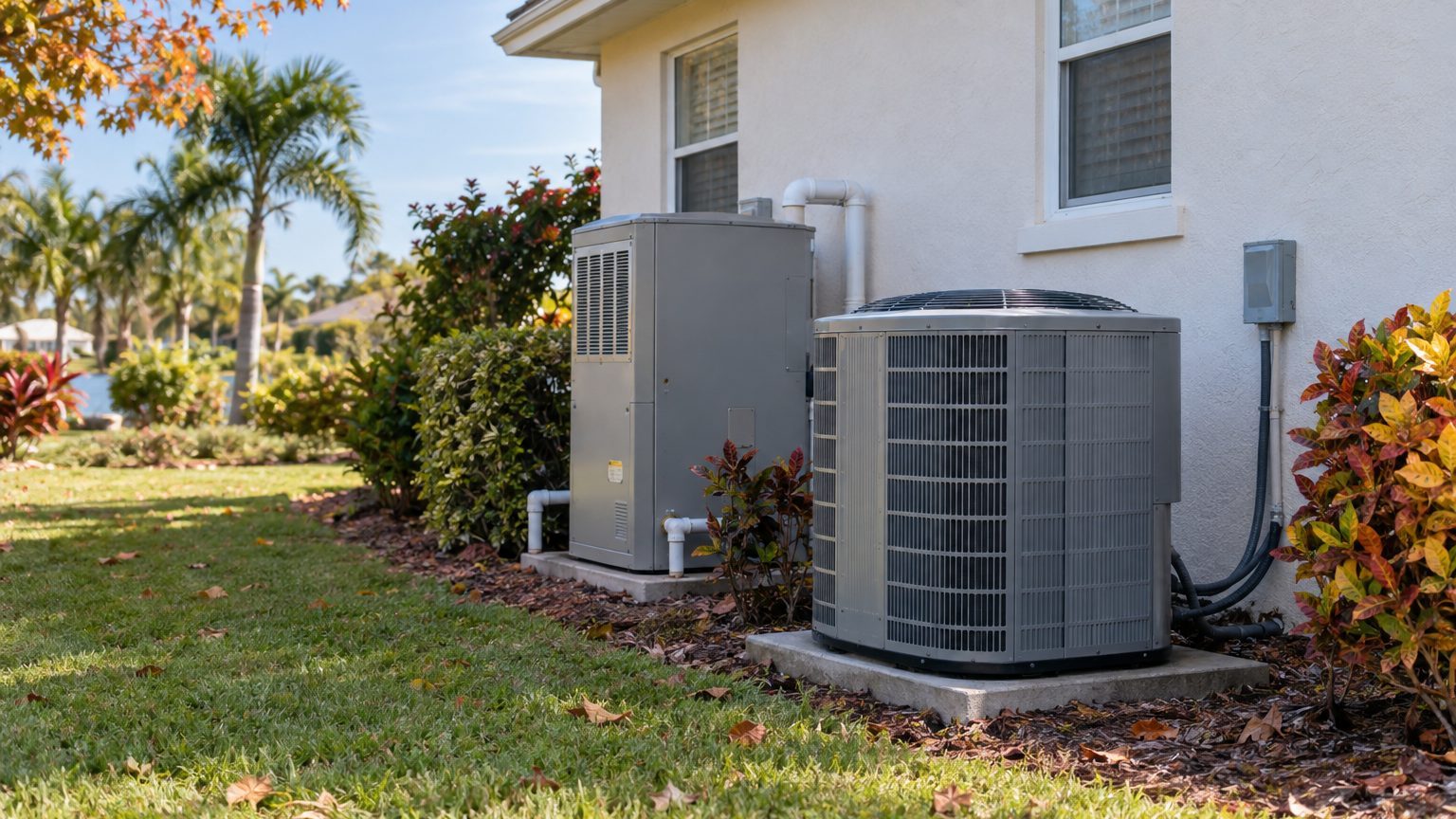

A natural gas furnace costs less to run in California: $22.34 per million Btu of delivered heat, against $41.05 for a heat pump, according to figures computed from federal price and efficiency data. The gap is $18.71 per million Btu. That compares running cost on the same unit of heat. It is not a yearly bill and not the price of the equipment. The cheaper fuel does not always make the better purchase, as the sections below show.
The short answer for California
Start with the three numbers. Delivering one million Btu of heat to a California house costs $97.45 with electric resistance (baseboard, 100% efficient), $41.05 with a heat pump rated at 8.1 HSPF2, and $22.34 with a natural gas furnace at 95% AFUE. The cheapest to run here is the gas furnace, by $18.71 per million Btu against the heat pump. I computed these from EIA average residential prices, ENERGY STAR efficiencies and EIA energy conversions.
The heat pump still beats electric resistance by a wide margin. If your home heats with baseboard or wall heaters today, the comparison that matters is $97.45 against $41.05, and the heat pump wins it easily. Gas only enters the picture when a gas line already serves the house or could.
Two limits on these numbers. The figure compares fuels on one unit, so it says nothing about how many million Btu your house needs in a winter. That depends on its size, insulation and leakiness. And it uses statewide average prices. California utilities and rate plans differ, so the gas and electric rates on your own bill can move the gap in either direction.
If you only need heat and a gas line is already connected, the furnace is the cheaper system to run, and the heat pump is the cheaper choice over any form of electric resistance.
What each option costs to run in California
| System | Efficiency used | Cost per million Btu delivered |
|---|---|---|
| Electric resistance (baseboard) | 100% efficient | $97.45 |
| Heat pump | 8.1 HSPF2 (seasonal COP about 2.4) | $41.05 |
| Natural gas furnace | 95% AFUE | $22.34 |
Electricity is priced at 33.25 cents per kWh, the average residential price year-to-date through July in the U.S. Energy Information Administration’s Electric Power Monthly, Table 5.6.B. The gas figure comes from EIA’s average residential natural gas price for the state, converted at about 1,037 Btu per cubic foot. Electricity converts at 3,412 Btu per kWh. Both are statewide averages. Your utility’s rate sheet is the place to check the real numbers.
Efficiency matters as much as the fuel price because you pay for the fuel but want the heat. A kWh of electricity holds 3,412 Btu, and baseboard turns all of it into heat, no more. A heat pump moves heat from outdoor air, so a seasonal COP of about 2.4 means it delivers roughly two and a half units of heat for each unit of electricity it uses. That is why it lands at $41.05 instead of $97.45. A furnace at 95% AFUE turns 95% of its gas into heat, and gas is the cheaper fuel per Btu in California, so it still comes out lower.
The heat pump line uses the ENERGY STAR minimum, which is a floor, not a typical unit. ENERGY STAR asks 8.5 HSPF2 of a non-ducted split system and 8.1 of a ducted one. A ductless unit has no duct losses, so it must be better to earn the same badge. For the reasoning behind that, see What HSPF2 Measures, and Why Ductless Asks for More. Compare HSPF2 with HSPF2, never with SEER2, which rates cooling.
Compare cost per million Btu delivered, not the price per kWh against the price per unit of gas. The first tells you what you will pay for heat, and the second hides the efficiency difference.
How cold it gets, and what that does to a heat pump
Los Angeles International Airport, the reference station here, logs about 1,214 heating degree days a year (base 65 F), according to NOAA’s 1991-2020 Climate Normals. Heating degree days add up, day by day, how far the average temperature sat below 65 F. Twice the total means roughly twice the fuel for the same house. A figure of 1,214 describes a short, mild heating season.
The coldest month tells the same story. Its mean daily minimum at that station is 49.1 F. Nights there get cool but stay far from the range where a heat pump struggles. In a climate like this, a heat pump barely leaves its efficient range, so the seasonal COP of about 2.4 behind the $41.05 figure is not a worst-case stand-in for a few brutal weeks.
That is one station, and California is large. A mountain county can run far colder than the coast. In deep cold a heat pump’s efficiency drops, and a backup, either resistance strips or a furnace, carries the coldest nights. A seasonal average like the 2.4 here smooths that over, so a home at elevation should expect a higher winter bill than the table suggests. For how cold air changes heat pump output, read How Cold Is Too Cold for a Heat Pump.
The short season also changes what the cost gap is worth. If a home needs few million Btu in a winter, an $18.71 difference per million Btu adds up to a modest sum over the year. A cold-climate home with the same gap pays much more for the same choice.
On the coast and in other mild areas, weather should not be what rules out a heat pump; in mountain country, size the backup before you size the heat pump.
What homes in California already heat with
RECS 2020, the Energy Information Administration’s residential survey, puts California’s main heating equipment at furnaces in 62% of homes, central heat pumps in 3% and steam or hot-water boilers in 1%. By fuel, natural gas heats 64%, electricity 20% and propane 2%. For fuel oil or kerosene, the survey publishes no figure, because too few households were found to report one. That is different from zero.
These shares describe what was installed, which mostly follows which fuel was cheap and available when homes were built. They are not a recommendation, and they are state-level numbers, not a count for your county or your street.
Still, they shape the decision. In a house with a gas furnace and ducts, the swap is straightforward, and the real question is the choice in Repairing a Furnace or Replacing It. For the 20% of homes that heat with electricity, the table above shows the savings: the same electric bill buys heat at $41.05 per million Btu instead of $97.45.
A house without a gas line changes the comparison entirely, because the gas furnace’s low running cost is not on offer. And a boiler house is a different conversion. With no ducts, a ductless system is the natural candidate, a trade covered in Ductless or Central. For the wider picture, see Heating a Home in California.
Check which fuel and which distribution system your house already has before comparing running costs, because that decides which conversion you are pricing.
When the other choice wins
The furnace wins on running cost, so the cases below favor the heat pump anyway. The first is a house with no gas service. Without a line, the furnace needs a new connection, or propane (2% of homes, no price in these figures), and the realistic comparison is the heat pump at $41.05 against resistance at $97.45.
The second is air conditioning. Los Angeles International Airport records about 720 cooling degree days a year, against 1,214 heating degree days, so cooling is a real load in this climate. A heat pump heats and cools with one machine. A gas furnace still needs a separate air conditioner, which means two systems to buy and eventually replace. Choosing a heat pump means one outdoor unit does both jobs, and the heating cost gap has to be weighed against that.
The third is a dual-fuel setup, where a heat pump handles most of the season and a furnace takes over when it gets cold. That makes sense for mountain homes, where a heat pump alone strains on the coldest nights. On the coast, where the coldest month’s mean low is 49.1 F, a second heating system is probably more hardware than the climate asks for.
The fourth is an old system with years left. A working furnace that heats the house well costs nothing to buy this year, and the $18.71 per million Btu gap favors keeping it. Replacing a healthy furnace to chase a running-cost saving that does not exist would be paying to lose money. Rebates change that arithmetic, but they vary by utility and program, so check current terms before deciding.
Pick the heat pump when you have no gas, need cooling, or are replacing a failed system anyway; keep the furnace when it works and the house only needs heat.
Common questions
Is a heat pump cheaper than a gas furnace in California?
Not on running cost, by these figures. Heat costs $41.05 per million Btu with a heat pump at 8.1 HSPF2 and $22.34 with a 95% AFUE gas furnace, a difference of $18.71. The heat pump is cheaper than electric resistance at $97.45.
Is that figure what I will pay each year?
No. It prices one million Btu delivered, using statewide average prices. Your annual bill depends on how many million Btu your house needs and on your utility’s rates.
Does a heat pump work in California’s cold areas?
Yes, with limits. The Los Angeles reference station has a coldest-month mean low of 49.1 F, which is easy for a heat pump. Mountain counties run colder, where efficiency drops and a backup carries the coldest nights.
What does ENERGY STAR require for a heat pump?
Ducted split systems and single-package units must reach at least 8.1 HSPF2 and 15.2 SEER2. Non-ducted split systems must reach at least 8.5 HSPF2 and 15.2 SEER2. These are minimums to earn the label, not typical values.