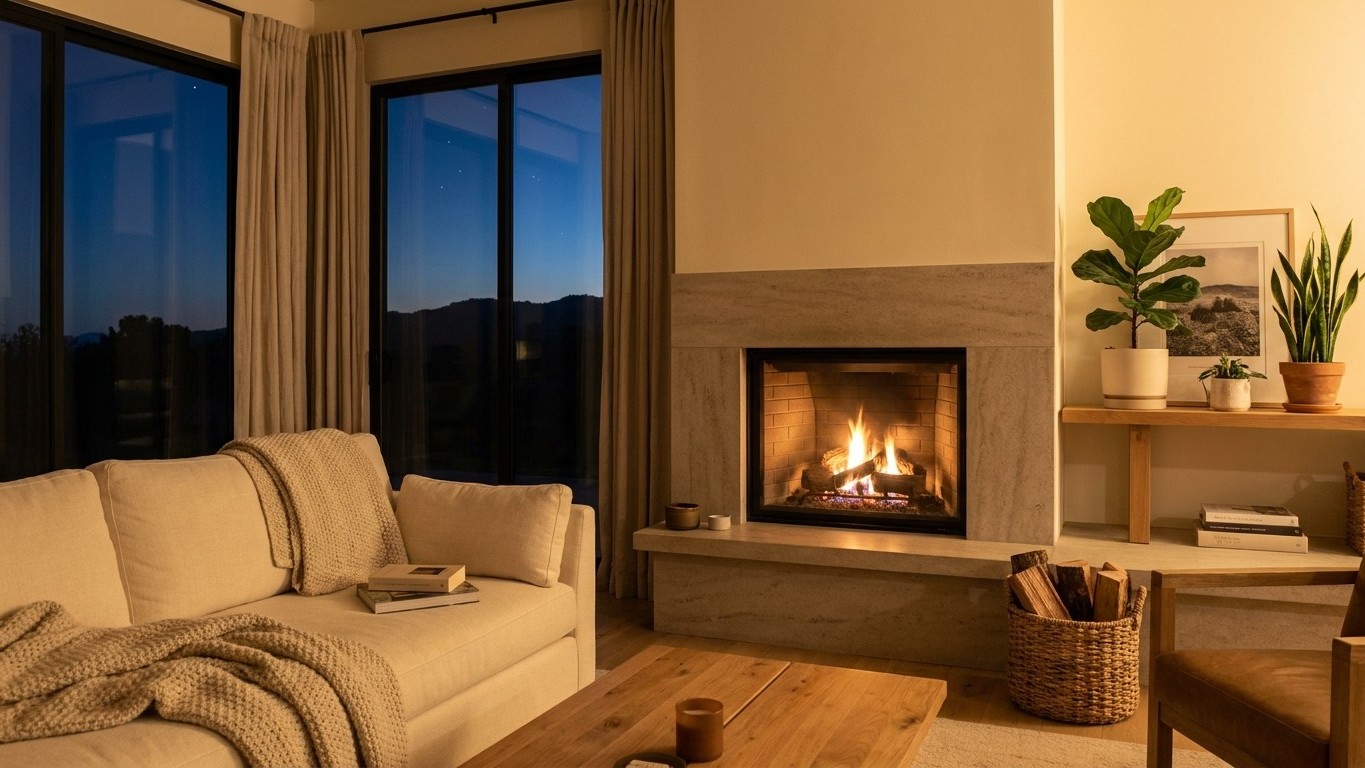

In most of California, firewood is not a survival tool. It’s an amenity, something that makes a mild winter evening better rather than something standing between a family and hypothermia. That changes which woods make sense to buy, how much to stock, and how much effort seasoning deserves.
How cold it actually gets here

The number that matters most is 49.1°F. That’s the average daily low for the coldest month at the reference station in Los Angeles, according to NOAA’s 1991-2020 Climate Normals. Not the record low some news segment mentions after a rare frost, and not the average temperature across the whole day. Just the typical overnight floor in the coldest stretch of the year.
For context, a lot of the Midwest and Northeast sits well below freezing for that same figure. Los Angeles sits nearly 20 degrees above freezing. That gap is the whole story.
When the coldest month’s average low stays in the high 40s, a house doesn’t need to fight to hold heat overnight. Pipes don’t freeze. Furnaces cycle on and off instead of running nonstop for weeks. A fireplace or wood stove becomes optional equipment, not the difference between a functioning home and an emergency.
That’s a very different situation from, say, a mountain town in the Sierra Nevada or a high desert community in the eastern part of the state, where elevation and continental air masses push winters much colder than the coastal norm. This page is written for the reference climate, the mild coastal and valley California that most residents actually live in, not for the exceptions.
Because the figure sits well above 40°F, the honest framing here is comfort. A fire on a 50-degree night, cracked windows, a glass of wine, maybe some background noise from the wind outside. Nobody in this climate is choosing between burning wood and losing heat entirely. That reframes every other question on this page: how much wood to buy, which species to bother with, how carefully to season it.
It also means the math that applies to a Vermont or Minnesota household, where a cord calculation is a matter of getting through January without running out, doesn’t transfer here. A California household burning wood for three or four cool months a year, mostly in the evenings, is solving a different problem than a household burning around the clock. Keep that distinction in mind for every section that follows, because it changes what “worth the effort” and “how much wood” actually mean.
Which woods are worth the effort here
Density decides how much heat comes out of a fixed volume of wood, because a cord, a stack measuring 4 feet by 4 feet by 8 feet (128 cubic feet), holds a set amount of space no matter what species fills it. A denser hardwood packs more actual wood mass into that same box, which is why a cord of dense hardwood delivers more usable heat than a cord of something light and airy, even though people are buying “a cord” either way.
According to Michigan State University Extension, a cord of well-seasoned hardwood carries about 20 million BTU on average, roughly equivalent to 145 gallons of #2 fuel oil or 215 gallons of LP gas. That’s an average across hardwood species and assumes proper seasoning; a green, wet cord of the same wood delivers far less usable heat because energy goes into boiling off water before any of it reaches the room.
Given California’s mild reference climate, the case for chasing the single densest, hardest-to-find hardwood is weak. A homeowner heating occasionally through a Los Angeles-area winter with lows around 49°F doesn’t need the overnight-burn density that a Minnesota household planning for single-digit nights would prioritize. Moderate-density hardwoods that are actually sold and seasoned locally do the job for evening fires and weekend use.
Red oak is worth naming specifically because MSU flags it as an exception on the drying side: its cell structure makes it dry more slowly than other hardwoods, so a red oak cord needs more time stacked and exposed to air before it hits burnable moisture levels. That’s a real cost, not a reason to avoid it, but it means a red oak load bought in late summer for a winter fire might not be ready in time.
Softer, lighter woods have their place too: as kindling, as a quick-burning supplement, or for the shoulder-season evenings in October and April when a big overnight burn isn’t the goal anyway. They’re not a substitute for hardwood on a genuinely cold night, but California rarely produces genuinely cold nights by the standard other regions use.
Availability often matters more than any density chart. A species that looks ideal on paper but that no local seller stacks and seasons properly is a worse buy than a modest hardwood a reader can actually get dried to 20 percent moisture. Check what’s sold seasoned, split, and covered near home before shopping by species name alone.
How much wood a winter takes
There’s no honest single number for “cords per winter” that applies across California, and any source that hands out one flat figure is skipping the variables that actually decide it. Three things move the estimate: how cold the winter actually gets where the wood is burned, how well the house holds heat, and whether wood is the main heat source or an occasional supplement to a furnace or heat pump.
Start with the cold figure from the first section. A household near the coastal or valley reference climate, with lows averaging 49.1°F in the coldest month, is heating for comfort on cool evenings rather than fighting sustained cold. That alone points toward a small seasonal need, often a fraction of a cord to a couple of cords for a household that burns fires a few nights a week through the cooler months.
Insulation is the second lever, and it’s a big one. A drafty older house with single-pane windows and minimal attic insulation loses heat far faster than a tightly sealed, well-insulated one, even in the exact same climate. That mismatch can easily double the wood a household burns to get the same level of comfort. Two neighbors on the same street, same winter, same fireplace, can have very different firewood needs purely because of how their houses were built or upgraded.
The third variable is the role wood plays in the house’s heating plan. A family using a fireplace mostly for ambiance on top of a working furnace burns a fraction of what a household actually depending on a wood stove for daily warmth needs, even in a mild climate. Wood as the backup system versus wood as the primary system is close to the biggest single swing factor there is.
The practical move is to buy conservatively the first season, track how much gets burned by the time cool weather passes, and adjust the next year’s order from that real number rather than a general estimate. In a mild reference climate like this one, overbuying costs storage space more than it costs money, but tracking actual use still beats guessing.
Drying wood in this climate
Seasoning matters more than species selection anywhere firewood gets burned, and California’s climate shapes how long that seasoning takes without changing the target. According to MSU Extension, firewood should burn at 20 percent moisture or less, while green, freshly cut wood can carry over 60 percent moisture. That difference is the reason a “free load” of unseasoned wood often burns poorly, smokes heavily, and wastes much of its potential heat boiling off water instead of warming the room.
What dries wood is airflow and time, not direct sun exposure. Wood needs to be split, then stacked loosely enough that air moves through the pile, ideally off the ground and covered on top while the sides stay open. A round log left whole, or a pile stacked tight against a wall with no airflow, dries far slower regardless of how sunny the location is.
California’s inland and valley regions tend to offer long, dry summers that favor faster seasoning compared to humid climates elsewhere in the country, but that advantage still requires a full season stacked properly. Coastal fog and marine humidity in some areas slow the process compared to the hot interior, so the same wood cut on the same day can season at different rates depending on exactly where it sits.
MSU singles out red oak as a case that takes longer than other hardwoods no matter how favorable the climate, because of how its cell structure holds moisture. A red oak load stacked in a dry California summer still needs more time than an ash or similar hardwood stacked right next to it.
Given the mild reference winter here, the most common mistake is cutting or buying wood in spring and expecting it ready for that same winter’s fires. One summer stacked, split, and exposed to air is generally the minimum for reaching 20 percent moisture, which means wood meant for this winter should already have been down and stacked well before the heat of summer arrived. Wood cut this spring is wood for next winter, not this one.