
If you’ve ever grown a lush, leafy onion plant that never made a bulb, the problem probably wasn’t your soil or your watering schedule. It was the seed packet. In Connecticut, the deciding factor isn’t heat or fertilizer, it’s how many hours of daylight the plant gets on the longest day of the year. Get that number wrong and an onion plant will grow tall green tops all summer, then simply rot in the ground come fall. Here’s Which Varieties Actually match Connecticut’s daylight, and which ones are a guaranteed loss no matter how well you tend them.
How long your longest day is

Bridgeport, Connecticut sits at 41.16 degrees north latitude, and on the longest day of the year the sun is up for 14 hours and 58 minutes there. That single figure decides more about your onion harvest than your fertilizer schedule, your soil pH, or how much compost you worked in last fall. Onions don’t bulb because the weather warms up. They bulb because the length of daylight crosses a threshold that tells the plant to stop building leaves and start storing sugar in a swollen stem base. Miss that threshold and nothing you do in the garden will fix it.
Almost 15 hours of daylight puts Connecticut squarely in long-day and intermediate-day territory. Short-day onions, the type that dominates seed racks and grocery store onion sets across the Deep South, need only about 12 hours of daylight to trigger bulbing. Plant one in Connecticut and it will start trying to bulb in early summer, while the plant is still small, giving you an onion the size of a golf ball instead of the size of a baseball. Long-day varieties wait for something closer to 14 to 16 hours, which is exactly what a Connecticut summer delivers.
Here’s the part that trips people up: Connecticut isn’t a point on a map, it’s a state that runs from the Long Island Sound coastline up to the Massachusetts border, a stretch that covers roughly a full degree of latitude. Bridgeport’s 41.16 degrees is a fair stand-in for most of the state, but a gardener up near the northwest corner or in the Litchfield hills sits close enough to that line that the difference is trivial for onion purposes, unlike temperature, which shifts a lot more across that same distance. Daylight length barely changes over one degree of latitude. Frost dates change plenty. Keep that distinction in mind as you read When to Plant Onions in Connecticut below.
Connecticut gets just under 15 hours of daylight at the peak of summer. That number rules out an entire category of onion before you even pick a variety name, and it opens the door to two others, which brings us to The Best Onion Varieties for Connecticut.
Which varieties bulb in Connecticut
Given a longest day of 14 hours and 58 minutes, Connecticut gardens fall into the sweet spot for long-day and intermediate-day onions. Of the 28 varieties documented for latitude range on this site, 19 have a published range that covers 41.16 degrees north outright, meaning Bridgeport, and by extension nearly all of Connecticut, sits comfortably inside their bulbing zone.
- Ailsa Craig (long-day, 38-60N)
- Barolo (long-day, 38-55N)
- Blush (long-day, 38-55N)
- Bridger (long-day, 35-50N)
- Cabernet (intermediate-day, 35-45N)
- Calibra (intermediate-day, 35-45N)
- Elsye (intermediate-day, 32-45N)
- Expression (intermediate-day, 32-45N)
- Frontier (long-day, 40-50N)
- Monastrell (intermediate-day, 35-46N)
- New York Early (long-day, 38-50N)
- Patterson (long-day, 38-55N)
- Red Carpet (long-day, 40-45N)
- Red Long of Florence (intermediate-day, 38-50N)
- Red Long of Tropea (intermediate-day, 35-48N)
- Rossa di Milano (long-day, 38-50N)
- Scout (intermediate-day, 32-46N)
- Sierra Blanca (intermediate-day, 32-45N)
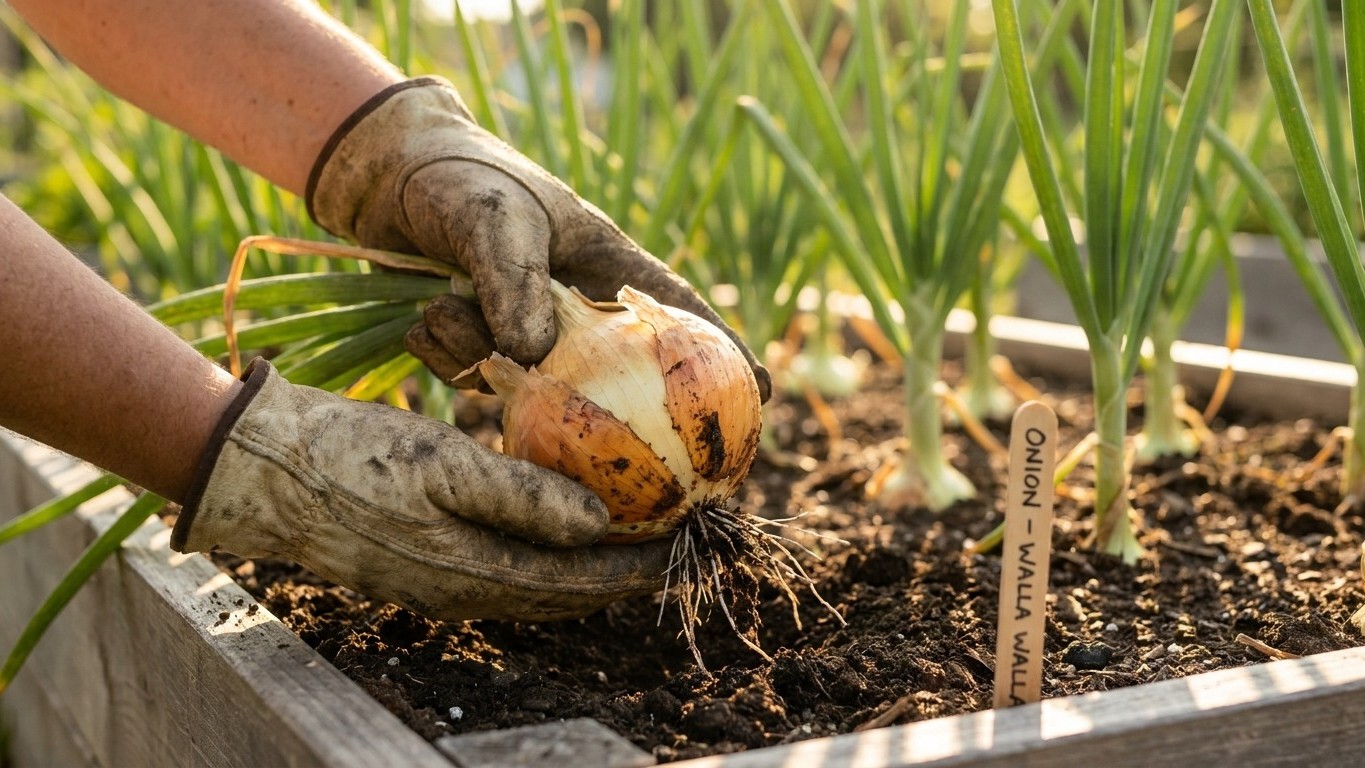
- Walla Walla Sweet (long-day, 35-55N)
Three more sit close enough to a published boundary that they land in a blurred zone rather than a clear yes: Candy (intermediate-day, 33-40N), Safrane (long-day, 42-50N), and Talon (long-day, 42-50N). Each of these has a range edge within about 1.5 degrees of Bridgeport’s latitude, which means the boundary is really a gradient, not a wall. These three may bulb reliably in southern Connecticut, especially near the coast, and may lag or underperform further north or inland. Treat them as a gamble worth trying in a small trial row, not a sure thing.
Now the list that actually matters if you’ve already lost a season to the wrong seed packet. Four varieties, all short-day types built for latitudes between 20 and 38 degrees north, will not bulb properly in Connecticut: Gabriella (20-35N), Madalyn (20-35N), Red Rock (30-36N), and White Castle (30-38N). Plant any of these here and the days are already too long by early summer, so the plant bulbs too early and too small, often no bigger than a walnut. Two more, on the opposite end, fail for the opposite reason: Powell (long-day, 43-47N) and Redwing (long-day, 43-65N) are bred for latitudes north of Connecticut, and here the day simply never gets long enough to trip their bulbing trigger. The result isn’t a small onion. It’s leaves all summer, then a soft, rotten stem when frost finally hits. No bulb ever forms.
- Gabriella (short-day, 20-35N)
- Madalyn (short-day, 20-35N)
- Red Rock (short-day, 30-36N)
- White Castle (short-day, 30-38N)
- Powell (long-day, 43-47N)
- Redwing (long-day, 43-65N)
If any of those six names sound familiar because they came off a rack of grocery store onion sets, that’s not a coincidence. Sets sold at big-box garden centers rarely list a day-length category on the label, which is exactly how so many Connecticut gardeners end up with a bed of green tops and no onions at all.
When to plant onions in Connecticut
Connecticut’s frost window, based on the 1991-2020 climate normals from the NOAA station at Bridgeport (USW00094702), runs from a last spring freeze between April 2 and April 12, to a first fall freeze between October 28 and November 10. That’s the frame for every onion planting decision in the state, and it’s a firm frame: long-day and intermediate-day onions in this climate go in as young plants or sets in early spring, not in fall.
That’s a different calendar than a Gulf Coast garden, where mild winters let short-day onions go into the ground in October and overwinter as small plants before bulbing the following spring. Connecticut winters are too harsh for that approach. Instead, aim to get onion sets or transplants into the ground as early as the soil can be worked, typically late March to mid-April, giving the plants a long stretch of cool growing weather before the summer solstice triggers bulbing.
Treat the April 2 to April 12 window as an average, not a promise. It’s built from three decades of data, and it describes a 30 to 70 percent probability band for a 32-degree freeze, not a guarantee that frost stops on a specific date. A late cold snap outside that window is entirely possible, especially inland or in low-lying spots where cold air pools. Onions themselves tolerate a light frost reasonably well once established, which gives you some margin to plant a bit ahead of the average date rather than waiting past it.
Coastal versus inland timing
Bridgeport’s frost dates represent the mildest part of the state, sitting right on the Long Island Sound. Inland and northwest Connecticut, up toward Litchfield County and the Berkshire foothills, freeze noticeably earlier in fall and later in spring than the coastal station suggests. A gardener in those areas should plan on a shorter frost-free season and may want to push planting a week or so later in spring, and harvest a bit earlier in fall, compared with the Bridgeport dates.
Sweet onions or onions that keep
What ends up in your kitchen come winter depends on a trade-off that has nothing to do with luck and everything to do with chemistry. According to University of Missouri Extension, sweet onion varieties don’t store as well as pungent ones, and the reason is the same compound that makes an onion sting your eyes and burn your tongue: volatile sulfur. A sweet onion has less of it, which is exactly what makes it pleasant to eat raw, and exactly what makes it break down faster in storage. A pungent onion has more sulfur compounds, and those compounds double as a kind of built-in preservative.
Day length lines up with that same trade-off almost perfectly. Short-day onions, grown in the South, tend to run sweeter and milder, and they’re usually eaten within weeks of harvest rather than stored through winter. Long-day and intermediate-day onions, the kind that actually bulb in Connecticut, tend to run sharper and hold up in storage for months. That’s not a coincidence of breeding, it’s the same sulfur chemistry showing up on both ends of the equation.
For a Connecticut garden, that means leaning toward the sharper, long-keeping side of the spectrum if the goal is a pantry that lasts into winter. A variety like Patterson or Frontier, both long-day types documented above, is bred with storage in mind and will hold in a cool, dark spot well past the holidays. A softer, sweeter pick like Walla Walla Sweet, also on the list of varieties that bulb here, gives up storage life for flavor, and is better planned as a summer and early fall onion rather than one you’re counting on for a March stew.
The practical move is to grow both if space allows: a sweeter variety for eating fresh through late summer, and a sharper, long-day keeper set aside and cured properly for the root cellar or a cool closet shelf. That combination is what actually reflects what Connecticut’s daylight and climate can give a home gardener, rather than chasing a single onion that tries to do everything at once and does none of it particularly well.