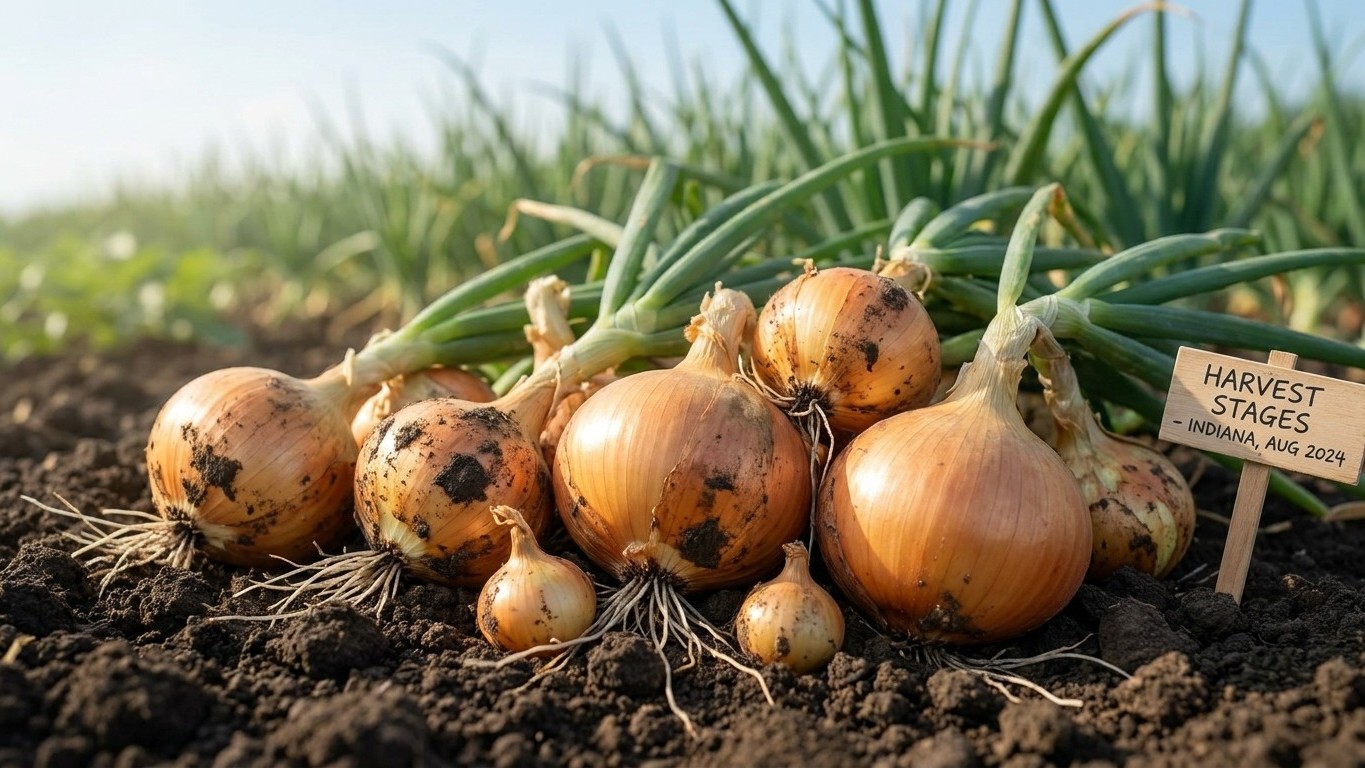

Indianapolis sits at 39.71 degrees north, and on the longest day of the year the sun gives it 14 hours and 49 minutes of daylight. That single number decides which onions will bulb in an Indiana garden and which ones will simply sulk in the ground. It puts most of the state in intermediate-day and long-day territory, with short-day types ruled out almost everywhere except the far southern tip. Getting the timing right matters just as much as picking the right variety, so it’s worth checking When to Plant Onions in Indiana before you put anything in the ground.
How long your longest day is

Onions don’t bulb because the weather warms up. They bulb because the length of the day crosses a threshold that’s wired into the variety. Short-day onions start swelling once the day reaches about 12 hours, according to Clemson Cooperative Extension’s home garden guidance. Long-day onions hold off until the day stretches to somewhere between 14 and 16 hours. At 14 hours 49 minutes, Indianapolis clears the short-day trigger by a wide margin and sits comfortably inside the long-day window too, which is why both intermediate-day and long-day varieties have a real shot here.
That’s really the whole page in one paragraph. Everything below is detail on how to act on it. A short-day onion planted in central Indiana will start forming a bulb almost as soon as it’s in the ground, before the plant has built enough leaf mass to feed a decent-sized onion. The result is a small, unsatisfying bulb, not a failure of soil or watering. A long-day onion, on the other hand, waits patiently through spring, builds a full canopy of leaves, and only starts bulbing once the day length arrives at its trigger, which in Indiana it eventually does.
Indiana runs from roughly 37.8 degrees north near Evansville to about 41.5 degrees north up near the Michigan border. That’s close to four degrees of latitude, which is enough to shift the daylight math meaningfully. A gardener in the Ohio River valley is working with a slightly shorter longest day than someone near the Great Lakes, and the northern edge of the state gets closer to the middle of the long-day range while the south sits nearer the intermediate zone. If you’re gardening near either edge of the state, it’s worth checking your own city’s latitude rather than assuming Indianapolis numbers apply exactly to you. The gap isn’t huge, but for a variety sitting close to a published boundary, it can be the difference between a solid bulb and a disappointing one.
Which varieties bulb in Indiana
Catalogue ranges for onion varieties are published as latitude bands, and at 39.71 degrees north, a good number of them line up with Indiana. For a deeper breakdown, see The Best Onion Varieties for Indiana. Eighteen documented varieties have published ranges that cover this latitude directly:
- Ailsa Craig (long-day, 38-60N)
- Barolo (long-day, 38-55N)
- Blush (long-day, 38-55N)
- Bridger (long-day, 35-50N)
- Cabernet (intermediate-day, 35-45N)
- Calibra (intermediate-day, 35-45N)
- Candy (intermediate-day, 33-40N)
- Elsye (intermediate-day, 32-45N)
- Expression (intermediate-day, 32-45N)
- Monastrell (intermediate-day, 35-46N)
- New York Early (long-day, 38-50N)
- Patterson (long-day, 38-55N)
- Red Long of Florence (intermediate-day, 38-50N)
- Red Long of Tropea (intermediate-day, 35-48N)
- Rossa di Milano (long-day, 38-50N)
- Scout (intermediate-day, 32-46N)
- Sierra Blanca (intermediate-day, 32-45N)
- Walla Walla Sweet (long-day, 35-55N)
Two more, Frontier (long-day, 40-50N) and Red Carpet (long-day, 40-45N), sit close enough to the 39.71N mark to fall in a blurred zone. Their published ranges start just above this latitude, so they may bulb reasonably well here, especially in the northern third of the state, but a gardener growing them in southern Indiana is working at the edge of what the variety was bred for. Treat these as a maybe, not a guarantee.
Now the part that actually matters if you’ve had a bad season before. Eight varieties will not bulb properly in Indiana, and they fail for opposite reasons. Four are short-day types published for latitudes well south of here: Gabriella, Madalyn, Red Rock, and White Castle, all rated for roughly 20 to 38 degrees north. Planted in Indiana, they hit their 12-hour trigger while still small, so they bulb early and stay tiny. That’s a variety mismatch, not a feeding problem, and no amount of fertilizer fixes it.
The other four are long-day types published for latitudes above Indiana: Powell (43-47N), Redwing (43-65N), Safrane (42-50N), and Talon (42-50N). These need a day length Indiana’s summer never quite delivers. The plant doesn’t bulb small, it doesn’t bulb at all. It keeps making leaves through the season, then rots in the ground as fall arrives. If you’ve ever pulled up a patch of lush green onion tops attached to nothing, this is very likely why.
When to plant onions in Indiana
Because Indiana lands in intermediate-to-long-day territory rather than the mild-winter short-day zone of the Deep South, planting here follows the northern pattern: onions go in from late winter into early spring, as sets, transplants, or seed started indoors, rather than in autumn. Autumn planting works where winters stay mild enough for young plants to overwinter, which isn’t the case across most of Indiana.
The frame for spring planting is the last spring frost, which at the Indianapolis reference station runs from April 9 to April 21, based on NOAA’s 1991-2020 climate normals for 32-degree freeze probabilities. Onion sets and transplants tolerate a light frost better than many garden crops, so growers often get seedlings or sets in the ground a few weeks ahead of that window rather than waiting past it, watching soil conditions rather than the calendar alone.
Those dates are averages, not guarantees. NOAA and Purdue’s own extension guidance both note there’s roughly a 10 percent chance of a 32-degree freeze event after the published spring date, so anyone planting on the early edge of that April 9 to 21 range should have row cover or another protection method within reach.
On the other end of the season, the first fall frost at Indianapolis runs from October 21 to October 30. That date matters more for harvest timing and curing than for planting, since onions should already be maturing and drying down well before frost arrives. Remember, too, that Indianapolis is a single reference point. Southern Indiana tends to see its last spring frost and first fall frost run a couple of weeks earlier and later, respectively, than the northern part of the state, so gardeners near either edge should nudge these dates accordingly rather than applying them uniformly.
Sweet onions or onions that keep
Every onion variety sits somewhere on a trade-off between flavor and shelf life, and it isn’t a marketing choice, it’s chemistry. According to University of Missouri Extension, the bite in a pungent onion comes from volatile sulfur compounds, and those same compounds are what protect the bulb during storage. A sweet variety simply has fewer of them. That makes it better eaten fresh off the counter and worse at surviving a winter in a pantry or root cellar.
This lines up with the day-length groupings already at play in Indiana. Intermediate-day varieties, several of which are documented as covering this latitude, such as Candy and Cabernet, tend to run sweeter and shorter-keeping. Long-day varieties that also fit Indiana’s daylight window, like Patterson, Bridger, or Ailsa Craig, generally carry more of those sulfur compounds and hold longer in storage.
What that means practically is that an Indiana garden doesn’t have to choose one lane exclusively, but it does need to plan for both. A bed of Candy or a similar intermediate-day sweet onion gives you something worth slicing raw in July and August, but it isn’t going to last into winter no matter how carefully it’s cured. A bed of Patterson or Bridger won’t taste quite as mild at the table, but properly cured and stored in a cool, dry, dark spot, those bulbs are the ones still sound in the pantry come March.
The honest way to plan a season is to grow both, in a ratio that matches how you actually eat. Heavy salad and grilling season ahead? Lean into the sweeter intermediate-day types. Want onions that carry the kitchen through winter soups without a grocery run? Put more of the bed into long-day keepers. Just don’t expect one variety to do both jobs. No onion sold as sweet is going to store like a pungent long-day type, and none of the varieties that keep well through winter are going to taste mild enough to eat like an apple.