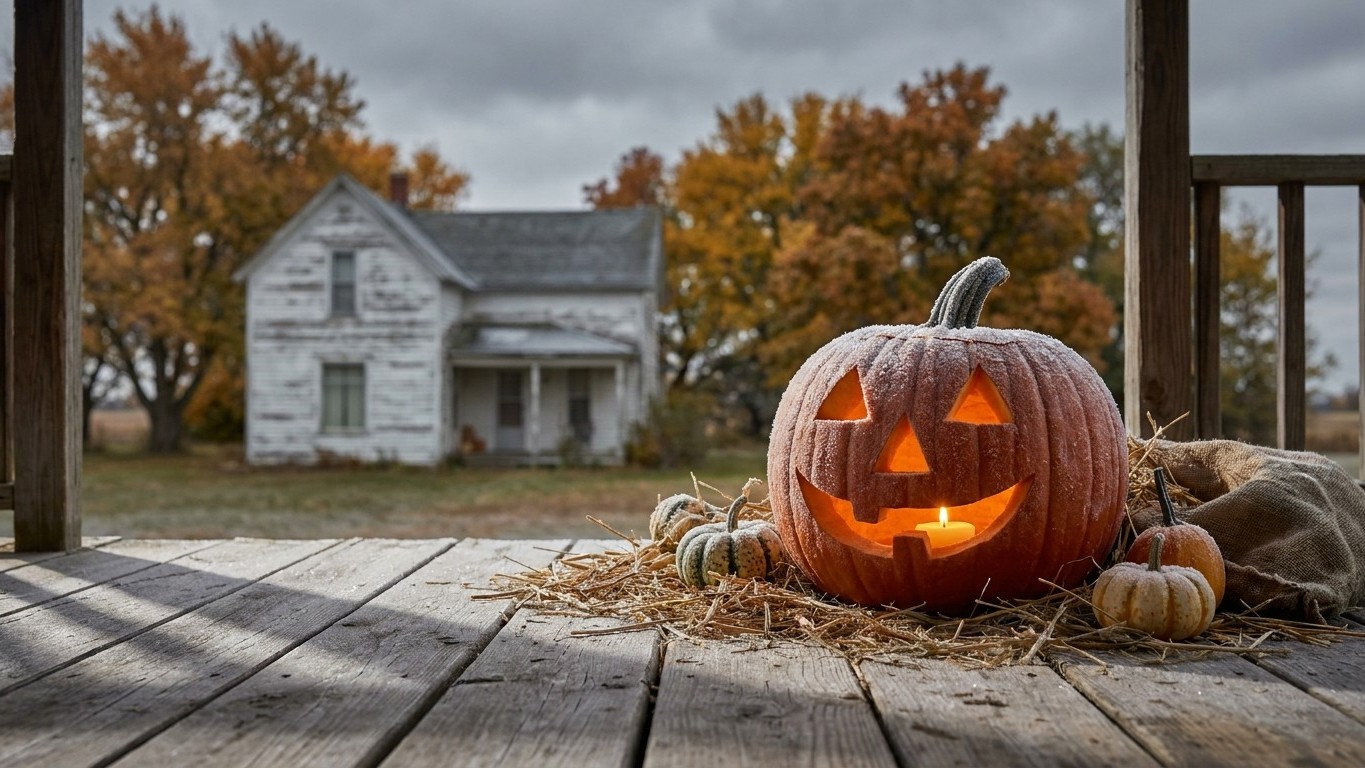

Around Wichita, the mean first fall frost lands somewhere between October 23 and November 2, a window that straddles Halloween almost exactly. That single fact should guide when you pick up the knife. A pumpkin left on a porch through the back half of October in Kansas is gambling against a frost date that could arrive a full week early or a couple of days late. The safest play is to carve close to the holiday itself, not weeks ahead of it.
The short answer

NOAA’s 1991-2020 climate normals put the mean first fall freeze for the Wichita area somewhere in that October 23 to November 2 stretch. That’s not a single date you can circle on a calendar. It’s an average built from thirty years of weather, and any given year can land well outside it. What matters for a pumpkin sitting outside is that Halloween falls right in the middle of that window, which means some years the frost beats the holiday and some years it doesn’t show up until after trick-or-treaters have gone home.
That timing puts Kansas in an odd middle ground compared to places further north, where frost reliably arrives weeks before Halloween, or the Deep South, where it may not show up until well into November. Here, the risk is real but not guaranteed, and it’s close enough to the holiday that you can’t simply carve early and assume you’re in the clear.
The practical window, then, runs roughly from a few days before Halloween up to the day itself. Carving any earlier than that stretches a cut pumpkin’s exposure to whatever the weather decides to do, whether that’s a stretch of unseasonably warm afternoons that speeds up softening or an early frost that damages the flesh before you’ve even lit a candle inside it. Carving right up against Halloween, rather than a week or two out, keeps the exposed pumpkin’s time outdoors as short as possible.
None of this means you should panic about an exact date. A mean frost date is a statistical average, not a forecast, and the actual first freeze in any given fall could land anywhere in that range or outside it entirely. The takeaway for Kansas carving plans is simpler than it sounds: treat the last few days before Halloween as your carving window, keep the whole pumpkin cool and dark until then, and don’t assume you have weeks of margin just because the calendar says late October. Kansas weather in autumn moves fast, and a pumpkin that’s already carved has no defenses against either a sudden cold snap or a run of warm, sunny days.
Frost or heat: which one gets it here
The cold end
A whole pumpkin is meant to be stored between 45 and 50 degrees Fahrenheit, according to University of Illinois Extension. In Kansas, the relevant threat in late October is cold, not warmth, and the frost data explains why. With the mean first fall frost landing somewhere between October 23 and November 2, a pumpkin left outdoors unprotected in that stretch is sitting right at the edge of freezing temperatures, well below that 45-50 degree comfort band. A frost won’t necessarily ruin a whole, uncarved pumpkin the way it would a carved one, but repeated freeze-thaw cycles on exposed flesh (which is exactly what a jack-o’-lantern has) speed up softening and rot fast.
It’s worth separating this from winter hardiness numbers, which measure something different. The mean daily minimum for the coldest month near Wichita runs around 22.5 degrees Fahrenheit, a figure that describes how cold January gets, not what late October looks like. That number belongs to hardiness zone conversations about whether a perennial plant survives the winter here at all. It has nothing to do with pumpkin carving timing, and conflating the two is a common mistake. The frost date, not the hardiness zone, is the number that matters for a porch pumpkin.
The warm end
Heat is a much smaller concern here than it is farther south. By the time late October arrives in Kansas, daytime highs have generally cooled enough that keeping a whole pumpkin above 50 degrees isn’t the issue it might be in, say, a Gulf Coast state where a warm autumn can push storage temperatures too high for weeks at a stretch. That doesn’t mean warmth is irrelevant. A stretch of unseasonably mild, sunny days can still soften an already-carved pumpkin faster than expected, and direct sun on a dark porch surface adds heat a thermometer reading of the air might not capture. But the dominant risk in this region, by a wide margin, is the cold end of that range, not the warm end.
Where to keep it until you carve
- Choose it well at the patch. Look for 1 to 2 inches of stem left on the pumpkin. That stem is the seal on the fruit, not a handle, and once it breaks off, that spot becomes an open door for rot. Never carry or lift a pumpkin by the stem. Pick one that’s heavy for its size, without soft spots or blemishes; shape doesn’t matter.
- Find a cool, dark spot close to 45-50 degrees. An unheated garage, an enclosed porch out of direct sun, or a cellar or basement corner away from any heat vents comes closest to that range in a typical Kansas home during late October. A sunny front step looks festive but runs warmer than it feels, especially on clear afternoons.
- Keep it away from ripening fruit. Apples, potatoes, and tomatoes give off a gas that speeds up aging in nearby produce, pumpkins included. A pumpkin stored in a fruit bowl or next to a bag of potatoes ages faster than one kept on its own.
- Watch the forecast, not just the calendar. Since the mean frost date for this area sits right around Halloween, check short-range forecasts as the holiday approaches. If a hard freeze is called for a few nights before Halloween, that’s a signal to bring the whole pumpkin somewhere sheltered rather than leaving it exposed outside.
- Carve as close to Halloween as your plans allow. A whole, uncarved pumpkin stored properly can keep for three to six months. A carved one has no such published shelf life, so shortening the gap between the knife and the porch display is the one variable fully in your control.
Checking this against your own county
The frost figures here come from a single reference weather station near Wichita, and Kansas is a big state with real differences in elevation and terrain across it. Suburban and rural spots often see their first fall frost earlier than an airport station reports, sometimes by a week or two, and higher elevations can see it earlier still. That gap matters more than it sounds, since it can shift your carving window by several days in either direction.
For a more local answer, K-State Research and Extension maintains county-level offices across Kansas and can point you to frost data specific to your area rather than the regional average used here. That’s the better source for anyone whose garden sits well outside a metro area, on a hill, or in a low-lying spot that tends to collect cold air.
Common questions
Does a light frost ruin a whole, uncarved pumpkin?
A whole pumpkin’s tough skin offers real protection against a light frost, unlike a carved one with exposed flesh. Repeated hard freezes are more damaging than a single light frost, but the safest approach is still to store whole pumpkins in that 45-50 degree range rather than testing their limits outdoors.
How long does a carved pumpkin actually last?
No university extension publishes a specific number of days for a carved pumpkin, and there’s no verified preservation protocol behind the tips you’ll see elsewhere online. What extension sources do publish is guidance on picking a pumpkin well, keeping it whole as long as possible, and carving it close to the day you plan to display it.
Is the hardiness zone useful for figuring out frost timing?
No. Hardiness zones describe winter cold severity for perennial plants, not the date of the first fall frost. For carving timing, the frost date itself, not the zone number, is the figure that matters.
What’s the single biggest storage mistake people make with pumpkins?
Storing them near ripening fruit like apples, potatoes, or tomatoes. Those items release a gas that speeds up aging in nearby produce, and a pumpkin sitting in a kitchen fruit bowl ages noticeably faster than one kept alone in a cool, dark spot.