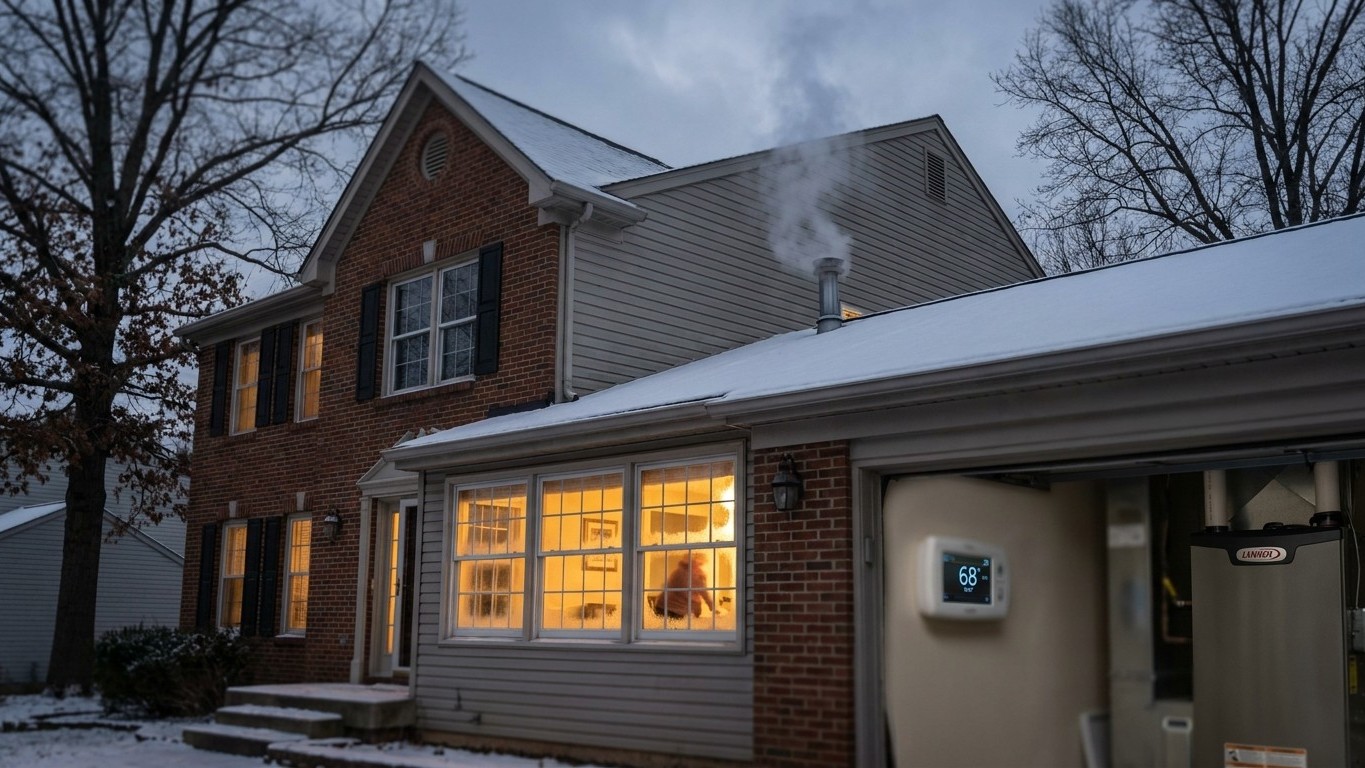

Baltimore’s coldest month sits at a mean daily minimum of 25.4°F. That single number shapes how much wood, propane, or heating oil a Maryland household burns through, how long the season drags on, and what a wet stack of firewood will cost you in wasted heat. Here’s what the numbers mean once winter actually arrives.
How cold it gets, and for how long

The 25.4°F figure comes from NOAA’s 1991-2020 Climate Normals for Baltimore, and it’s not the record low or some scary overnight dip. It’s the average low across the coldest month, which for most of Maryland means January. That distinction matters: a mean minimum in the mid-20s describes a winter that hovers just below freezing on a typical night, not one that plunges into deep-freeze territory for weeks at a stretch.
Compare that to a place like International Falls, Minnesota, where the coldest-month minimum sits well below zero, and you get a sense of where Maryland lands on the national scale: cold enough to demand a real heating system, mild enough that the season doesn’t stretch on forever. When Does the Heating Season Start in Maryland? Generally it runs from mid-October through early April, roughly five to six months, but the hardest stretch, the one that actually drives fuel consumption, is concentrated in December through February.
What this means for equipment
A furnace or heat pump sized for Baltimore’s climate doesn’t need to handle the kind of sustained sub-zero load that a system in the Upper Midwest does. That’s good news for anyone weighing supplemental heat sources, wood stoves, pellet inserts, propane heaters. They’re not fighting an uphill battle against relentless cold; they’re filling gaps on the coldest nights and taking pressure off the primary system during shoulder months. When Can You Turn the Heat Off in Maryland? A mean minimum near freezing also means moisture stays part of the equation all winter. Ice, freeze-thaw cycles, and damp cold all factor into how a house loses heat and how a chimney or flue performs, which is worth keeping in mind before assuming any heating strategy that works in a drier, colder climate will translate directly here.
What a cord of wood is worth here
A cord is a volume, not a weight, and that’s the entire trap buyers fall into. It’s a stack measuring 4 feet by 4 feet by 8 feet, which works out to 128 cubic feet, no more and no less. Anyone selling a “truckload” or a “rick” without specifying that measurement is asking you to trust a number that doesn’t exist in any standard.
| Measurement | Value |
|---|---|
| Dimensions | 4 ft x 4 ft x 8 ft |
| Volume | 128 cubic feet |
| Heat energy (well-seasoned hardwood) | about 20 million BTU |
Michigan State University Extension puts that 20 million BTU figure in terms a homeowner can actually use: one cord of well-seasoned hardwood delivers roughly the heat of 145 gallons of #2 fuel oil, or 215 gallons of LP gas. That’s a useful yardstick when you’re trying to figure out how many cords a Maryland winter, with its five-to-six-month season, will realistically eat through.
But that 20 million BTU number is an average, and it moves a lot depending on species and moisture. Dense hardwoods like oak or hickory pack more mass into that same 128 cubic feet than a softer wood like pine, so they burn longer and hotter from the identical stack size. And a wet cord doesn’t deliver anywhere near 20 million BTU, no matter what species it is, because a chunk of that energy gets spent boiling off water before the wood ever throws real heat into the room.
How long wood takes to dry in Maryland
Seasoning isn’t a fixed calendar date. It’s a moisture target: MSU Extension recommends burning wood at 20 percent moisture or less, while green, freshly cut wood can sit above 60 percent. That gap is enormous, and it’s why “seasoned” firewood and “green” firewood behave like two different fuels even when they’re the same species.
Split green wood typically reaches that 20 percent threshold after one full summer of being stacked so air can move through it, split and stacked, not left in rounds. Rounds trap moisture inside the bark and dry at a fraction of the rate. Maryland’s humid summers don’t accelerate that process the way a drier climate might; if anything, the region’s humidity means airflow through the stack matters more here than it would in the arid Southwest.
Red oak is the named exception worth remembering. MSU points out that its cell structure makes it dry slower than most other hardwoods, so a red oak stack that looks ready after one summer may still be holding more moisture than it should. Burning wood before it’s actually seasoned doesn’t just waste heat, it creates a mess in the flue. Wet wood produces more smoke and more creosote buildup, since the fire is working harder to boil off water than to combust cleanly. That buildup means a chimney needs sweeping sooner, and in the worst cases, it raises the risk of a chimney fire. None of that requires alarm, it just requires checking moisture before you load the stove, and giving a stack the time and airflow it actually needs rather than the time you’d prefer it needed.
Where to check before you buy
Baltimore is the reference point for the figures above, but Maryland stretches from the Appalachian ridges of Garrett County to the tidal flats of the Eastern Shore, and elevation and exposure shift both Temperature and wood-drying conditions meaningfully across that range. A mountain property in the western panhandle sees colder nights and a longer heating season, while the Eastern Shore tends to run milder.
For species availability, local seasoning conditions, and any seasonal burn restrictions that apply in a specific county, the University of Maryland Extension is the resource to check. Burn rules, including outdoor burning permits and air-quality advisory days, are set at the local and county level and do change from year to year, so what applied last winter isn’t guaranteed to apply this one. Checking before you buy or before you load a truck with a season’s worth of firewood saves both money and a possible citation.
What each heat source costs to run in Maryland
At Maryland’s average residential prices, this is what one million Btu of heat delivered into the house costs with each system. It compares fuels on the same unit: it is not a yearly bill, and it leaves out the price of the equipment.
| System | Cost per million Btu delivered |
|---|---|
| Electric resistance (baseboard, 100% efficient) | $62.43 |
| Heat pump at 8.1 HSPF2 (seasonal COP about 2.4) | $26.30 |
Cheapest to run in Maryland: heat pump, $36.13 less per million Btu than the electric resistance.
Prices: U.S. Energy Information Administration (EIA), average residential prices. Efficiencies: ENERGY STAR criteria. A heat pump’s figure is a seasonal average; in the coldest weather its efficiency drops.