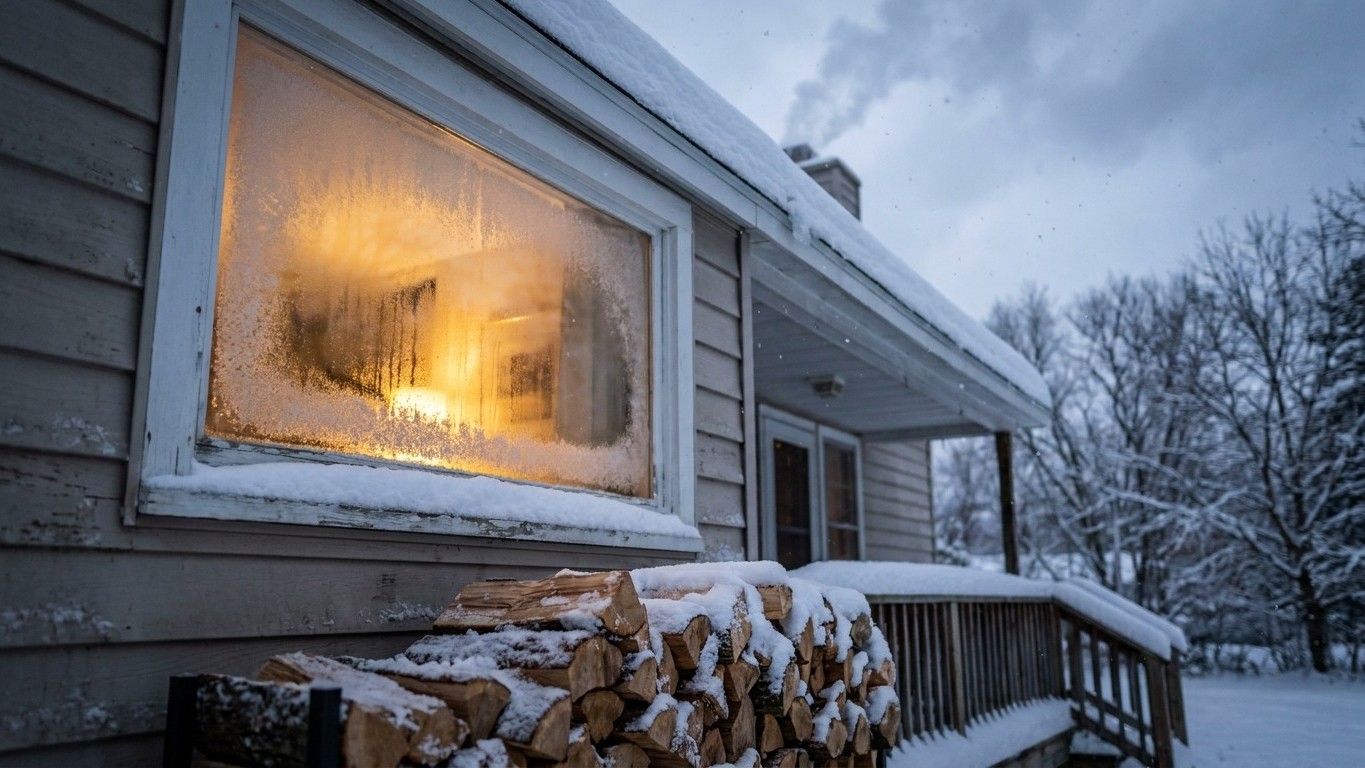

A Michigan winter means four to five months where the furnace or wood stove runs daily, not just on the coldest nights. The numbers below, drawn from NOAA climate data and Michigan State University Extension research, show what that actually demands from a house and from anyone stacking wood for it.
How cold it gets, and for how long

The average daily low in Michigan’s coldest month sits at 19.2°F, based on NOAA NCEI Climate Normals from 1991-2020 at the Detroit reference station. That’s not the record low some news segment likes to mention. It’s the typical nighttime floor, night after night, for the whole month. A single cold snap is easy to shrug off. A month that averages 19.2°F for its lows is a different animal entirely.
What that number really tells a homeowner is about duration, not just depth. Detroit’s winter doesn’t spike down and bounce back. It settles into the high teens for weeks, then holds there while the calendar drags through December, January, and often a good chunk of February. A heating system built for occasional cold isn’t built for that kind of sustained load. Furnaces run longer cycles. Wood stoves need reloading more often, sometimes overnight. Heat pumps, if a household relies on one, work harder to pull warmth out of air that barely gets above freezing during the day.
Why this figure matters more than the record low
A record low is a headline. It happens once, maybe twice a decade, and it’s gone in a day. The 19.2°F figure is a pattern, and patterns are what wear down equipment, budgets, and firewood stacks. Insulation gaps that go unnoticed in October become expensive in January when the house is fighting a 19-degree night instead of a 40-degree one. Same goes for a chimney that hasn’t been swept: a system running near-constantly for months puts more hours, and more creosote, through the flue than one that only kicks on occasionally.
This is also why heating season length matters as much as the low itself. A place that dips to 19°F for two weeks and then warms up isn’t asking the same thing of a house as one that holds near that mark for a full season. Michigan does the latter, and knowing exactly when does the heating season start in Michigan? is the baseline any furnace sizing, insulation upgrade, or decision about When Can You Turn the Heat Off in Michigan? should start fromde, or firewood order should start from, not the record cold snap that makes the local news once a winter.
What a cord of wood is worth here
A cord isn’t a weight. It’s a volume: a stack measuring 4 feet by 4 feet by 8 feet, which works out to 128 cubic feet. That distinction is where most firewood buyers get shorted, because a “cord” of loosely stacked, oddly cut rounds can look full while actually holding a fraction of that volume. Dense hardwood species pack more mass into that same 128 cubic feet than lighter woods do, which is why species matters as much as quantity when you’re buying by the cord.
| Measurement | Value |
|---|---|
| Standard cord dimensions | 4 ft x 4 ft x 8 ft |
| Total volume | 128 cubic feet |
| Heat energy, well-seasoned hardwood | about 20 million BTU per cord |
According to Michigan State University Extension, a cord of well-seasoned hardwood delivers roughly 20 million BTU, which the extension service equates to about 145 gallons of #2 fuel oil or 215 gallons of LP gas. That comparison is useful because it turns an abstract stack of logs into something a homeowner can measure against a fuel bill they already understand. Given a heating season that runs four to five months at Michigan’s typical winter temperatures, a single cord rarely carries a whole household through on its own unless wood is a supplemental heat source rather than the primary one.
The 20 million BTU figure is an average, not a guarantee. MSU is clear that species and moisture content move that number substantially. A cord of oak or hard maple, properly seasoned, will outperform a cord of soft, fast-growing wood at the same volume. And a cord that hasn’t dried enough won’t deliver anywhere close to that figure, because a good portion of its heat gets spent evaporating water it should have shed months earlier.
How long wood takes to dry in Michigan
Firewood needs to reach around 20 percent moisture or less before it burns efficiently. Green, freshly cut wood can hold more than 60 percent moisture, according to Michigan State University Extension. That gap between 60 and 20 percent isn’t cosmetic. Every bit of that water has to boil off before the wood starts actually producing usable heat, and that boiling process consumes energy that would otherwise be warming the house.
Split and stacked wood, with air moving freely through the pile, typically reaches that 20 percent target after one full summer of drying. That’s the key phrase: split and stacked. Rounds left whole, or wood piled tight against a wall with no airflow, dry far slower, sometimes never reaching a usable moisture level even after a year. Michigan’s humid summers don’t help matters the way a drier climate would, so getting the stacking right matters more here than it might elsewhere.
Red oak is the notable exception MSU points to. Its cell structure resists drying, so it needs longer than a single summer to season properly, even when split and stacked well. Anyone burning red oak on the same one-summer timeline as ash or maple is likely burning it too soon.
Burning wood before it’s ready doesn’t just waste effort. It cuts heat output noticeably, since so much of the fire’s energy goes into steaming off residual moisture instead of warming a room. It also leaves more creosote behind in the flue, which builds up faster with wet wood than with properly seasoned fuel. That means more frequent chimney sweeping, and a higher risk of a chimney fire if that maintenance gets skipped. None of this is dramatic on any single night. It’s a slow accumulation, the kind of thing that shows up as a chimney sweep’s bad news in November rather than a crisis in the moment.
Where to check before you buy
Every figure above comes from the Detroit reference station and applies most directly to that part of the state. Michigan spans a lot of ground between the southern border and the Upper Peninsula, and elevation, lake effect, and exposure shift both Temperature and typical wood species availability from one county to the next. A homeowner in the Keweenaw Peninsula is dealing with a longer, harder winter than one near Detroit, even though both are technically the same state.
Species availability also varies by region, and so do local burn restrictions, which are set at the county or municipal level and can change from year to year based on air quality conditions or drought risk. There’s no statewide rule that covers every township the same way.
Before buying a season’s worth of firewood, or deciding what species to plan around, check with Michigan State University Extension. Its outreach offices can speak to what’s actually available and well-suited to a specific county, and can point to any current local restrictions on open burning or wood-stove use that a state-level overview like this one simply can’t track.
What each heat source costs to run in Michigan
At Michigan’s average residential prices, this is what one million Btu of heat delivered into the house costs with each system. It compares fuels on the same unit: it is not a yearly bill, and it leaves out the price of the equipment.
| System | Cost per million Btu delivered |
|---|---|
| Electric resistance (baseboard, 100% efficient) | $63.10 |
| Heat pump at 8.1 HSPF2 (seasonal COP about 2.4) | $26.58 |
| Natural gas furnace at 97% AFUE | $10.86 |
Cheapest to run in Michigan: natural gas furnace, $15.72 less per million Btu than the heat pump.
Prices: U.S. Energy Information Administration (EIA), average residential prices. Efficiencies: ENERGY STAR criteria. A heat pump’s figure is a seasonal average; in the coldest weather its efficiency drops.