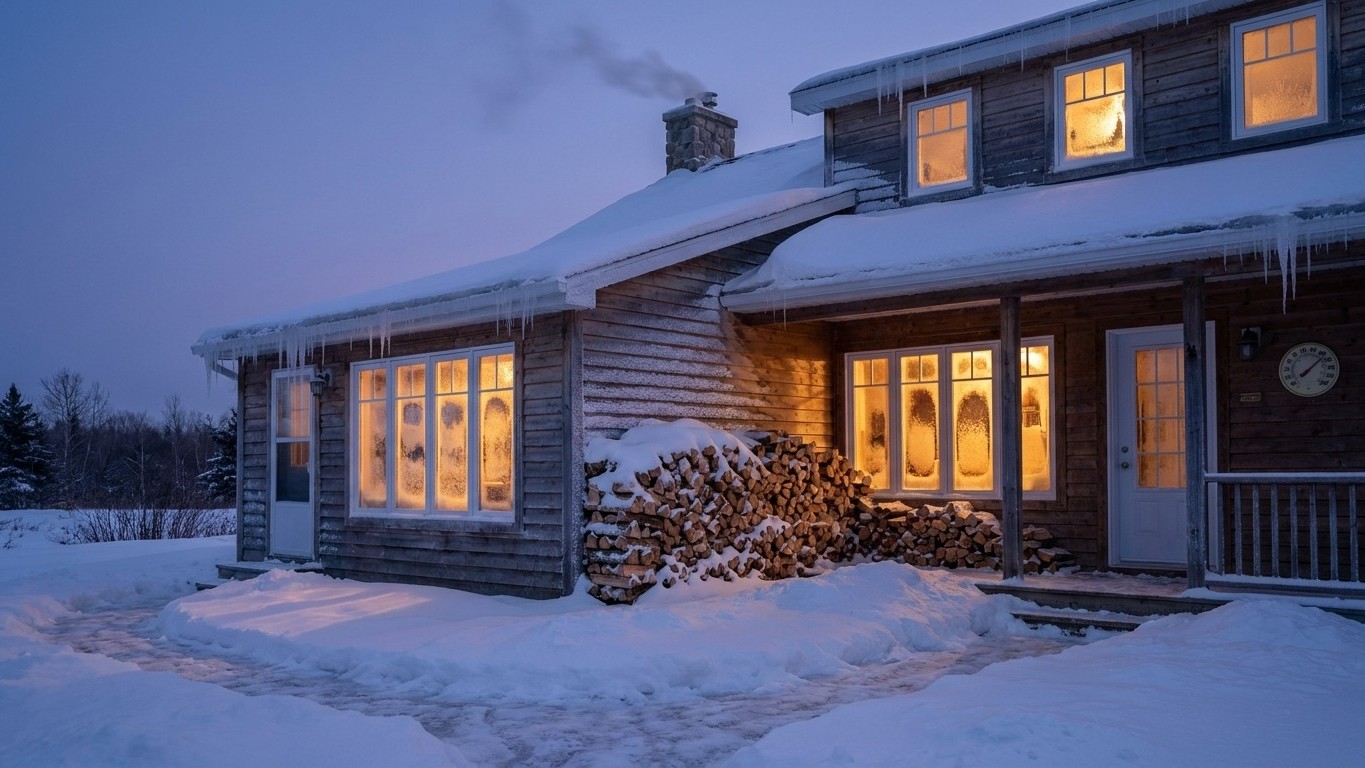

New Brunswick winters keep furnaces and wood stoves running hard for months at a time, and the coldest stretch drives the season’s average low down near 7°F. That single number shapes everything else here: how much wood a household needs, how long that wood has to dry, and why buying decisions made in October show up on the thermometer in January. Knowing When Does the Heating Season Start in New Brunswick? is the first step in planning around those numbers.
How cold it gets, and for how long

The mean daily minimum for the coldest month sits at 6.9°F, based on Canadian Climate Normals from the 1981-2010 period at the Moncton reference station. That’s not the record low some news story mentions once a decade. It’s the average overnight low across the coldest month of a typical year, which is a far more useful number for anyone planning how to heat a house.
A mean minimum near 7°F tells you two things at once. First, pipes, seals, and older windows get tested night after night, not just during one cold snap. Second, whatever heat source carries a home here needs to sustain output over a genuinely long season, not just survive a few brutal days. That’s the real difference between a winter that dips to zero for a week and one that hovers in single digits for weeks on end: the second kind burns through fuel reserves at a steady, unforgiving pace.
Houses built or retrofitted for this climate tend to lean on multiple layers: a primary heat source sized for sustained cold, plus a backup that can carry the load if the first one falters during an extended stretch. Wood heat fits into that picture for a lot of households here, either as a supplement to oil or electric heat or as the main source in older or rural homes. Whatever the setup, a coldest-month minimum below 10°F means margin matters. Undersized equipment or under-seasoned fuel doesn’t just underperform, it gets exposed exactly when the household can least afford it.
What a cord of wood is worth here
A cord is a volume, not a weight, and that distinction is where a lot of firewood buyers get shorted. The standard measure is a stack 4 feet high, 4 feet wide, and 8 feet long, which works out to 128 cubic feet of stacked wood, air gaps included. Two cords of the same size can hold very different amounts of usable heat depending on the species stacked inside them, because denser wood packs more mass into that same 128 cubic feet.
According to Michigan State University Extension, a cord of well-seasoned hardwood delivers about 20 million BTU. MSU frames that in terms a homeowner can actually use: one cord is roughly equivalent to the heat from 145 gallons of #2 fuel oil, or 215 gallons of LP gas. Against a winter with a coldest-month minimum near 7°F, that comparison matters, because it means a full wood supply for a heating season isn’t a casual stack by the shed. It’s a planned quantity, sized against how many months of sustained cold the wood needs to cover.
| Measurement | Value |
|---|---|
| Cord dimensions | 4 ft x 4 ft x 8 ft |
| Total volume | 128 cubic feet |
| Heat energy (well-seasoned hardwood) | about 20 million BTU |
| Fuel oil equivalent | roughly 145 gallons of #2 fuel oil |
| LP gas equivalent | roughly 215 gallons of LP gas |
That 20 million BTU figure is an average, not a guarantee. It assumes wood that’s been properly seasoned, meaning most of the water content is already gone before it hits the firebox. Green, unseasoned wood can carry moisture over 60 percent by weight, and every bit of that water has to boil off before the wood releases usable heat. Burn green wood and a chunk of the fuel’s energy goes toward drying itself out inside the stove, not warming the house. That’s the whole trick of buying firewood by the cord: the stack size tells you volume, but only the moisture content tells you what you’re actually getting for it.
How long wood takes to dry in New Brunswick
Seasoning time isn’t a fixed number stamped on every log pile. It depends on humidity, summer heat, and airflow, which means the same species dries at different rates in different climates. MSU Extension’s guidance is that firewood should be burned at 20 percent moisture or less, and that split, stacked green wood typically reaches that point after one full summer of exposure to sun and moving air.
Two words matter more than any calendar date here: split and stacked. Rounds left whole, or wood piled in a dense heap with no airflow through it, will not dry on the same schedule, no matter how many months pass. The wood needs surface area exposed and air moving through the stack to actually shed that internal moisture.
Red oak is the named exception worth knowing before buying a mixed load. MSU notes that its cell structure makes it dry more slowly than other common hardwoods, so a red oak stack needs more time than a single summer to reach that 20 percent target. Burn it early and it acts like green wood even if it looks weathered on the outside.
The cost of skipping this step isn’t subtle. Wet wood burns cooler, since energy that should be heating the house is instead boiling off trapped moisture. It also produces more creosote, the tar-like residue that builds up inside a chimney flue and raises the risk of a chimney fire. A stove loaded with unseasoned wood typically needs its chimney swept more often than one burning properly dried fuel. None of that is dramatic on any single night. It’s a slow tax that shows up as a colder house and a dirtier flue over the course of a season.
Where to check before you buy
Everything above describes conditions at the Moncton reference station, and New Brunswick spans a real range of elevation, coastal exposure, and inland cold that a single station can’t fully capture. A homestead further inland or at higher elevation may see colder overnight lows or a longer stretch of hard freeze.
Species availability also shifts by region, and burn restrictions, where they exist, are set locally and revised from year to year rather than fixed once and forgotten. Before committing to a wood supplier or a heating plan, it’s worth checking current guidance through Agriculture and Agri-Food Canada, which can point toward provincial and regional resources on species availability and any seasonal burning guidelines that apply in a specific area.
None of that changes the basic math laid out above. A cord is still 128 cubic feet, seasoned hardwood still averages around 20 million BTU, and wood still needs a full summer, split and stacked, to get there. What changes locally is availability and any rules around when and how much can be burned, and those are worth a quick check before wood shows up in the yard.
What each heat source costs to run in New Brunswick
At New Brunswick’s average residential prices, this is what one million Btu of heat delivered into the house costs with each system (Canadian dollars). It compares fuels on the same unit: it is not a yearly bill, and it leaves out the price of the equipment.
| System | Cost per million Btu delivered |
|---|---|
| Electric resistance (baseboard, 100% efficient) | C$48.68 |
| Heat pump at 8.1 HSPF2 (seasonal COP about 2.4) | C$20.51 |
Cheapest to run in New Brunswick: heat pump, C$28.17 less per million Btu than the electric resistance.
Prices: Hydro-Québec, 2025 Comparison of Electricity Prices in Major North American Cities. Efficiencies: ENERGY STAR criteria. A heat pump’s figure is a seasonal average; in the coldest weather its efficiency drops.